1. A genus of cetaceous fish, with teeth in both jaws, and a pipe in the head, comprehending the dolphin the porpoise, the grampus and the beluga. But the fish to which seamen give this name, is the Coryphaena hippuris of Linne. It has a flat roundishsnout and a tapering body, with a fin running along the back from the head to the tail, consisting of a coriaceous membrane with soft spines.
2. In ancient Greece, a machine suspended over the sea, to be dropped on any vessel passing under it.
1. A cetacean of the genus Delphinus and allied genera (esp. D. delphis); the true dolphin.
2. The Coryphaena hippuris, a fish of about five feet in length, celebrated for its surprising changes of color when dying. It is the fish commonly known as the dolphin. See Coryphaenoid.
3. A mass of iron or lead hung from the yardarm, in readiness to be dropped on the deck of an enemy's vessel.
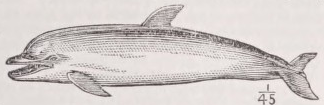
DOLPHIN(Delphinus delphis), the common name of a species of whale belonging to the family Delphinidae. It usually measures from 6 to 8 feet in length, and is thickest near the centre, where the dorsal fin rises to a height of 9 or 10 inches, and whence the body tapers towards both extremities. The forehead descends abruptly to the base of the slightly flattened beak, which is about 6 inches long, and is separated from the forehead by a transverse depression. The mouth is armed with sharp, slightly curved teeth, of uniform size, varying in number from 40 to 50 on each side of either jaw, and those above locking exactly with the teeth below. The aperture of the ear in dolphins is exceedingly minute; the eyes are of moderate size and the blow-hole is crescent-shaped. The colour of the upper surface is black, becoming lighter on the flanks, and perfectly white on the parts beneath. Like many other cetaceans, the dolphin is gregarious, and large herds are often seen following ships in full sail, and disporting themselves on the surface of the water as if delighted at the near proximity of man. In such exercises they exhibit the most remarkable agility, individuals having been known to leap to such a height out of the water as to fall upon the deck. Their aquatic gambols and apparent relish for human society have attracted the attention of mariners in all ages, and have probably given rise to the many fabulous stories told of dolphins by ancient historians. Their appearance at sea was formerly regarded as a good omen by sailors, for although it presaged a tempest, yet by thus giving warning of its approach, it enabled them, in those days when the mariner’s compass was unknown, and navigators had consequently to keep within sight of the coast, to steer for a place of safety. ...The dolphin is exceedingly voracious, feeding on fish, cuttlefishes, and crustaceans. On the south coast of England it is said to live chiefly on pilchard and mackerel, and when in pursuit of these it is often taken in the fishermen’s nets. The female brings forth a single young one, which she nurses with the greatest care. Her milk is both abundant and rich, and during the operation of suckling the mother floats in a slightly sidelong position, so as to allow of the necessary respiration in herself and her young. The dolphin was formerly supposed to be a fish, and as such was allowed to be eaten by Roman Catholics on those occasions when the use of flesh was prohibited, and it seems to have been esteemed as a great delicacy by the French. It is said to show great fondness for music, and according to the ancient fable, Arion was said to have escaped on the back of a dolphin which he had first charmed by his music. It is an inhabitant of the temperate regions of the North Atlantic and the Mediterranean Sea, and has been observed as far north as the coast of Greenland. It is much more common in English than in Scottish waters. Among the seafaring population of Britain the name “dolphin” is most usually given to the beautifully coloured fish Coryphaena hippuris — the dorado of the Portuguese, and it is to the latter the poet is alluding when he speaks of “the dying dolphin’s changing hues ’’—while the true dolphin is usually spoken of as the “bottlenose” or “bottlehead.” This species occurs as a fossil in the sandy downs of the French coast.
9th ed. Encyclopædia Britannica, vol. 7, p. 346 [597 words — estimated reading time: 4 minutes]
This site uses cookies to remember your display preferences (search sources and editions, Bible version, auto-link, images, light/dark theme). No personal data whatsoever is collected. Privacy Policy