
Alt. of Fesse
Word of the Day: Catachrestical
fess. [Latin fascia, a band.] In heraldry, a bank or girdle, possessing the third part of the escutcheon; one of the nine honorable ordinaries.
A band drawn horizontally across the center of an escutcheon, and containing in breadth the third part of it; one of the nine honorable ordinaries.
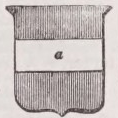
The exact center of the escutcheon.
Fessler
Encyclopedia Britannica
FESSLER, Ignaz Aurelius (1756-1839), a celebrated Hungarian ecclesiastic, historian, and freemason, was born on the 18th May 1756 at the village of Zurâny in the county of Moson. His mother, who was a pious Roman Catholic, made every effort to secure for him a strict religious education. On the 9th July 1773 he joined the order of Capuchins as a novice, and in the following year he took the monastic vows, assuming the name of Innocentius. After living in disagreement with his superiors in different monasteries he was transferred to the Capuchin house at Vienna; and while there, by means of a private letter, he drew the attention of the emperor Joseph II. to the irregularities of the monasteries. The searching investigation which followed raised up against him many implacable enemies. Released from the monastery by an imperial decree, he was in 1784 appointed professor of Oriental languages and hermeneutics in the university of Lemberg. In 1787 he brought out his tragedy of Sidney, which his enemies attacked so violently as profane and revolutionary that they compelled him to resign his office and seek refuge in Silesia. In Breslau he met with a cordial reception from Korn the publisher, and was, moreover, subsequently employed by the prince of Carolath as tutor to his sons. In 1791 Fessler was converted to Protestantism, and in 1796 he went to Berlin, where he founded a humanitarian society, and was commissioned by the freemasons of that city to assist Fichte in reforming the statutes and ritual of their lodge. He soon after this obtained a Government appointment in connexion with the newly-acquired Polish provinces, but in consequence of the battle of Jena (1806) he lost this office, and remained in very needy circumstances until 1809, when he was summoned to St ...Petersburg by Alexander I., to fill the post of court councillor, and the professorship of Oriental languages and philosophy at the Alexander-Newski Academy. This office, however, he was soon obliged to resign, owing to his alleged atheistic tendencies, but he was subsequently nominated a member of the legislative commission In 1815 lie was deprived of his salary, but it was restored to him in 1817. In November 1819 he was appointed consistorial president of the Protestant communities at Saratov, and subsequently became chief superintendent of the Lutheran communities in St Petersburg. Fessler’s numerous works are all written in German. In recognition of his important services to Hungary as a historian, he was in 1831 elected a corresponding member of the Hungarian Academy of Sciences. He died at St Petersburg, December 15, 1839, in the 84th year of his age. His most important works are —Die Geschichten der Ungarn und ihrer Landsassen, 10 vols. ,∙ Leipsic, 1815-25; Marcus Aurelius, 3 vols., Breslau, 1790-92 (3d edition, 4 vols., 1799); Aristides und Themis-tokles, 2 vols., Berlin, 1792 (3d edition, 1818); Attila, König der Hunnen, Breslau, 1794; Mathias Corvinus, 2 vols., Breslau, 1793-94; and Die drei grossen Könige der HUngarn aus dem Arpadischen Stamme, Breslau, 1808.
9th ed. Encyclopædia Britannica, vol. 9, p. 113
[525 words — estimated reading time: 3 minutes]
[525 words — estimated reading time: 3 minutes]
No thesaurus entries found for "Fess".
No Bible verses found for "Fess".