
A student of the first year.
Word of the Day: Catachrestical
Fuchs
Encyclopedia Britannica
FUCHS, Johann Joseph. See Fux.
FUCHS, Johann Nepomuk von (1774-1856), an eminent chemist and mineralogist, was born at Mattenzell, near Bromberg, in the neighbourhood of the Baieriscber Wald, May 15, 1774. Having acquired a knowledge of medicine at Vienna and Heidelberg, he in 1801 turned his attention to chemistry and mineralogy, which he studied at Freiberg, Berlin, and Faris. In 1807 he became professor of those sciences at the university of Landshut, and in 1823 conservator of the mineralogical collections at Munich, where, on the occasion of the removal thither of the university of Landshut, in 1826 he was appointed professor of mineralogy. In 1852 he retired from public life, and in 1854 he was raised to the nobility by the king of Bavaria. He died at Munich, March 5, 1856. Mineralogy and inorganic chemistry are indebted to Fuchs for numerous researches. He is more especially known for his discovery, in 1823, of a process for making a soluble glass, used for fixing fresco-colours, according to the method termed stereochromy. Among his works are—
Ueber den gegenseitigen Einfluss der Chemie und Mineralogie, Munich, 1824; Die Naturgeschichte des Mincralrcichs, Kenroten, 1842; Ueber die Theorien der Erde, Munich, 1844; Bereitung, Eigenschaften, und Nutzanwendung des Wasser glasses, Munich, 1857, of which French translations appeared in 1861 and 1864. His collective works were published at Munich in 1856....
FUCHS, Leonhard (1501-1566), a celebrated German physician, and one of the fathers of scientific botany, was born at Wembdingen in Bavaria, January 17,1501. At the age of five years he lost his father, but under the care of his mother he early made great progress in learning. In his tenth year he was sent to school at Heilbronn, whence, a twelvemonth later, he was removed to Erfurt. After a year and a half he was admitted a student of the university of that town, which in 1521 conferred on him the degree of “baccalaureus.” During the next 18 months he gave lessons in Latin and literature in his native town. He then repaired to the university of Anspach, where in 1521 he was created a master of arts. About the same time he espoused the doctrines of the Reformation. Having in 1524 received his diploma as doctor of medicine, he practised for two years in Munich. He became in 1526 professor of medicine at Ingolstadt, and in 1528 physician to the margrave of Anspach. In Anspach he was the means of saving the lives of many during the epidemic locally known as the “English sweating-sickness.” By the duke of Würtemberg Fuchs was, in 1535, appointed to the professorship of medicine at the university of Tübingen, a post held by him till his death, which took place May 10, 1566. Among his numerous writings are the following :—
Errata recentiorum medicorum LX numero, adjectis eorum confutationibus, Haguenau, 1530, 4to; Cornariìis Furens (an answer to a pamphlet by his medical opponent Cornarius, entitled Vulpecula Excoriata}, Basel, 1533, 8vo, Vienna, 1545; Paradoxorum medicinas libri tres, Basel, 1535, fol., &c.; Tabules aliquot universae medicinas, Basel, 1538, 4to; De curandi ratione (Tübingen, 1539)? 16mo, Leyd., 1548, 8vo, &c.; Medendi Methodus, Basel, 1541, fol., Lyons, 1541, and Paris, 1550, 8vo; De historia stirpium commentarii insignes, Basel, 1542, fol., a work illustrated with more than 500 excellent outline illustrations, including figures of the common foxglove, and of another species of the genus Digitalis, so named by him: it was several times re-edited, and was translated into most European languages; De sanandis totius humani corporis . . . malis, Bases, 1542, 8vo, Paris, 1543, and Lyons, 1547, 16mo; Nicolai Myrepsi Medicamentorum Opus, . . . e grasco in latinum conversum, 1549, fol.; Institutiones Medicinae, Leyd. (2d ed.), 1560, 8vo; De componendorum miscendorumque medicamentorum ratione, Leyd., 1561, fol.; De compositione medicamentorum, Lyons, 1563, 12mo; Opera Didactica, a revised collection of various of his already published works, Frankf., 1566 and 1604, fol.: the latter edition has prefixed to it a life of the author by Hitzler. Fuchs was an advocate of the Galenic school of medicine, and published several Latin translations of treatises by its founder and by Hippocrates, besides controversial tracts against the opinions of H. Thriverius, G. Ryf∏us, C. Egenolphus, G. Rufinus, G. Puteanus, and S. Montius.
9th ed. Encyclopædia Britannica, vol. 9, p. 805
[5 words — estimated reading time: 1 minute]
[5 words — estimated reading time: 1 minute]
A genus of flowering plants having elegant drooping flowers, with four sepals, four petals, eight stamens, and a single pistil. They are natives of Mexico and South America. Double-flowered varieties are now common in cultivation.
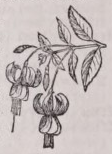
Fuchsia
Encyclopedia Britannica
FUCHSIA, so named by Plumier in honour of the botanist Leonhard Fuchs (v. supra), a genus of plants of the natural order Onagracece, characterized by entire, usually opposite leaves; pendent flowers; a funnel-shaped, brightly coloured, quadripartite, deciduous calyx; 4 petals, alternât-ing with the calycine segments; 8, rarely 10, exserted stamens, a long and filiform style, and inferior ovary; and fleshy, ovoid, many-seeded berries or fruit. All the members of the genus, with the exception of the New Zealand species, F. excorticata, F. Kirkei, and F. procum- bens, are natives of Central and South America,—occurring in the interior of forests, or in damp and shady mountainous situations. The various species differ not a little in size as well as in other characters; some, as F. verrucosa, being dwarf shrubs; others, as F. arborescens and#, apetala, attaining a height of 12 to 16 feet, and having stems several inches in diameter. Plumier, in his Nova Plantarum Americanarum Genera, p. 14, tab. 14, Paris, 1703, 4to, gave a description of a species of fuchsia, the first known, under the name of Fuchsia triphylla, flore coccineo, and a somewhat conventional outline figure of the same plant was published at Amsterdam, in 1757, by Burmann. In the Histoire des Plantes Médicinales of the South American traveller Feuillée (p. 64, pl. xlvii,), written in 1709-11, and published by him with his Journal, Paris, 1725, the name Thilco is applied to a species of fuchsia from Chili, which is described, though not evidently so figured, as having a pentamerous calyx. The F. coccinea of Aiton (see Dr J. D. Hooker, J. Proc. Linnean Soc., Botany, vol. x. p. 458, 1867), the first species of fuchsia cultivated in England, where it was long confined to the greenhouse, was brought from South ...America by Captain Firth in 1788, and placed in Kew Gardens. Of this species Mr Lee, a nurseryman at Hammersmith, soon afterwards obtained an example, and procured from it by means of cuttings several hundred plants, which he sold at a guinea each. In 1823 F. ma-crostemon and F. gracilis, and during the next two or three years several other species, were introduced into England; but it was not until about 1837, or soon after florists had acquired F. f tilgens, that varieties of interest began to make their appearance. The numerous hybrid forms now existing are the result chiefly of the intercrossing of that or other long-flowered with globose-flowered plants. F. Venus victrix, raised by Mr Gulliver, gardener to the Rev. S. Marriott of Horsemonden, Kent, and sold in 1822 to Messrs Cripps, was the earliest white-sepalled fuchsia, and is one of the best of its kind for hybridization. The first fuchsia with a white corolla w as produced about 1853 by Mr Storey. In some varieties the blossoms are variegated, and in others they are double. There appears to be very little limit to the number of forms to be obtained by careful cultivation and selection. To hybridize, the flower as soon as it opens is emasculated, and it is then fertilized with pollen from some different flower. As seed in the high-bred varieties of fuchsia is produced in but small quantity, it is worth, if it will germinate, at least 50 guineas an ounce (see H. Cannel, Gardeners Mag., 1875, p. 251). To procure the seed, which when good is firm and plump, the ripe pods are sun-dried for a few days, and then crushed between the finger and thumb; the seed is next cleansed in water from the surrounding pulp, dried in saucers, and wrapped in paper for use. It is sown about February or March in light, rieh, well-drained mould, and is thinly covered with sandy soil, and watered. A temperature of 70°-75° Fahr, has been found suitable for raising. The seedlings are pricked off into shallow pots or pans, and when 3 inches in height are transferred to 3-inch pots, and are then treated the same as plants from cuttings (v. infst. Fuchsias may be grafted as readily as camellias, preferably by the splice or whip method, the apex of a young shoot being employed as a scion; but the easiest and most usual method of propagation is by cuttings. As one of the most expeditious ways of procuring these, Loudon recommends to put plants in heat in January, and to take their shoots when three inches in length. For summer flowering in England they are best made about the end of August, and should be selected from the shortest-jointed young wood. Coarse brown sand intermixed with a little leaf-mould, with a surface-layer of silver-sand, affords them a good soil for striking. In from two to three weeks they may be put into 3∙inch pots containing a compost of equal parts of rich loam, silver-sand, and leafmould. They are subsequently moved from the frame or bed, first to a warm and shady, and then to a more airy part of the greenhouse. In January a little artificial heat may be given, to be gradually increased as the days lengthen. The side-shoots are generally pruned when they have made three or four joints, and for bushy plants the leader is stopped soon after the first potting. Care is taken to keep the plants as near the glass as possible, and shaded from bright sunshine, also to provide them plentifully with water, except at the time of shifting, when the roots should be tolerably dry. For the second potting a suitable soil is a mixture of well-rotted cow-dung or old hotbed mould with leaf mould and sandy peat, and to promote drainage a little peat-moss may be placed immediately over the crocks in the lower part of the pot. Weak liquid manure greatly promotes the advance of the plants, and should be regularly supplied twice or thrice a week during the flowering season. After this, water is gradually withheld from them, and they may be placed in the open air to ripen their wood. The common garden fuchsia, F. fulgens, stands the winter in England if cut down and covered with 4-6 inches of dry ashes (Smee), and many other species may be grown in the open air if afforded a little protection from frosts. F. discolor, a native of the Falkland Islands, is a particularly hardy species (see Trans. Hort. Soc. Lond., 2d sen, ii. p. 284). The nectar of fuchsia flowers has been shown by Mr A. S. Wilson (Rep. Brit. Assoc., 1878) to contain nearly 78 per cent, of cane sugar, the remainder being fruit sugar. The berries of some fuchsias are subacid or sweet, and edible. From certain species a dye is obtainable. The so-called “native fuchsias” of Southern and Eastern Australia are plants of the genus Correa, and natural order Rutaceae.
See J. C. Loudon, Arboretum, vol. ii. pp. 942-5; Félix Porcher, Histoire et Culture du Fuchsia, Paris, 1874; F. W. Burbidge, The Propagation and Improvement of Cultivated Plants, 1877; The Floral World, 1878, pp. 74-76, 253-4.
9th ed. Encyclopædia Britannica, vol. 9, p. 806 — signed F. H. B.
[1,192 words — estimated reading time: 7 minutes]
[1,192 words — estimated reading time: 7 minutes]
Aniline red; an artificial coal-tar dyestuff, of a metallic green color superficially, resembling cantharides, but when dissolved forming a brilliant dark red. It consists of a hydrochloride or acetate of rosaniline. See Rosaniline.
No thesaurus entries found for "Fuchs".
No Bible verses found for "Fuchs".