One of the masses of generative tissue primitively alike in both sexes, but giving rise to either an ovary or a testis; a generative gland; a germ gland.
GONDA, a district of Oudh, lying between 26° 46' and 27° 50' N. lat., and between 81° 35' and 82° 48' E. long., bounded on the N. by the lower range of the Himâlayas, on the E. by Basti district, on the S. by Fyzabad and Bara Banki, and on the W. by Bharaich, and having an area of 2824 square miles.
Gonda presents the aspect of a vast plain with very slight undulations, studded with groves of mango trees. The surface consists of a rich alluvial deposit which is naturally divided into three great belts known as the tarai or swampy tract, the uparhàr or uplands, and the tarhar or wet lowlands, all three being marvellously fertile. Several rivers flow through the district, but only two, the Gogra and Râpti, are of any commercial importance, the first being navigable throughout the year, and the latter during the rainy season. The country is dotted over with small lakes, the water of which is largely used for irrigation. The ferce naturoe consist of tigers, leopards, bears, wolves, aud deer. Large game birds are plentiful....
This district has no particular history of its own; what ancient history it has is included in that of Oudh. On the outbreak of the mutiny, the raja of Gonda, after honourably escorting the Government treasure to Fyzabad, joined the rebels. His estates, along with those of the rani of Tulsipur, were confiscated, and conferred as rewards upon the maharajas of Balrampur and Shahganj, who had remained loyal. The census of 1869 disclosed a population of 1,166,515 (602,862 males, and563,653 females)—Hindus, 1,049,397; Mahometans, 117,070; Christians—European, Eurasian, and native —48. Five towns contain a population exceeding 5000, namely, Gonda, Balrampur, Colonelganz, Nawabganj, and Utraula. Rice, wheat, and barley are the chief products of the district. The area under cultivation is 993,858 acres. The exports are rice and food grains; the imports, cotton, European piece goods, and salt. The administration is under a deputy commissioner, aided by two European assistants. The total revenue (1875-76) amounted to £135,509; the expenditure to £15,810. The police force (1873) consisted of 484 officers and men, maintained at a cost of £6655. Education is still in its infancy. In 1875-76 there were 116 schools under Government inspection, attended by 5879 pupils. Fever is prevalent throughout the district. The other principal diseases are scurvy, cholera, diarrhoea, and goitre. The average rainfall during the eleven years 1865-1875 was 42’0 inches. The average yearly temperature is 77 - 5° Fahr., the highest recorded being 106°, the lowest 48°.
<3onda, the chief town and administrative headquarters of Gouda district, in 27° 8' N. lat. and 82° 1' E. long. The site on which the town now stands was originally a jungle, in the centre of which was a cattle fold (Gontha or Gothân), in which the cattle were enclosed at night as a protection against wild beasts, and from this the town derived its name. The place was formerly celebrated for the manufacture of shields; now it is neither of commercial nor of religious importance. The town contains a civil station, dispensary, school, literary institute, courthouse, and jail. Population, 13,722.
9th ed. Encyclopædia Britannica, vol. 10, p. 769 [542 words — estimated reading time: 4 minutes]
GONDAR, properly Guendar, a town of Abyssinia, formerly the capital of the Amharic kingdom, is situated on a basaltic ridge in the country of Dembea, about 21 miles N.E. of Lake Tsana or Tana, a splendid view of which is obtained from the castle. According to Riippell, its latitude is 12° 35' N. and its longitude 37° 31' 57" E., aud it lies 7460 feet above the level of the sea. Two streams, the Angreb on the east side and the Gaha or Kaha on the west, flow down from the ridge, and meeting below the town pass onwards to the lake. In the Gaha the Christian inhabitants of Gondar are accustomed to bathe in vast disorderly crowds on the feast of St John the Baptist (10th September), and again in a more decent manner on the auniversary of the Saviour’s birth. The town is divided into several districts separated from each other by w ood and field,-—one being the Abun-Bed or bishop’s quarter, another the Etchege-Bed or quarter of the prior or chief of the monks, while a third takes its name from the Debra Birhan or Church of the Light, and a fourth from the Gemp or castle. This was at one time a splendid pile, designed on the plan of a mediaeval stronghold; and the solidity of its masonry, the beauty of its ornamentations, and the general effect of its arrangement stand in striking contrast to the mean and monotonous houses of the town, which are all erected after the cylindro-conical type. It was built in the 16th century for King Socinius by the Portuguese adventurers, who employed Indian workmen in its erection. At some distance there is another palace built at a later date for Ras Michael, which affords no bad imitation of the Portuguese style. Upwards of forty churches, all in the circular Abyssinian style, are said to exist in the town and immediate vicinity; of ...these the most important is the Quisquam or Flight into Egypt, erected by Mint-wab Muntwar, the empress mother of Yasu the Great and Yasu the Little. The painting of the interior was probably executed by the Venetian artists mentioned by Bruce. The city was founded in the 15th century by emperor Fasiiidas, or A’lem-Seged; it has been frequently sacked, and in 1868 it was laid in ruins by Theodorus, who did not spare either the castle or the churches. The population, estimated by Bruce at 10,000 families, has been brought to a very low ebb by the political distractions of the country. In 1853 Heuglin thought the inhabitants might number from 5000 to 6000, and in 1861-62 he raised the figure to from 6000 to 7000. About 2000 of the number are Mahometans, and there is a considerable settlement of Jews (Falasha). Cotton cloth, gold and silver ornaments, copper wares, fancy articles in bone and ivory, excellent saddles, and shoes are among the products of the local industry. The shoes are made almost exclusively for the clergy, as the ordinary Abyssinians either go barefoot or wear sandals. See especially Riippell, Heise in Abyssinien, Frankfort-on-the-Main, 1838-40; Heuglin, Reise nach Abessinien, Jena, 1868; Lejean, Voyage en Abyssinie, Paris, 1872; and Raffray, Afrique Occidentale, Paris, 1876. Views of the castle are given by Heuglin and Raffray.
9th ed. Encyclopædia Britannica, vol. 10, p. 770 [560 words — estimated reading time: 4 minutes]
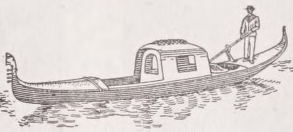
A flat-bottomed boat, very long and narrow, used at Venice in Italy on the canals. A gondola of middle size is about thirty feet long and four broad, terminating at each end in a sharp point or peak rising to the highth of a man. It is usually rowed by two men, called gondoliers, who propel the boat by pushing the oars. The gondola is also used in other parts of Italy for a passage boat.
1. A long, narrow boat with a high prow and stern, used in the canals of Venice. A gondola is usually propelled by one or two oarsmen who stand facing the prow, or by poling. A gondola for passengers has a small open cabinamidships, for their protection against the sun or rain. A sumptuary law of Venice required that gondolas should be painted black, and they are customarily so painted now.
GONDWÂNA, a tract of country in Central India, extending from the 19th to the 25th degree of N. lat., deriving its name from the aboriginal tribe of Gonds, who form the predominant element in the population. The tract may be considered as comprising part of the British territory of Sâgor and Nerbudda, with the districts of Singrauli, Chotâ Nâgpur, and Sirguja, the petty native states on the S.W. frontier of Bengal, the Cuttack Mahals, and the northern portion of Nâgpur. It is estimated to be 400 miles in length by 280 in average breadth. Gondwâna, in its most extensive sense, includes all that part of India within the above-mentioned boundaries which remained unconquered by the Mahometans up to the reign of Aurungzebe. But Gondwâna proper is limited to four districts, named Mândla, Chlιatisgarh, Nâgpur, and Chândal, and it stretches south along the east side of the Wardha and Godâvari, to within 100 miles of the mouth of the latter. The greater part of this province is a mountainous, unhealthy, and ill-watered country, covered with jungle, and thinly inhabited; and to its poverty and other bad qualities its independence may be ascribed. A continued chain of moderately elevated hills extends from the southern frontier of Bengal almost to the Godâvari, and by these the eastern was formerly separated from the western portion of the Nâgpur dominions. This province contains the sources of the Nerbudda and the Son, and is bounded by the Wardha and Godâvari; but a want of water is still the general defect, the streams by which it is intersected, namely, the Mahânadi, Kârun, Hatus, and Silâir, being inconsiderable, and not navigable within its limits. The Gonds, or the hill tribes who took refuge in the mountains and fastnesses from the invaders of the ...country, are the original inhabitants of the country, and, till recently, retained all their primeval habits of barbarism. They have now adopted a form of Hinduism, but they retain many of their ancient customs, and abstain from no flesh except that of the ox, cow, and bull. According to the census of 1872 they numbered 2,041,276, or nearly 25 per cent, of the entire population of the Central Provinces. The more fertile tracts of Gondwâna were subdued at an early period by the Marhattâs, who claimed as paramount over the whole. The inhabitants were rendered nominally tributary; but it was found impossible to collect any revenue from them without military force, so that, in fact, the collection of the revenue was like a plundering expedition, the cost of which always exceeded the profit.
During the war against the Pindaris in 1818, when the British troops invaded the territories of Appa Sahib, the raja of Nagpur, their operations were greatly facilitated by the insurrection of the hill tribes, who occupied the passes into the Nagpur territories. For a long series of years it was the policy of the raja of this territory, a descendant of Sivaji, to interfere as little as possible with the neighbouring powers. At length, in 1803, Raghoji Bhonsla was induced, in an evil hour for himself, to depart from this system of neutrality, and to join Sindhia in a confederacy against the British. He was soon reduced, however, by the defeats which the confederates sustained at Assaye and Argaum, to sue for peace, as the price of which he ceded a large portion of his dominions to the conquerors, namely, the province of Orissa. After the death of this raja, the throne, contested by various competitors, was at last secured by Appa Sahib, his nephew, who, in the war against the Pindaris, joined the coalition against the British power, and was involved in ruin along with his other allies. A treaty of peace was concluded with him, which he violated; and he was finally deposed in 1818, and the grandson of the late raja put in his stead. The latter prince, after a reign of 35 years, died without issue in 1853; the dynasty thus became extinct, and the kingdom of Nagpur was incorporated with the British empire, and now forms the chief commissionership of the Central Provinces.
9th ed. Encyclopædia Britannica, vol. 10, p. 770 [710 words — estimated reading time: 5 minutes]
2. An instrument, first used in the East, made of an alloy of copper and tin, shaped like a disk with upturned rim, and producing, when struck, a harsh and resounding noise.
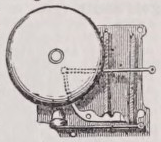
3. A flat saucerlike bell, rung by striking it with a small hammer which is connected with it by various mechanical devices; a stationary bell, used to sound calls or alarms; -- called also gong bell.
GONG (Chinese, gong-gong or tam-tam), a sonorous or musical instrument of Chinese origin and manufacture, made in the form of a broad thin disc with a deep rim. Gongs vary in diameter from about 20 to 40 inches, and they are made of bronze containing a maximum of 22 parts of tin to 78 of copper; but in many cases the proportion of tin is considerably less. Such an alloy, when cast and allowed to cool slowly, is excessively brittle, but it can be tempered and annealed in a peculiar manner. If suddenly cooled from a cherry-red heat, the alloy becomes so soft that it can be hammered and worked on the lathe, and afterwards it may be hardened by re-heating and cooling it slowly. In these properties, it will be observed, the alloy behaves in a manner exactly opposite to steel, and the Chinese avail themselves of the known peculiarities for preparing the thin sheets of which gongs are made. They cool their castings of bronze in water, and after hammering out the alloy in the soft state, the finished gongs are hardened by heating them to a cherry red, and allowing them to cool slowly. The gong is beaten with a round, hard, leather-covered pad, fitted on a short stick or handle. It emits a peculiarly sonorous sound, its complex vibrations bursting into a wave-like succession of tones, sometimes shrill, sometimes deep. In China and Japan it is used in religious ceremonies, state processions, marriages, and other festivals; and it is said that the Chinese can modify its tone variously by particular ways of striking the disc. Among Western communities it is only employed as a substitute for a dinner bell or a general household signal.
9th ed. Encyclopædia Britannica, vol. 10, p. 771 [294 words — estimated reading time: 2 minutes]
But before they lay down, the men of the city, even the men of Sodom, compassed the house round, both old and young, all the people from every quarter:
Before they had gone to bed, all the men of the city of Sodom, both young and old, surrounded the house.
And it came to pass, as soon as Isaac had made an end of blessing Jacob, and Jacob was yet scarce gone out from the presence of Isaac his father, that Esau his brother came in from his hunting.
As soon as Isaac had finished blessing him and Jacob had left his father’s presence, his brother Esau returned from the hunt.
And let us arise, and go up to Bethel; and I will make there an altar unto God, who answered me in the day of my distress, and was with me in the way which I went.
Then let us arise and go to Bethel. I will build an altar there to God, who answered me in my day of distress. He has been with me wherever I have gone.”
And the man, the lord of the country, said unto us, Hereby shall I know that ye are true men; leave one of your brethren here with me, and take food for the famine of your households, and be gone:
Then the man who is lord of the land said to us, ‘This is how I will know whether you are honest: Leave one brother with me, take food to relieve the hunger of your households, and go.
And Jacob their father said unto them, Me have ye bereaved of my children: Joseph is not, and Simeon is not, and ye will take Benjamin away: all these things are against me.
Their father Jacob said to them, “You have deprived me of my sons. Joseph is gone and Simeon is no more. Now you want to take Benjamin. Everything is going against me!”
And when they were gone out of the city, and not yet far off, Joseph said unto his steward, Up, follow after the men; and when thou dost overtake them, say unto them, Wherefore have ye rewarded evil for good?
They had not gone far from the city when Joseph told his steward, “Pursue the men at once, and when you overtake them, ask, ‘Why have you repaid good with evil?
And when money failed in the land of Egypt, and in the land of Canaan, all the Egyptians came unto Joseph, and said, Give us bread: for why should we die in thy presence? for the money faileth.
When the money from the lands of Egypt and Canaan was gone, all the Egyptians came to Joseph and said, “Give us food. Why should we die before your eyes? For our funds have run out!”
When that year was ended, they came unto him the second year, and said unto him, We will not hide it from my lord, how that our money is spent; my lord also hath our herds of cattle; there is not ought left in the sight of my lord, but our bodies, and our lands:
When that year was over, they came to him the second year and said, “We cannot hide from our lord that our money is gone and all our livestock belongs to you. There is nothing left for our lord except our bodies and our land.
Judah is a lion’s whelp: from the prey, my son, thou art gone up: he stooped down, he couched as a lion, and as an old lion; who shall rouse him up?
Judah is a young lion— my son, you return from the prey. Like a lion he crouches and lies down; like a lioness, who dares to rouse him?
This site uses cookies to remember your display preferences (search sources and editions, Bible version, auto-link, images, light/dark theme). No personal data whatsoever is collected. Privacy Policy