
Same as Banxring.
Word of the Day: Catachrestical
Any one of numerous species of bright-colored singing birds belonging to Tanagra, Piranga, and allied genera. The scarlet tanager (Piranga erythromelas) and the summer redbird (Piranga rubra) are common species of the United States.
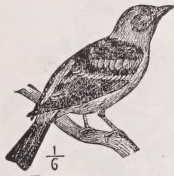
Tanager
Encyclopedia Britannica
TANAGER, a word adapted from the quasi-Latin Tanagra of Linnaeus, which again is an adaptation, perhaps with a classical allusion, of Taηgara, used by Brisson and Buffon, and said by Marcgrave (fHst. Ker. Nat. Brasiliae, p. 214) to be the Brazilian name of certain birds found in that country. From them it has since been extended to a great many others mostly belonging to the southern portion of the New World, now recognized by ornithologists as forming a distinct Family of Oscines, and usually considered to be allied to the FringiUidae (cf. Finch, vol. ix. p. 191); but, as may be inferred from Prof. Parker’s remarks in the Zoological Transactions (x. pp. 252, 253, and 267), the Tanagridae are a “feebler” form, and thereby bear out the opinion based on the examination of many types both of Birds and Mammals as to the lower morphological rank of the Neotropical Fauna as a whole (cf. Birds, vol. iii. p. 743)....
The Tanagers are a group in which Mr Sclater has for many years interested himself, and his latest treatment of them is contained in the British Museum Catalogue (xi. pp. 49-307). Therein he admits the existence of 375 species, which he arranges in 59 genera, forming six Subfamilies, Procniatinae, Euphoniinae, Tanagrinae, Lamprotinae, Phoenicophilinae, and Pitylinae. These are of very unequal extent, for, while the first of them consists of but a single species, Procnias tersa,— the position of which may be for several reasons still open to doubt,—the third includes more than 200. Nearly all are birds of small size, the largest barely exceeding a Song-Thrush. Most of them are remarkable for their gaudy colouring, and this is especially the case in those forming the genus called by Mr Sclater, as by most other authors, Calliste, a term inadmissible through preoccupation, to which the name of Tanagra of right seems to belong, while that which he names Tanagra should probably be known as Thraupis. The whole Family is almost confined to the Neotropical Region, and there are several forms peculiar to the Antilles; but not a tenth of the species reach even southern Mexico, and not a dozen appear in the northern part of that country. Of the genus Pyranga, which has the most northern range of all, three if not four species are common summer immigrants to some part or other of the United States, and two of them, P. rubra and P. aestiva,— there known respectively as the Scarlet Tanager and the Summer Redbird, — reach even the Dominion of Canada, visiting as well, though accidentally, Bermuda. P. aestiva has a western representative, P. cooperi, which by some authors is not recognized as a distinct species. The males of all these are clad in glowing red, P. rubra having, however, the wings and tail black. The remaining species, P. ludoviciana, the males of which are mostly yellow and black, with the head only red, does not appear eastward of the Missouri plains, and has not so northerly a range. Another species, P. hepatica, has just shewn itself within the limits of the United States. In all these the females are plainly attired; but generally among the Tanagers, however bright may be their coloration, both sexes are nearly alike in plumage. Little has been recorded of the habits of the species of Central or South America, but those of the north have been as closely observed as the rather retiring nature of the birds renders possible, and it is known that insects, especially in the larval condition, and berries afford the greater part of their food. They have a pleasing song, and build a shallow nest, in which the eggs, generally 3 in number and of a greenish-blue marked with brown and purple, are laid.
On a whole the Tanagridae, may perhaps be considered to hold the same relation to the FringiUidae as the Icteridae do to the Sturnidae and the Mniotiltidae to the Sylviidae or Turdidae, in each case the purely New-World Family being the “feebler” type. (a. n.)
9th ed. Encyclopædia Britannica, vol. 23, p. 45
[677 words — estimated reading time: 4 minutes]
[677 words — estimated reading time: 4 minutes]
Of or pertaining to the tanagers.
No thesaurus entries found for "Tana".
King James Bible KJV Bible
Berean Standard Bible BSB Bible
1 KJV and 0 BSB verses contain “Tana”