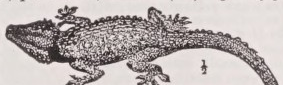
Any lizard of the family Geckonidae. The geckoes are small, carnivorous, mostly nocturnal animals with large eyes and vertical, elliptical pupils. Their toes are generally expanded, and furnished with adhesive disks, by which they can run over walls and ceilings. They are numerous in warm countries, and a few species are found in Europe and the United States. See Wall gecko, Fanfoot.
GECKO, the common name applied to all the species of Geclcotidoe, an extensive family of lizards belonging to the Pachyglossae, or “thick-skinned” sub-order of Gray. The geckoes are small creatures, seldom exceeding 8 inches in length including the tail. With the head considerably flattened, the body short and thick, the legs not high enough to prevent the body dragging somewhat on the ground, the eyes large and almost destitute of eyelids, and the tail short and in some cases nearly as thick as the body, the geckoes altogether lack the litheness and grace characteristic of most lizards. Their colours also are dull, and to the weird and forbidding aspect thus produced the general prejudice against those creatures in the countries where they occur, which has led to their being classed with toads and snakes, is no doubt to be attributed. Their bite was supposed to be venomous, and their saliva to produce painful cutaneous eruptions; even their touch was thought sufficient to convey a dangerous taint. It is needless to say that in this instance the popular mind was misled by appearances. The geckoes are not only harmless, but are exceedingly useful creatures, feeding on insects and worms, which, owing to the great width of their oesophagus, they are enabled to swallow whole, and in pursuit of which they do not hesitate to enter human dwellings, where they are often killed on suspicion. The structure of the toes in those lizards forms their most characteristic anatomical feature. These organs are flattened out into broad discs, and are furnished with transverse lamellar plates, by means of which the geckoes are enabled to run with ease on the smoothest surface, and to imitate the fly in remaining suspended on ceilings or on the under surfaces of leaves. Most of the ...species have nails to their toes, and these in their sharpness and retractility bear considerable resemblance to the claws of feline animals. They are nocturnal in their habits; but when not exposed to the hot sunshine they are able to pursue their prey by day. They hibernate; and two fatty masses in front of the pubis are supposed to furnish the means of nourishment during this period. Many of the species possess to a limited extent the chameleon faculty of changing colour, while their colouring generally may be regarded as protective; a few Indian forms are said to become luminous in the dark. The geckoes form an extensive family, including 60 genera and 200 species, found throughout the warmer regions of the earth, two only being inhabitants of Europe, and even these occur also in the north of Africa. Unlike most lizards, they are found in the remotest oceanic islands, a fact which leads Mr Wallace (Geographical Distribution of Animals) to suppose that they possess exceptional means of distribution.
9th ed. Encyclopædia Britannica, vol. 10, p. 126 [469 words — estimated reading time: 3 minutes]
This site uses cookies to remember your display preferences (search sources and editions, Bible version, auto-link, images, light/dark theme). No personal data whatsoever is collected. Privacy Policy