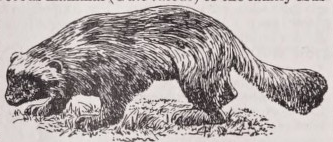
4. of Europe and Siberia. It grows to the length of three feet, but has short legs and moves slowly. It is a carnivorous animal, and in order to catch its prey, it climbs a tree and from that darts down upon a deer or other animal. It is names from its voraciousappetite.
3. A carnivorousmammal (Gulo luscus), of the family Mustelidae, about the size of a large badger. It was formerly believed to be inordinatelyvoracious, whence the name; the wolverene. It is a native of the northern parts of America, Europe, and Asia.
Glutton[Verb transitive and intransitive]Webster's Dictionary 1913
GLUTTON, or Wolverene(Gulo luscus'), a carnivorousmammal, belonging to the Mustelidoe orweasel family, but differing from the typical forms of the genus Mustela in the greater heaviness and clumsiness of its body, presenting in this respect a striking resemblance to the bear. Its legs are short and stout, with large feet, the toes of which terminate in strong, sharp claws, considerably curved. Its mode of progression is semi-plantigrade. In size and form it is not unlike the European badger, measuring from 2 to -3 feet in length, exclusive of the thick bushy tail, which is about 8 inches long. Its head is broad, its eyes small, with defective vision, and its back arched. Its fur consists of an undergrowth of short woolly hair, mixed with long straight hairs, to the abundance and length of which on the sides •and tail the creature owes its shaggy appearance. The colour of its fur is blackish-brown, with a broad band of chestnut colour stretching from the shoulders along each side of the body, the two meeting near the root of the tail; while, unlike the majority of arctic animals, the fur of the glutton in winter-time grows darker in colour. Like other weasels it is provided with anal glands, which secrete a yellowish fluid possessing a highly foetid odour. The glutton is a boreal animal, inhabiting the northern regions of both hemispheres, but most abundant in the circumpolar area of the New World, where it occurs throughout the British provinces and Alaska, being specially numerous in the neighbourhood of the Mackenzie River, and extending southwards as far as New York and the Rocky Mountains. Many erroneous statements have been made regarding the glutton by early writers on natural history, from Olaus Magnus to Buffon, one of which has perpetuated itself in the ...animal’s common name,—the fact being that the wolverene is not more gluttonous than are the majority of carnivorous animals. It feeds on grouse and the smaller rodents, and on foxes, which it digs from their burrows during the breeding season. Its want of activity, however, renders it dependent for most of its food on the dead carcases of animals. These it frequently obtains by methods which have made it peculiarly obnoxious to the hunter and trapper. Should the hunter, after succeeding in killing his game, leave the carcase insufficiently protected for more than a single night, the glutton, whose fear of snares is sufficient to prevent him from touching it during the first night, will, if possible, get at and devour what he can of it on the second, hiding the remainder beneath the snow. He annoys the trapper by following up his lines of martentraps, which often extend to a length of 40 or 50 miles, each of which he enters from behind, extracting the bait, pulling up the traps, and devouring or concealing the entrapped martens. So persistent is the glutton in this practice, when once it discovers a line of traps, that its extermination along the trapper’s route is a necessary preliminary to the successful prosecution of his business. This is, however, no easy task, as the glutton is too cunning to be caught by the methods successfully employed on the other members of the weasel family. The trap generally used for this purpose is one made to resemble a cache, or hidden store of food, such as the Indians and hunters are in the habit of forming, the discovery and rifling of which is one of the glutton’s most congenial occupations,—the bait, instead of being paraded as in most traps, being in this case carefully concealed, to lull the knowing beast’s suspicions. One of the most prominent characteristics of the wolverene is its propensity, akin to that of certain members of the crow family, to steal and hide things, not merely food which it might afterwards need, or traps which it regards as personal enemies, but articles which cannot possibly have any interest for it except that of curiosity. An amusing instance of this is quoted by Cowes in his valuable work, recently published, on the Fur-bearing Animals of North America, in which he says— “A hunter and his family, having left their lodge unguarded during their absence, on their return found it completely gutted—the walls were there, but nothing else. Blankets, guns, kettles, axes, cans, knives, and all the other paraphernalia of a trapper’s tent had vanished, and the tracks left by the beast showed who had been the thief. The family set to work, and, by carefully following up all his paths, recovered, with some trifling exceptions, the whole of the lost property.” The cunning it displays in unravelling the oftentimes complicated snares set for it forms at once the admiration and the despair of every trapper, while its great strength and ferocity render it a dangerous antagonist to animals much larger than itself, and occasionally even to man. The rutting season occurs in March, and the female, secure in her burrow, produces her young—four or five at a birth—in June or July. In defence of these she is exceedingly bold, and the Indians, according to Cowes, “have been heard to say that they would sooner encounter a she-bear with her cubs than a carcajou (the Indian name of the glutton) under the same circumstances.” The wolverene has a curious habit which has not hitherto been observed in any other of the lower animals. On catching sight of its relentless human enemy, it may be observed, before finally determining on flight, sitting on its haunches, and, in order to get a clearer view of the danger, shading its eyes with one of its forepaws. When pressed for food it becomes fearless, and has then been known to come on board an ice-bound vessel, and in presence of the crew to seize on a canister of meat. The flesh of the glutton is uneatable; it is therefore only valuable for its fur, which, when several skins are sewn together, forms elegant hearth and carriage rugs.
9th ed. Encyclopædia Britannica, vol. 10, p. 696 [1,017 words — estimated reading time: 6 minutes]
The Son of man came eating and drinking, and they say, Behold a man gluttonous, and a winebibber, a friend of publicans and sinners. But wisdom is justified of her children.
The Son of Man came eating and drinking, and they say, ‘Look at this glutton and drunkard, a friend of tax collectors and sinners!’ But wisdom is vindicated by her actions.”
One of themselves, even a prophet of their own, said, The Cretians are alway liars, evil beasts, slow bellies.
As one of their own prophets has said, “Cretans are always liars, evil beasts, lazy gluttons.”
This site uses cookies to remember your display preferences (search sources and editions, Bible version, auto-link, images, light/dark theme). No personal data whatsoever is collected. Privacy Policy