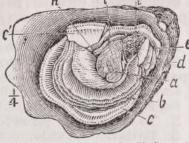
The organization of the oyster, as compared with that of a typical lamellibranch such as Anodon (see Mollusca), is brought about by the reduction of the anterior part of the body accompanying the loss of the anterior adductor, and the enlargement of the posterior region. The pedal ganglia and auditory organs have disappeared with the foot, at all events have never been detected; the labial ganglia are very minute, while the parieto-splanchnic are well developed, and constitute the principal part of the nervous system....
According to Spengel the pair of ganglia near the mouth, variously called labial or cerebral, represent the cerebral pair and pleural pair of a gastropod combined, and the parieto-splanchnic pair correspond to the visceral ganglia, the commissure which connects them with the cerebro-pleural representing the visceral commissure. Each of the visceral ganglia is connected or combined with an olfactory ganglion underlying an area of specialized epithelium, which constitutes the olfactory organ, the osphradium. This view (which, it may be pointed out, differs from that given under Mollusca) alone admits of a satisfactory comparison between the lamellibranch and the gastropod; if the parieto-splanchnic were merely an olfactory ganglion its connexion by a commissure with its fellow would be an abnormality, and the olfactory ganglion in the lamellibranch would innervate the gills, adductor muscle, mantle, and rectum, parts which in gastropods are innervated from the visceral ganglia. The heart and pericardial chamber in the oyster lie along the anterior face of the adductor muscle, almost perpendicular to the direction of the gills, with which in Anodon they are parallel. In Anodon and the majority of lamellibranchs the ventricle surrounds the intestine; in the oyster the two are quite independent, the intestine passing above the pericardium. The renal organs of the oyster were discovered by Hoek to agree in their morphological relations with those of other lamellibranchs.
The generative organs of the oyster consist of a system of branching cavities on each side of the body lying immediately beneath the surface. All the cavities of a side are ultimately in communication with an efferent duct opening on the surface of the body a little above the line of attachment of the gills. The genital opening on each side is situated in a depression of the surface into which the renal organ also opens. The genital products are derived from the cells which line the cavities of the genital organs. The researches of Hoek have shown that in the same oyster the genital organs at one time produce ova, at another spermatozoa, and that consequently the oyster does not fertilize itself. How many times the alternation of sex may take place in a season is not known. It must be borne in mind that in what follows the species of the European coasts, Ostrea edulis, is under consideration. The ova are fertilized in the genital duct, and before their escape have undergone the earliest stages of segmentation. After escaping from the genital aperture they find their way into the infra-branchial part of the mantle cavity of the parent, probably by passing through the supra-branchial chamber to the posterior extremity of the gills, and then being conducted by the inhalent current caused by the cilia of the gills into the infra-branchial chamber. In the latter they accumulate, being held together and fastened to the gills by a white viscid secretion. The mass of ova thus contained in the oyster is spoken of by oyster fishers as “white spat,” and an oyster containing them is said to be “sick.” While in this position the ova go through the series of changes figured in vol. xvi. p. 638 (fig. 6). At the end of a fortnight the white spat has become darkcoloured from the appearance of coloured patches in the developing embryos. The embryos having then reached the condition of “trochospheres” escape from the mantle cavity and swim about freely near the surface of the water among the multitude of other creatures, larval and adult, which swarm there. The larvae are extremely minute, about τ ⅜ π inch long and of glassy transparency, except in one or two spots which are dark brown. From the trochosphere stage the free larvae pass into that of “veligers.” How long they remain free is not known; Prof. Huxley kept them in a glass vessel in this condition for a week. Ultimately they sink to the bottom and fix themselves to shells, stones, or other objects, and rapidly take on the appearance of minute oysters, forming white disks i 1 σ inch in diameter. Thè appearance of these minute oysters constitutes what the fishermen call a “fall of spat.” The experiment by which Hoek conclusively proved the change of sex in the oyster was as follows. In an oyster containing white spat microscopic examination of the genital organs shows nothing but a few unexpelled ova. An oyster in this condition was kept in an aquarium by itself for a fortnight, and after that period its genital organs were found to contain multitudes of spermatozoa in all stages of development.
The breeding season of the European oyster lasts from May to September. The rate of growth of the young oyster is, roughly speaking, an inch of diameter in a year, but after it has attained a breadth of 3 inches its growth is much slower. Prof. Möbius is of opinion that oysters over twenty years of age are rare, and that most of the adult Schleswig oysters are seven to ten years old.
The development of the American oyster, 0. virginiana, and of the Portuguese oyster, 0. angulata, is very similar to that of 0. edulis, except that there is no period of incubation within the mantle cavity of the parent in the case of these two species. Hence it is that so-called artificial fertilization is possible; that is to say, the fertilization may be allowed to take place in a tank or aquarium in which the conditions are under control. But if it is possible to procure a supply of spat from the American oyster by keeping the swarms of larvae in confinement, it ought to be possible in the case of the European oyster. All that would be necessary would be to take a number of mature oysters containing white spat and lay them down in tanks till the larvae escape. This would be merely carrying oyster culture a step further back, and instead of collecting the newly fixed oysters, to obtain the free larvae in numbers and so insure a fall of spat independently of the uncertainty of natural conditions.
Natural beds of oyster occur on stony and shelly bottoms at depths varying from 3 to 20 fathoms. In nature the beds are liable to variations, and, although Prof. Huxley is somewhat sceptical on this point, it seems that they are easily brought into an unproductive condition by over-dredging. Oysters do not flourish in water containing less than 3 per cent, salt; and hence they are absent from the Baltic. The chief enemies of oysters are the dog-whelk, Purpura lapillus, and the whelk-tingle, Murex erinaceus, which bore through the shells. Starfishes swallow oysters whole. Cliona, the boring sponge, destroys the shells and so injures the oyster; the boring annelid Leucodore also excavates the shell.
The wandering life of the larvae makes it uncertain whether any of the progeny of a given oyster-bed will settle within its area and so keep up its numbers. It is known from the history of the Liimfjord beds that the larvae may settle 5 miles from their place of birth.
The genus Ostrea has a world-wide distribution, in tropical and temperate seas; seventy species have been distinguished. Its nearest allies are Anomia among living forms, Gryphsea among fossils. For the so-called Pearl-Oyster εee Pearl. (J. T. C.).
Oyster Industry.
The oyster industry of the world is seated chiefly in the United States and France. Great Britain has still a few natural beds remaining, and a number of well-conducted establishments for oyster culture. Canada, Holland, Italy, Germany, Belgium, Spain, Portugal, Denmark, Norway, and Russia have also oyster industries, which are comparatively insignificant, and in the case of the two countries last named, hardly worthy of consideration in a statistical statement. Recent and accurate statistics are lacking except in two or three instances. A brief review by countries in the order of their importance is here presented.
United States. — This is by far the most extensive of the fishery industries of the country, yielding products three times as valuable as those of the cod fishery and six times those of the whale fishery. In 1880 it employed 52,805 persons, and yielded 22,195,370 bushels, worth to the fishermen $9,034,861. On 13,047,922 bushels there is a rise of value in passing from producers to market, which amounts to $4,368,991, and results either from replanting or from packing in tin cans. The value of the capital, invested in the industry is returned as $10,583,295. There are employed 4155 vessels, valued at $3,528,700, and 11,930 boats. The actual fishermen number 38,249, the shoresmen 14,556. Fully 80 per cent, of the total yield is obtained from the waters of Chesapeake Bay. France.— The oyster industry of France employed in 1881 29,431 men, women, and children in the parks, beds, and preserves. The number of such establishments upon the public domain was 32,364, with an area of 19,891 acres, and 970 establishments upon private property, with an area of 926 acres. From these 374,985,770 oysters were dredged during the season of 1880-81, from September 1 to June 15, worth 2,061,753 francs, while the total number of oysters disposed of during this period amounted to 680,372,750, worth 17,951,114 francs. This total includes the oysters dredged in the sea as well as those gathered from the artificial breeding-grounds or parks.
Great Britain.— A brief discussion of the British oyster fisheries may be found under Fisheries, vol. ix. p. 265. A recent estimate gives the total value of the oysters obtained from British seas at £2,000,000, worth 2d. each, or, perhaps, 240,000,000 in all. An extensive import trade is carried on with the United States, which has grown up within the past decade, as is shown by the following statement of import values:—1874, $41,419; 1875, $38,733; 1876, $99,012; 1877, $121,301; 1878, $254,815; 1879, $306,941; 1880, $366,403; 1881, $414,584; 1882, $372,111; 1883, $371,497.
Holland.— Since 1870 the beds in the province of Zealand have been greatly enriched by careful methods of culture and protection; andin 1881 the product amounted to 21,800,000 oysters, worth about 1,350,000 guilders. About half the product of the Dutch oyster fishery is sent to England, and large quantities of the young oysters are laid down to fatten in the English oyster-beds.
Germany.— Germany has a small oyster industry on the west coast of Schleswig-Holstein. According to Lindeman, the largest annual product of these beds has rarely exceeded 4,000,000 oysters. From 1859 to 1879 they were rented to a company in Flensburg for an annual payment of 80,000 marks. In 1879 the lease was transferred to a Hamburg firm, who paid for that year 163,000 marks.
Italy.— Oyster culture in Italy, according to Bouchon-Brandely, is carried on in only one locality, Taranto, though small quantities of natives are obtained from the Gulfs of Genoa and Naples, from the coasts of the Adriatic, and from the ponds of Corsica. The sea of Taranto is leased by the city to a company that pays an annual rent of 38,000 francs. The product of this body of water is estimated variously at from 6,000,000 to 10,000,000 oysters yearly. The entire annual product of Italy does not probably exceed 20,000,000 oysters, valued at about £40,000.
Belgium.— Oyster culture is carried on upon a small scale at Ostend. There being no native beds, the seed oysters are brought from England, a practice which, according to Lindeman, originated as early as 1765. The product probably does not exceed 10,000 bushels a year, and is consumed chiefly in Germany and Holland, though there is a small exportation.
Spain.— According to a recent report by Don Francisco Sola, there are forty-three establishments in Spain for the cultivation of oysters and other shell-fisheries. The amount of oysters annually produced is estimated at 167,673 kilogrammes (368,880 lb), valued at 50,296 pesetas (about £2000). These are exported to Algiers, France, Portugal, and South America.
Portugal.— There appear to be no statistics for Portugal. Considerable quantities of seed oysters are planted at present in the Bay of Arcachon and elsewhere in France, and in England the Anglo-Portuguese oyster is apparently growing in favour. Denmark.— The very insignificant oyster fishery of Denmark has its seat chiefly in the Liimfjord and at Frederikshaven. All the oyster-beds, being Government property, are carefully protected by law. Statistics for late years are not accessible. In 1847 the product of the Frederikshaven beds was about 200,000 oysters; but the yield of late years has been much smaller. The Liimfjord beds were discovered about 1851. From 1876 to 1881 the Danish oyster fisheries were leased to a firm in Hamburg, which paid 240,000 kroner (£13,000) as yearly rental.
Russia.— Glimm states that a speciés of oyster, Ostrea adriatica, is found in considerable numbers along the coast of the Crimea, and is the object of a considerable trade. Oysters brought from Theodosia cost in St Petersburg about 3s. sterling the score.
Norway.— The average value of the yield for the five years ending 1881 was 7600 kroner (£420). The quantity produced in 18 - 81 was 267 hectolitres (735 bushels), valued at 7000 kroner (£390). The industry is seated for the most part in the districts of southern Trondhjem and Jarlsberg, the product of the latter province being nearly half that of all Norway.
Subjoined is a rough estimate of the total number of oysters obtained annually from the sea (North America, 5,572,000,000; Europe, 2,331,200,000):—
[table]
The oyster industry is rapidly passing from the hands of the fisherman into those of the oyster culturist. The oyster being sedentary, except for a few days in the earliest stages of its existence, is easily exterminated in any given locality; since, although it may not be possible for the fishermen to rake up from the bottom every individual, wholesale methods of capture soon result in covering up or otherwise destroying the oyster banks or reefs, as the communities of oysters are technically termed. The main difference between the oyster industry of America and that of Europe lies in the fact that in Europe the native beds have long since been practically destroyed, perhaps not more than 6 or 7 per cent, of the oysters of Europe passing from the native beds directly into the hands of the consumer. It is probable that 60 to 75 per cent, are reared from the spat in artificial parks, the remainder having been laid down for a time to increase in size and flavour in shoal waters along the coasts. In the United States, on the other hand, from 30 to 40 per cent, are carried from the native beds directly to market. The oyster fishery is everywhere, except in localities where the natural beds are nearly exhausted, carried on in the most reckless manner, and in all directions oyster grounds are becoming deteriorated, and in some cases have been entirely destroyed. It remains to be seen whether the Government of the States will regulate the oyster fishery before it is too late, or will permit the destruction of these most important reservoirs of food. At present the oyster is one of the cheapest articles of diet in the United States; and, though it can hardly be expected that the price of American oysters will always remain so low, still, taking into consideration the great wealth of the natural beds along the entire Atlantic coast, it seems certain that a moderate amount of protection will keep the price of seed oysters far below European rates, and that the immense stretches of submerged land especially suited for oyster planting may be utilized and made to produce an abundant harvest at much less cost than that which accompanies the complicated system of culture in vogue in France and Holland.
The most elaborate system of oyster culture is that practised at Arcachon and elsewhere in France, and, to a limited extent since 1865, on the island of Hay ling, near Portsmouth, in England. The young oysters, having been collected in the breeding season upon tiles or hurdles, are laid down in artificial ponds, or in troughs, where the water is supplied to them at the discretion of their proprietors. The oysters are thus kept under control like garden plants from the time they are laid down to that of delivery to commercial control. The numerous modifications of this system are discussed in various recent reports.
The simplest form of oyster culture is the preservation of the natural oyster-beds. Upon this, in fact, depends the whole future of the industry, since it is not probable that any system of artificial breeding can be devised which will render it possible to keep up a supply without at least occasional recourse to seed oysters produced under natural conditions. It is the opinion of almost all who have studied the subject that any natural bed may in time be destroyed by overfishing (perhaps not by removing all the oysters, but by breaking up the colonies, and delivering over the territory which they once occupied to other kinds of animals), by burying the breeding oysters, by covering up the projections suitable for the reception of spat, and by breaking down, through the action of heavy dredges, the ridges which are especially fitted to be seats of the colonies. The immense oyster-beds in Pocomoke Sound, Maryland, have practically been destroyed by over-dredging, and many of the other beds of the United States are seriously damaged. The same is doubtless true of all the beds of Europe. It has also been demonstrated that under proper restriction great quantities of mature oysters, and seed oysters as well, may be taken from any region of natural oyster-beds without injurious effects. Parallel cases in agriculture and forestry will occur to every one. Möbius, in his most admirable essay Die Auster und Die Austemwirthschaft, has pointed out the proper means of preserving natural beds, declaring that, if the average profit from a bed of oysters is to remain permanently the same, a sufficient number of mother oysters must be left in it, so as not to diminish the capacity of maturing. He further shows that the productive capacity of a bed can only be maintained in one of two ways :—(1) by diminishing the causes which destroy the young oysters, in which case the number of breeding oysters may safely be decreased; this, however, is practicable only under such favourable conditions as occur at Arcachon, where the beds may be kept under the constant control of the oyster-culturist; (2) by regulating the fishing on the natural beds in such a manner as to make them produce permanently the highest possible average quantity of oysters. Since the annual increase of half-grown oysters is estimated by him to be four hundred and twenty-one to every thousand full-grown oysters, he claims that not more than 42 per cent, of these latter ought to be taken from a bed during a year.
The Schleswig-Holstein oyster-beds are the property of the state, and are leased to a company whose interest it is to preserve their productiveness. The French beds are also kept under Government control. Not so the beds of Great Britain and America, which are as a general rule open to all comers, except when some close-time regulation is in force. Prof. Huxley has illustrated the futility of “close-time” in his remark that the prohibition of taking oysters from an...