
A water fowl of the genus Colymbus, and order of ansers. It is found in the northern parts of Europe, Asia, and America.
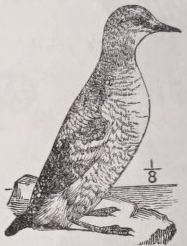
GUILLEMOT (French, Guillemot ), the name accepted by nearly all modern authors for a Sea-bird, the Colymbus troile of Linnaeus and the Uria troile of Latham, which nowadays it seems seldom if ever to bear among those who, from their vocation, are most conversant with it, though, according to Willughby and Ray his translator, it was°in their time so called “by those of Northumberland and Durham.” Around the coasts of Britain it is variously known as the Frowl, Kiddaw or Skiddaw, Langy (ef. Icelandic, Langula), Lavy, Marrock, Murre, Scout (cf. Coot, vol. vi. p. 341), Scuttock, Strany, Tinker or Tinkershire, and Willock. The number of local names testifies to the abundance of this bird, at least of old time, in different places, but it should be observed that in certain districts some of them are the common property of this species and the Razor-bill. In former days the Guillemot yearly frequented the cliffs on many parts of the British coasts in countless multitudes, and this is still the case in the northern parts of the United Kingdom; but more to the southward nearly all its smaller settlements have been rendered utterly desolate by the wanton and cruel destruction of their tenants during the breeding season, and even the inhabitants of those which were more crowded had become so thinned that, but for the intervention of the Sea Birds Preservation Act (32 and 33 Vict. cap. 17), which provided under penalty for the safety of this and certain other species at the time of year when they were most exposed to danger, they would unquestionably by this time have been exterminated so far as England is concerned. The slaughter, which, before the passing of that Act, took place annually on the cliffs of the Isle of Wight, near Flamborough Head, and at such other stations ...frequented by this species and its allies the Razor-bill and Puffin, and the Kittiwake-Gull, as could be easily reached by excursionists from London and the large manufacturing towns, was in the highest degree brutal. No use whatever could be made of the bodies of the victims, which indeed those who indulged in their massacre were rarely at the trouble to pick out of the water; the birds shot were all engaged in breeding; and most of them had young, which of course starved to death through the destruction of their parents, intercepted in the performance of the most sacred duty of nature, and butchered to gratify the murderous lust of those who sheltered themselves under the name of “sportsmen.”
Part of the Guillemot’s history is still little understood. We know that it arrives at its wonted breeding stations on its accustomed day in spring, that it remains there till, towards the end of summer, its young are hatched and able, as they soon are, to encounter the perils of a seafaring life, when away go all, parents and progeny. After that time it commonly happens that a few examples are occasionally met with in bays and shallow waters. Tempestuous weather will drive ashore a large number in a state of utter destitution—many of them indeed are not unfrequently washed up dead—but what becomes of the bulk of the birds, not merely the comparatively few thousands that are natives of Britain, but the tens and hundreds of thousands, not to say millions, that are in summer denizens of more northern latitudes, no one can yet say. This mystery is not peculiar to the Guillemot, but is shared by all the Alcidae that inhabit the Atlantic Ocean. Examples stray every season across the Bay of Biscay, are found off the coasts of Spain and Portugal, enter the Mediterranean and reach Italian waters, or, keeping further south, may even touch the Madeiras, Canaries, or Azores; but these bear no proportion whatever to the mighty hosts of whom they are literally the “scouts,” and whose position and movements they no more reveal than do the vedettes of a well-appointed army. The common Guillemot of both sides of the Atlantic is replaced further northward by a species with a stouter bill, the U. arra or U. bruennichi of ornithologists, and on the west coast of North America by the U. californica. The habits of all these are essentially the same, and the structural resemblance between all of them and the Auks is so great that of late several systematists have relegated them to the genus Alea, confining the genus Uria to the Guillemots of another group, of which the type is the U. grylla, the Black Guillemot of British authors, the Dovekey or Greenland Dove of sailors, the Tysty of Shetlanders. This bird assumes in summer an entirely black plumage with the exception of a white patch on each wing, while in winter it is beautifully marbled with white and black. Allied to it as species or geographical races are the U. maηdti, U. columba, and U. carbo. All these differ from the larger Guillemots by laying two or three eggs, which are generally placed in some secure niche, while the members of the other group lay but a single egg, which is invariably exposed on a bare ledge. (a. n.)