
Word of the Day: Catachrestical
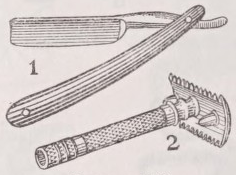
1. A keen-edged knife of peculiar shape, used in shaving the hair from the face or the head.
An aquatic fowl, the Alca torda; also, the Rhynchops nigra or cut-water.
A species of fish with a compressed body.
2. See Cutwater, 3.
Razorbill
Encyclopedia Britannica
RAZORBILL or Razor-billed Auk, known also on many parts of the British coasts as the Marrot, Murre, Scout, Tinker, or Willock—names which it, however, shares with the Guillemot (vol. xi. p. 262), and to some extent with the Puffin (see above, p. 101)—a common sea-bird of the Northern Atlantic, resorting in vast numbers to certain stations on rocky cliffs for the purpose of breeding, and, its object being accomplished, returning to deeper waters for the rest of the year. It is the Alca tor da of Linnaeus and most modern authors, congeneric with the Gare-fowl (vol. x. p. 78), if not with the true Guillemots, between which two forms it is intermediate—differing from the former in its small size and retaining the power of flight, which that presumably extinct species has lost, and from the latter in its peculiarly-shaped bill, which is vertically enlarged, compressed, and deeply furrowed, as well as in its elongated, wedge-shaped tail. A fine white line, running on each side from the base of the culmen to the eye, is in the adult bird in breeding-apparel (with a few very rare exceptions) a further obvious characteristic. Otherwise the appearance of all these birds may be briefly described in the same words—head, bi’east, and upper parts generally of a deep glossy black, and the lower parts and tip of the secondaries of a pure white, while the various changes of plumage dependent on age or season are alike in all. In habits the Razorbill closely agrees with the true Guillemots, laying its single egg (which is not, however, subject to the same amazing variety of coloration that is pre-eminently the Guillemot’s own) on the ledges of the cliffs to which it repairs in the breeding-season, but it is said then as a rule to occupy higher elevations, and when not ...breeding to keep further out to sea. On the east side of the Atlantic the Razorbill has its stations on convenient parts of the coast from the North Cape to Britanny, besides several in the Baltic, while in winter it passes much further to the southward, and is sometimes numerous in the Bay of Gibraltar, occasionally entering the Mediterranean but apparently never extending to the eastward of Sicily or Malta. On the west side of the Atlantic it breeds from 70° N. lat. on the eastern shore of Baffin’s Bay to Cape Farewell, and again on the coast of America from Labrador and Newfoundland to the Bay of Fundy, while in winter it reaches Long Island, (a. n.)
9th ed. Encyclopædia Britannica, vol. 20, p. 302
[436 words — estimated reading time: 3 minutes]
[436 words — estimated reading time: 3 minutes]
Sharpness Roget’s Thesaurus §253
N. sharpness, acuity, acumination, spinosity, point, spike, spine, spicule, spiculum, needle, hypodermic needle, tack, nail, pin, prick, prickle, spur, rowel, barb, spit, cusp, horn, antler, snag, tag thorn, bristle, adam's needle, bear grass, tine, yucca, nib, tooth, tusk, spoke, cog, ratchet, crag, crest, arete, cone peak, sugar loaf, pike, aiguille, spire, pyramid, steeple, beard, chevaux de frise, porcupine, hedgehog, brier, bramble, thistle, comb, awn, beggar's lice, bur, burr, catchweed, cleavers, clivers, goose, grass, hairif, hariff, flax comb, hackle, hatchel, heckle, wedge, knife edge, cutting edge, blade, edge tool, cutlery, knife, penknife, whittle, razor, razor blade, safety razor, straight razor, electric razor, scalpel, bistoury, lancet, plowshare, coulter, colter, hatchet, ax, pickax, mattock, pick, adze, gill, billhook, cleaver, cutter, scythe, sickle, scissors, shears, pruning shears, cutters, wire cutters, nail clipper, paper cutter, sword, bodkin, belduque, bowie knife, paring knife, bushwhacker, drawing knife, drawing shave, microtome, chisel, screwdriver blade, flint blade, guillotine, sharpener, hone, strop, grindstone, whetstone, novaculite, steel, emery
V. be sharp, taper to a point, bristle with, render sharp, sharpen, point, aculeate, whet, barb, spiculate, set, strop, grind, chip, cut
Adj. sharp, keen, acute, acicular, aciform, aculeated, acuminated, pointed, tapering, conical, pyramidal, mucronate, mucronated, spindle shaped, needle shaped, spiked, spiky, ensiform, peaked, salient, cusped, cuspidate, cuspidated, cornute, cornuted, cornicultate, prickly, spiny, spinous, spicular, thorny, bristling, muricated, pectinated, studded, thistly, briary, craggy, snaggy, digitated, two-edged, fusiform, dentiform, denticulated, toothed, odontoid, starlike, stellated, stelliform, sagittate, sagittiform, arrowheaded, arrowy, barbed, spurred, acinaciform, apiculate, apiculated, aristate, awned, awny, bearded, calamiform, cone-shaped, coniform, crestate, echinate, gladiate, lanceolate, lanciform, awl, awl-shaped, lance-shaped, awl-shaped, scimitar-shaped, sword-shaped, setarious, spinuliferous, subulate, tetrahedral, xiphoid, cutting, sharp edged, knife edged, sharp as a razor, keen as a razor, sharp as a needle, sharp as a tack, sharpened, set
King James Bible KJV Bible
Berean Standard Bible BSB Bible
6 KJV and 6 BSB verses contain “Razor”
All the days of the vow of his separation there shall no razor come upon his head: until the days be fulfilled, in the which he separateth himself unto the LORD, he shall be holy, and shall let the locks of the hair of his head grow.
For the entire period of his vow of separation, no razor shall pass over his head. He must be holy until the time of his separation to the LORD is complete; he must let the hair of his head grow long.
For, lo, thou shalt conceive, and bear a son; and no razor shall come on his head: for the child shall be a Nazarite unto God from the womb: and he shall begin to deliver Israel out of the hand of the Philistines.
For behold, you will conceive and give birth to a son. And no razor shall come over his head, because the boy will be a Nazirite to God from the womb, and he will begin the deliverance of Israel from the hand of the Philistines.”
And she vowed a vow, and said, O LORD of hosts, if thou wilt indeed look on the affliction of thine handmaid, and remember me, and not forget thine handmaid, but wilt give unto thine handmaid a man child, then I will give him unto the LORD all the days of his life, and there shall no razor come upon his head.
And she made a vow, pleading, “O LORD of Hosts, if only You will look upon the affliction of Your maidservant and remember me, not forgetting Your maidservant but giving her a son, then I will dedicate him to the LORD all the days of his life, and no razor shall ever come over his head.”
Thy tongue deviseth mischiefs; like a sharp rasor, working deceitfully.
Your tongue devises destruction like a sharpened razor, O worker of deceit.