
An animal of the genus Canis, resembling a dog and a fox; a native of Asia and Africa. It preys on poultry and other small animals. It is the Canis aureus of Linne.
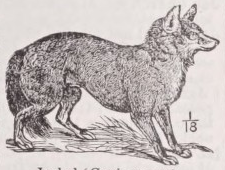
JACKAL(Canis aureus'), a carnivorous mammal belonging to the dog family. (Canidae), and believed by many naturalists to be one of the species from which certain of the semi-domesticated dogs of Asia and North Africa have been derived. It is dog-like in external appearance, and there is, according to Geoffroy Saint Hilaire, no constant difference between its structure and that of the small canine races. It resembles them in dentition, in the roundness of its eye pupils, in its period of gestation, and to a large extent also in its habits, while like the dog it is subject to hydrophobia. It grows to a height of 15 inches at the shoulders, and to a length of about 2 feet, exclusive of its bushy fox-like tail. Its fur is of a greyish-yellow colour, darker on the back and lighter coloured beneath. An excrescence consisting of a horny cone, half an inch in length, and concealed by a tuft of hair, is, according to Emerson Tennent, sometimes found on the head of the jackal. The Singhalese aver that it is only found on the leader of the pack, and they esteem it as an invaluable talisman. Jackals, of which there are several well-marked varieties, are widely distributed throughout southern Asia and the north of Africa. They are nocturnal animals, concealing themselves until dusk in woody jungles and other natural lurking places, thereafter sallying forth in packs, which sometimes number two hundred individuals, and visiting farmyards, villages, and towns in search of food. This consists for the most part of the smaller mammals and poultry, although their association in packs enables them also to hunt down antelopes and sheep. When unable to obtain living prey, they feed upon carrion and refuse of all kinds, and are thus useful in removing putrescent matter from the streets of ...Eastern towns. They are also fond of grapes and other fruits, and are thus the pests of the vineyard as well as the poultry-yard. The cry of the jackal has been described as even more appalling than that of the hyaena, a shriek from one member of a pack being the signal for a general chorus of screams, which is kept up during the greater part of the night. In India these animals are occasionally hunted with foxhounds and greyhounds, and from their extreme cunning and pluck they are said to afford excellent sport. When brought to bay, they frequently turn upon their assailants and inflict severe wounds with their teeth; at other times they have been known to feign death as a means of escape. Jackals are readily tamed; and domesticated individuals are said, when called by their masters, to wag their tails, crouch, and throw themselves on the ground, and otherwise behave in a dog-like fashion. The jackal, like the fox, has a peculiarly offensive odour, due to the secretion of a gland at the base of the tail, but in domesticated specimens this odour is much fainter than in the wild forms.