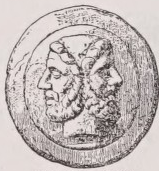
A Latin deity represented with two faces looking in opposite directions. Numa is said to have dedicated to Janus the covered passage at Rome, near the Forum, which is usually called the Temple of Janus. This passage was open in war and closed in peace.
JANUS, a Roman god, after whom the month of January was named. His temple was open in war and closed during peace, and the ceremony of closing it for the third time in Roman history was performed by Augustus, 29 B,c., when he had established his authority over the whole empire. This temple, which was in reality only an arch or gateway, facing east and west, stood near the forum. When most of the Roman gods were merged in Greek divinities, Janus retained his native character. Amid the obscurity that hangs over the genuine Roman religion, it is difficult to determine the nature and origin of Janus. It .is probable that he was the chief deity of one of the races which were united in the Roman people, and that his worship was maintained beside, but overshadowed by, that of Jupiter, the chief deity of another of these races. The hill of Janus, Janiculum, lay on the north or Etruscan side of the Tiber, and was doubtless the seat of his original worshippers. An Etruscan origin is thus suggested, and most authorities accept this hypothesis. The Romans themselves thought that Janus and the feminine Jana, i.e., Diana, were sun and moon; and the names are commonly assimilated to the Greek Zτ)ι∕, ie., ∆iηv. If, however, Janus was an Etruscan god, belonging to the Etruscan element in Rome, he must then be identified with the Etruscan deity Ani, the form of the name being prompted by the word janua, as Janus is the god of opening and beginning. The god is represented with two faces looking in opposite directions, a design found on the coins of the Etruscan Volaterra, but possibly due to the influence of Greek art....
See Preller, Röm. Myth. ; Gerhard, Griech. Myth.,∖∖. ; Hartung, Rclig. der Römer ; Schwegler, Röm. Geschichte, &c.; Deecke, Templum von Biαcenzα. Mommsen in his history proposes a different view.
9th ed. Encyclopædia Britannica, vol. 13, p. 568 [321 words — estimated reading time: 2 minutes]
V. change one's mind, change one's intention, change one's purpose, change one's note, abjure, renounce, withdraw from, waver, vacillate, wheel round, turn round, veer round, turn a pirouette, go over from one side to another, pass from one side to another, change from one side to another, skip from one side to another, go to the rightabout, box the compass, shift one's ground, go upon another tack, apostatize, change sides, go over, rat, recant, retract, revoke, rescind, recall, forswear, unsay, come over, come round to an opinion, crawfish *, crawl*, draw in one's horns, eat one's words, eat the leek, swallow the leek, swerve, flinch, back out of, retrace one's steps, think better of it, come back return to one's first love, turn over a new leaf, trim, shuffle, play fast and loose, blow hot and cold, coquet, be on the fence, straddle, bold with the hare but run with the hounds, nager entre deux eaux, wait to see how the cat jumps, wait to see how the wind blows
This site uses cookies to remember your display preferences (search sources and editions, Bible version, auto-link, images, light/dark theme). No personal data whatsoever is collected. Privacy Policy