
A bird, the Corvus glandarius.
JAY (French, Geaι), a well-known and very beautiful European bird, the Corvus glandarius of Linnaeus, the Garrulus glandarius of modern ornithologists. To this species are more or less closely allied numerous birds inhabiting the Palaearctic and Indian Regions, as well as the greater part of America, but not occurring in the Antilles, in the southern portion of the Neotropical Region, or in the Ethiopian or Australian. All these birds are commonly called Jays, and form a group of the Crows or Corvidae, which may fairly be considered a Subfamily, Garrulinae. Indeed there are, or have been, systematists who would elevate the Jays to the rank of a Family, Garrulidae — a proceeding which seems unnecessary. Some of them have an unquestionable resemblance to the Pies, if the group now known by that name can be satisfactorily severed from the true Corvinae. In structure the Jays are not readily differentiated from the Pies; but in habit, so far as is known of them, they are much more arboreal, delighting in thick coverts, seldom appearing in the open, and seeking their food on or under trees. They seem also never to walk or run when on the ground, but always to hop. The body-feathers are commonly loose and soft; and, gaily coloured as are most of the species, in few of them has the plumage the metallic glossiness it generally presents in the Pies, while the proverbial beauty of the “Jay’s wing” is due to the vivid tints of blue—turquoise and cobalt, heightened by bars of jet-black, an indication of the same style of ornament being observable in the greater number of the other forms of the group, and in some predominating over nearly the whole surface. Of the many genera th it have been proposed by ornithologists, perhaps about nine may be deemed sufficiently well ...established.
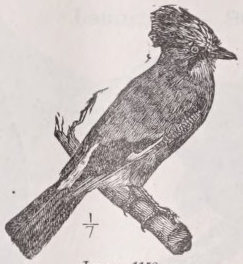
The ordinary European Jay, Garrulus glandarius (fig. 1), has of late years suffered so much persecution in the British Islands as to have become in many districts a rare bird. In Ireland it seems now to be indigenous to the southern half of the island only; in England generally, it is far less numerous than formerly; and Mr Lumsden {Scottish Naturalist, iii. pp. 230-240) has shewn that in Scotland its numbers have decreased with still greater rapidity. There is little doubt that it would have been exterminated by this time but for its stock being supplied in autumn by immigration, and for its shy and wary behaviour, especially at the breeding-season, when it becomes almost wholly mute, and thereby often escapes detection. No truthful man, however much he may love the bird, will gainsay the depredations on fruit and eggs that it at times commits; but the gardeners and gamekeepers of Britain fall into the usual error of persons imperfectly acquainted with the ways of Nature, and, instead of taking a few simple steps to guard their charge from injury, or at most of punishing the individual birds from which they suffer, deliberately adopt methods of wholesale destruction—methods that in the case of this species are only too easy and too effectual— by proffering temptation to trespass which it is not in Jay-nature to resist, and accordingly the bird runs great chance of total extirpation. Notwithstanding the war carried on against the Jay, its varied cries and active gesticulations shew it to be a sprightly bird, and at a distance that renders its beauty-spots invisible, it is yet rendered conspicuous by its cinnamon-coloured body and pure white tail-coverts, which contrast with the deep black and rich chestnut that otherwise mark its plumage, and even the young at once assume a dress closely resembling that of the adult. The nest, generally concealed in a leafy tree or bush, is carefully built, with a lining formed of fine roots neatly interwoven. Herein from four to seven eggs, of a greenish-white closely freckled, so as to seem suffused with light olive, are laid in March or April, and the young on quitting it accompany their parents for some weeks.
Though the common Jay of Europe inhabits nearly the whole of this quarter of the globe south of 64° N. lat., its territory in the east of Russia is also occupied by G. braηdti, a kindred form, which replaces it on the other side of the Ural, and ranges thence across Siberia to Japan; and again on the Lower Danube and thence to Constantinople the nearly-allied G. krynicki (which alone is found in southern Russia, Caucasia, and Asia Minor) shares its haunts with it. It also crosses the Mediterranean to Algeria and Morocco; but there, as in southern Spain, it is probably but a winter immigrant. The three forms just named have the widest range of any of the genus. Next to them come G. atricapillus, reaching from Syria to Beloochistan, G. japonicus, the ordinary Jay of southern Japan, and G. sinensis, the Chinese bird. Other forms have a much more limited area, as G. cervicalis, the local and resident Jay of Algeria, G. hyrcanus, found on the southern shores of the Caspian Sea, and G. taeυaηus confined to the island of Formosa. The most aberrant of the true Jays is G. lidthi, a very rare species, which seems to come from some part of Japan (vide Salvador!, Atti Accacl. Torino, vii. p. 474), though its exact locality is not known.
Leaving the true Jays of the genus Garrulus, it is expedient next to consider those of a group named, in 1831, Perisoreus by Bonaparte (Saggio, <fcc., Anim. Vertebrati, p. 43) and Dysornithia by Swainson (F. B.-Americana, ii. p. 495).
This group contains two species—one the Lanius infaustus of Linnaeus and the Siberian Jay of English writers, which ranges throughout the pine-forests of the north of Europe and Asia, and the second the Corvus canadensis of the same author, or Canada Jay, occupying a similar station in America. The so-called Siberian Jay is one of the most entertaining birds in the world. Its versatile cries and actions, as seen and heard by those who penetrate the solitude of the northern forests it inhabits,' can never be forgotten by one who has had experience of them, any more than the pleasing sight of its rust-colour ed tail, which an occasional gleam of sunshine will light up into a brilliancy quite unexpected by those who have only surveyed the bird’s otherwise gloomy appearance in the glasscase of a museum. It seems scarcely to know fear, obtruding itself on the notice of any passenger who invades its haunts, and, should he halt, making itself at once a denizen of his bivouac. In confinement it speedily becomes friendly, but suitable food for it is not easily found. Linnaeus seems to have been under a misapprehension when he applied to it the trivial epithet it bears; for by none of his countrymen is it deemed an unlucky bird, but rather the reverse. In fact, no one can listen to the cheery sound of its ordinary calls with any but a hopeful feeling. The Canada Jay, or “Whiskey-Jack” (the corruption probably of a Cree name), seems to be of a similar nature, but it presents a still more sombre coloration, its nestling plumage, indeed, being thoroughly Corvine in appearance and suggestive of its being a pristine form.
As though to make amends for the dull plumage of the species last mentioned, North America offers some of the most brilliantly coloured of the Subfamily, and the common
Blue Jay of Canada and the Eastern States of the Union, Cyanurus cristatus (fig. 2), is one of the most conspicuous birds of the transatlantic woods. The account of its habits by Alexander Wilson is known to every student of ornithology, and Wilson’s followers have had little to do but supplement his history with unimportant details. In this bird and its many allied forms, coloration, though almost confined to various tints of blue, seems to reach its climax, but want of space forbids more particular notice of them, or of the members of the other genera Cyanocüta, Cyaηocorax, Xanthura, Psilorhiηus, and more, which inhabit various parts of the Western continent. It remaiιTs, however, to mention the genus Cissα, including many beautiful forms belonging to the Indian Region, and among them the C. speciosa and C. sinensis, so often represented in Oriental drawings, though doubts may be expressed whether these birds are not more nearly related to the Pies than to the Jays. (a. n.)
JAY, John (1745-1829), American statesman, was the descendant of a refugee Huguenot family, and was born at New York, December 12, 1745. After three years spent in the house of the pastor of the French church at New Rochelle, followed by four under a private tutor at home, he entered King’s (now Columbia) College in 1760. On graduating there, May 15, 1764, he entered the office of Mr Kissam, an eminent New York lawyer; and in 1768 he was called to the bar. He rapidly rose into a lucrative practice, and in 1774 was married to Sarah, youngest daughter of William Livingston, afterwards governor of New Jersey. The great crisis in the fate of the American colonies was fast approaching; and, like many other clever young lawyers, Jay took an eager, active part in the proceedings that resulted in the independence of the United States. He was one of the committee of fifty selected by the citizens of New York in 1774 to correspond with other colonial committees on the subject of the Boston Port Bill. He was returned as a delegate from New York city to the continental Congress held at Philadelphia in September 1774, and, though almost the youngest member, was entrusted with drawing up the Address to the People oj Great Britain. The numerous committees and associations which were from time to time appointed to meet the exigencies of that troubled period almost always included Jay’s name. Of the second Congress also, which met at Philadelphia on May 10, 1775, Jay was a member; and his able and eloquent pen was again useful in writing addresses to the peoples of Canada and Ireland. He was a member of the secret committee of Congress for corresponding with the friends of America in Europe. In April 1776, while still retaining his seat in Congress, Jay was returned to the provincial convention of New York by New York city and county; and his consequent absence from Philadelphia deprived him of the honour of affixing his signature to the declaration of independence issued on July 4, 1776. It was Jay who drafted the constitution that was finally adopted by the New York convention; and that statesman, after acting as one of the council of safety for some time, accepted a provisional appointment as chief justice of New York State, which was afterwards confirmed under the organized constitution, with the proviso that he could hold with his judicial post no other save that of delegate to Congress “on special occasion.” Such occasion was found in the secession of what is now the State of Vermont from the jurisdiction of New Hampshire and New York. Jay was sent to Congress (December 7, 1778), of which he was immediately elected president. The following September his letter, written in the name of Congress, was addressed to the people of the States on the subject of currency and finance; and before the end of the year, having previously resigned his chief-justiceship and his presidency, he was despatched as plenipotentiary to Spain, where he landed January 22, 1780. The results of the mission were unsatisfactory. In addition to the fact that he was not received by the Spanish court in a formally diplomatic character, he was seriously embarrassed by the action of Congress in drawing bills upon him for more than half a million dollars, in the hope apparently that he would have received a subsidy from Spain before the bills fell due. Although by stooping to the humiliation of importuning the Spanish minister, and by accepting a number on his own personal responsibility, Jay was able to meet some of the bills, he was at length forced to protest others; and the credit of the new country was only saved by a timely subsidy from France, out of which Franklin was enabled to remit from Paris the sum required to meet the bills then due. In 1781 Jay was commissioned to act with Franklin, Adams, Jefferson, and Laurens in negotiating a peace with Great Britain. He arrived in Paris from Spain, June 23, 1782; and after a variety of negotiations, in the course of which Jay evinced a jealous suspicion of the disinterestedness of France and a punctilious attention to the dignity of his country, the provisional articles were signed on November 30, 1782, and the formal treaty on September 3, 1783. Jay resigned his commissions, and on July 24, 1784, landed as a private citizen in New York, where he was presented with the freedom of the city, and elected a delegate to Congress. On May 7th the last-named body had already chosen him to be foreign secretary; and in that post he remained till the beginning of the Federal Government in 1789. In the question of the institution of such a government he had taken a keen interest: he joined Hamilton and Madison in issuing the Federalist; he published anonymously (though without succeeding in concealing the authorship) An Address to the People of Hew York, in vindication of the constitution; and he ably seconded Hamilton in inducing his native State to adopt it. On September 26, 1789, he became the first chiefjustice of the supreme court of the United States. During one of his circuits Harvard University conferred on him the degree of LL.D. In 1792 he consented to stand for the governorship of New York State; but the “canvassers” who scrutinized the votes disqualified the returns of three counties; and, though Jay had received an actual majority of votes, his opponent General Clinton was declared elected.
During the war between Great Britain and France, the relations between the former and the American States became critical; a definite commercial treaty seemed the only means of averting war. Chief-Justice Jay was chosen envoy to England, though not without strong opposition. He landed at Falmouth in June 1794, signed a treaty with Lord Grenville on November 19, and disembarked again at New York, May 28, 1795. Several of the articles of “Jay’s Treaty,” especially that which declared that a free ship did not make free cargo, were hailed at home with furious denunciation. Jay was accused of having betrayed his country; his effigy was burnt along with copies of the treaty, and even after Washington signed the ratification in August, the States were in a ferment that prevented for a time the really beneficial action of the treaty. Two days before he landed, and before the particulars of the treaty had been published, Jay had been triumphantly returned as governor of his native State, and, notwithstanding his temporary unpopularity, he was reelected in April 1798. With the close of this second term of office in 1801, he closed his public career. Although not yet fifty-six years old, he refused all offers of office, and, retiring to his estate near Bedford in Westchester county, New York, spent the rest of his life in rarely interrupted seclusion. His public utterances from 1821 till 1828 were mostly as president of the American Bible Society. On May 17, 1829, John Jay, in his eighty-fourth year, ended a life whose purity and integrity are commemorated in a sentence by Daniel Webster: “When the spotless ermine of the judicial robe fell on John Jay, it touched nothing less spotless than itself.”
The Life of John Jay, with Selections from his Correspondence and Miscellaneous Papers, was published in 2 vols, by his son William Jay in 1833.
JAY, William (1769-1853), dissenting preacher and religious author, was born at Tisbury in Wiltshire on May 6, 1769. The son of a stone mason, he had adopted his father’s calling, when his appearance attracted the attention of the Rev. Cornelius Winter, the dissenting minister. Mr Winter at that time presided over a religious seminary at Marlborough, in which, with his advice and assistance, the young mason became a student in 1785. During the three years and a half that Jay spent at Marlborough, the wonderful preaching powers which distinguished him till the day of his death were rapidly developed. His first sermon was delivered in his seventeenth year; and before his majority he had preached nearly a thousand times. In 1788 he had even for a season occupied Rowland Hill’s pulpit in London. But his youth warned him to seek more time for study, and he therefore accepted the humble pastorate of Christian Malford, near Chippenham, where he remained about two years. He had hardly spent a year in his next charge at the Hot Wells, Clifton, when he was unanimously chosen to be minister of Argyle Independent Chapel in Bath; and on January 30, 1791, he entered the sphere in which he was to spend the rest of his active life, attracting to his chapel hearers of every religious denomination and of every social and literary rank, and winning for himself a wide and solid reputation as a brilliant pulpit orator, as an earnest religious author, and as a pious minister. In 1841 the jubilee of his pastorate was celebrated; in 1852 he was requested to retire; and the connexion of sixty-three years formally ended in January 1853. He died on December 27, 1853.
Asa preacher Jay was eloquent and impressive; but his expressions and style at times wanted refinement and delicacy. His sermons were often so practical and direct as to excite suspicion, though quite unfounded, of being aimed at individuals. He was fond of peculiar texts, and did not always restrain his sense of humour when in the pulpit. The popularity which his writings, especially his devotional writings, have found with a wide circle of readers vouches for their worth. In his books he is always earnest, homely, and practical, and at times attains a certain neatness of diction and aptness of illustration. Perhaps the best known of his works are his Morning and Evening Exercises; The Christian Contemplated; The Domestic Minister's Assistant ; and his Discourses. For his Short Discourses for the Use of Families the diploma of D.D. was conferred upon him by the college of New Jersey; but he did not avail himself of the title. Jay also wrote an excellent Life of Rev. Cornelius Winter, and Memoirs of Rev. John Clarke. An edition of Jay’s Works in 12 vols. 8vo, revised by himself, was issued in 1842-44; again, reduced in price, in 1856. A new edition, in 8 vols. 8vo, was announced in 1876. For further particulars see Jay’s Autobiography, 1854; Kev. S. Wilson’s Memoir of Jay, 1854; Wallace’s Portraiture of Jay, 1854; and Cyrus Jay’s Recollections of William Jay, 1859.