1. The character or dignity of a knight.
Word of the Day: Catachrestical
1. The character, dignity, or condition of a knight, or of knights as a class; hence, chivalry.
2. The whole body of knights.
Knighthood
Encyclopedia Britannica
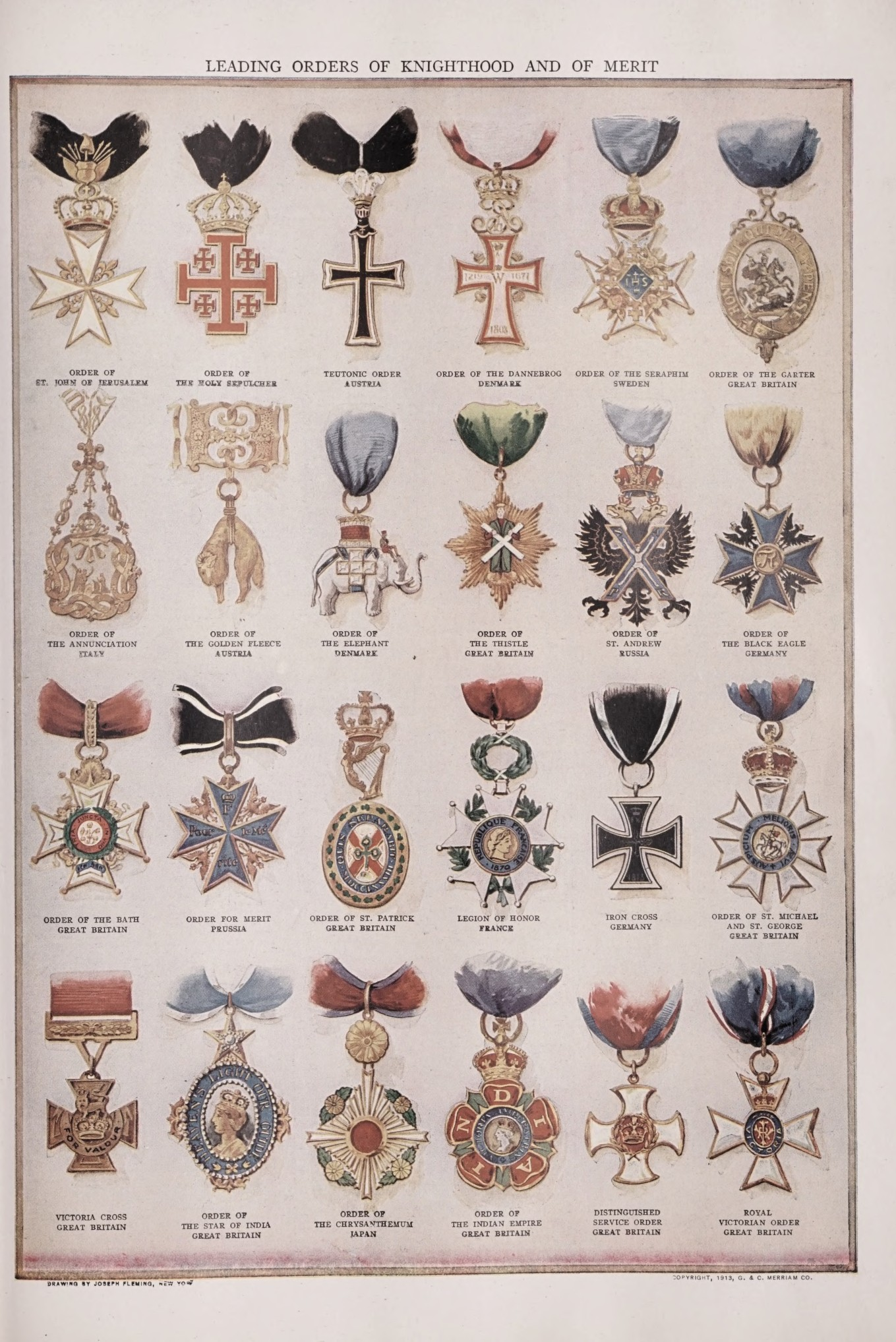
KNIGHTHOOD and CHIVALRY are two words which are nearly but not quite synonymous; that is, they may often, although they cannot always, be used precisely in the same way and exactly in the same sense. What we mean by the order of knighthood is to all intents and purposes what we mean by the order of chivalry. But in some of the more special applications of the several terms diversities in their respective significations manifest themselves. We could not, for example, say of anybody that he had received the honour of chivalry, or that he had lived in the age of knighthood. Again, we should speak of lands as held in chivalry not in knighthood, and of the rank or degree of knighthood not of chivalry. But taken together the two words knighthood and chivalry designate a single subject of inquiry, which presents itself under three different although connected and in a measure intermingled aspects. It may be regarded in the first place as a mode or variety of feudal tenure, in the second place as a personal attribute or dignity, and in the third place as a scheme of manners or social arrangements. It is under these three general aspects that the subject is to be dealt with here. For the more important religious as distinguished from the military orders of knighthood or 'chivalry the reader is referred to the headings St John (Knights of), Teutonic Knights, and Templars....
Our words knight and knighthood are merely the modern forms of the Anglo-Saxon or Old English cniht and cnihthad. Of these the primary signification of the first was a boy or youth, and of the second that period of life which intervenes between childhood and manhood. But some time before the middle of the 12th century they had acquired the meaning they still retain of the French chevalier and chevalerie. In a secondary sense cniht meant a servant or attendant answering to the German Knecht, and in the Anglo-Saxon Gospels a disciple is described as a learning cniht. In a tertiary sense the word appears to have been occasionally employed as equivalent to the Latin miles— usually translated by thegn— which in the earlier Middle Ages was used as the designation of the domestic as well as of the martial officers or retainers of sovereigns and princes or great personages. Sharon Turner suggests that cniht from meaning an attendant simply may have come to mean more especially a military attendant, and that in this sense it may have gradually superseded the word thegn. But the word thegn itself, that is, when it was used as the description of an attendant of the king, appears to have meant more especially a military attendant. As Dr Stubbs says, “the thegn seems to be primarily the warrior gesith”—the gesithas forming the chosen band of companions (comites) of the German chiefs (principes) noticed by Tacitus—“he is probably the gesith who had a particular military duty in his master’s service”; and he adds that from the reign of Athelstan “the gesith is lost sight of except very occasionally, the more importaut class having become thegns, and the lesser sort sinking into the rank of mere servants of the king.” It is pretty clear, therefore, that the word cniht could never have superseded the word thegn in the sense of a military attendant, at all events of the king. But besides the king, the ealdormen, bishops, and king’s thegns themselves had their thegns, and to these it is more than probable that the name of cniht was applied. Under the singular system of joint responsibility and suretyship which was characteristic of the Anglo-Saxon government, the practice of commendation had attained to extraordinary dimensions. He who was unattached to some superior—the lordless man—was indeed regarded as a kind of outlaw; and, if he refused or neglected to choose a lord for himself, his kindred were bound to present him to the county court and select a lord for him. Hence a relation which was for the most part merely personal, but which only required the addition of land holding—an addition, it can scarcely be doubted, sometimes made—to render it in all respects feudal, was widely and firmly established in England long before the Norman Conquest. The mutual rights and obligations of lord and man, in a far more advanced condition than they appear as between hlaford and gesith at an earlier period, were perfectly familiar to the Anglo-Saxons, and it was only in part due to the influence of the Normans that they were subsequently transformed into the mutual rights and obligations of lord and tenant. Around the Anglo-Saxon magnates were collected a crowd of retainers and dependants of all ranks and conditions; and there is evidence enough to show that among them were some called cηihtas who were not always the humblest or least considerable of their number. The testimony of Domesday also establishes the existence in the reign of Edward the Confessor of what Dr Stubbs describes as a “large class” of landholders who had commended themselves to some lord, and he regards it as doubtful whether their tenure had not already assumed a really feudal character. But in any event it is manifest that their condition was in many respects similar to that of a vast number of unquestionably feudal and military tenants who made their appearance after the Norman Conquest. If consequently the former were called cnihtas under the Anglo-Saxon régime, it seems sufficiently probable that the appellation should have been continued to the latter—practically their successors—under the Anglo-Norman régime. And if the designation of knights was first applied to the military tenants of the earls, bishops, and barons—who although they held their lands of mesne lords owed their services to the king—the extension of that designation to the whole body of military tenants need not have been a very violent or prolonged process. Assuming, however, that knight was originally used to describe the military tenant of a noble person, as cniht had sometimes been used to describe the thegn of a noble person, it would, to begin with, have defined rather his social status than the nature of his services. But those whom the English called knights the Normans called chevaliers, by which term the nature of their services was defined, while their social status was left out of considera tion. And at first chevalier in its general and honorary signification seems to have been rendered not by knight but by rider, as may be inferred from the Saxon Chronicle, wherein it is recorded under the year 1085 that William the Conqueror “dubbade his sunu Henric to ridere.” But, as Mr Freeman says, “no such title is heard of in the earlier days of England. The thegn, the ealdorman, the king himself, fought on foot; the horse might bear him to the field, but when the fighting itself came he stood on his native earth to receive the onslaught of her enemies.” In this perhaps we may behold one of the most ancient of British insular prejudices, for on the Continent the importance of cavalry in warfare was already abundantly understood. It was by means of their horsemen that the Austrasian Franks established their superiority over their neighbours, and in time created the Western empire anew, while from the word caballarius, which occurs in the Capitularies in the reign of Charlemagne, came the words for knight in all the Romance languages. In Germany the chevalier was called Ritter, but neither rider not chevalier prevailed against knight among ourselves. And it was long after knighthood had acquired its present mean ing with us that chivalry was incorporated into our language. It may be remarked too in passing that in official Latin, not only in England but all over Europe, miles held its own against both eques and caballarius.
Concerning the origin of knighthood or chivalry as it existed in the Middle Ages,—implying as it did a formal assumption of and initiation into the profession of arms,— nothing beyond more or less probable conjecture is possible. The mediaeval knights had nothing to do in the way of derivation with the “equites” of Rome, the knights of King Arthur’s Round Table, or the Paladins of Charlemagne. But there are grounds for believing that some of the rudiments of chivalry are to be detected in early Teutonic customs, and that they may have made some advance among the Franks of Gaul. We know from Tacitus that the German tribes in his day were wont to celebrate the admission of their young men into the ranks of their warriors with much circumstance and ceremony. The people of the district to which the candidate belonged were called together; his qualifications for the privileges about to be conferred upon him were inquired into; and, if he were deemed fitted and worthy to receive them, his chief, his father, or one of his near kinsmen presented him with a shield and a lance. Another custom apparently common to the Goths and the Franks was the ceremony of adoption by arms. By means of a solemn investiture with warlike weapons, the two parties to the formality or rite thenceforth acquired the artificial characters of father and son, not, as in the Roman practice of adoption, for any purpose of succession or inheritance, but in a purely honorary and complimentary manner. Selden and Du Cange concur in tracing the ceremony of “dubbing to knighthood” directly to the ceremony of the “adoptio per arma.” Among the Lombards the sons of their kings were forbidden to sit at the tables of their fathers until they had been invested with arms, and this, it is further said, by some foreign prince or potentate. But among the Franks we find, from the authorities cited by Du Cange, Charlemagne girding his son Louis the Pious, and Louis the Pious girding his son Charles the Bald with the sword, when they arrived at manhood. These cases can hardly be referred, as the Lombard usages may, to the “adoptio per arma.” Yet it is indisputable that in the investiture of Louis and Charles with the sword some ceremony was observed which was deemed worthy of record, not for its novelty, but as a thing of recognized importance. It does not follow that a similar ceremony extended to personages less exalted than the sons of kings and emperors. But if it did we must naturally suppose that it applied in the first instance to the mounted warriors who formed the most formidable portion of the warlike array of the Franks. It was among the Franks indeed, and possibly through their experiences in war with the Saracens, that cavalry first acquired the pre-eminent place which it long maintained in every European country. In early society, where the army is not a paid force but the armed nation, the cavalry must necessarily consist of the noble and wealthy, and cavalry and chivalry, as Mr Freeman observes, will be the same. Since then we discover in the Capitularies of Charlemagne actual mention of “caballarii” as a class of warriors, it may reasonably be concluded that formal investiture with arms applied to the “caballarii,” if it was a usage extending beyond the sovereign and his heir apparent. “But,” as Hallam says, “he who fought on horseback and had been invested with peculiar arms in a solemn manner wanted nothing more to render him a knight;” and so he concludes, in view of the verbal identityof “chevalier” and “caballarius,”that “we may refer chivalry in a general sense to the age of Charlemagne.” Yet, if the “caballarii” of the Capitularies are really the precursors of the later knights, it remains a difficulty that the Latin name for a knight is “miles,” although “caballarius” became in various forms the vernacular designation.
Before it was known that the chronicle ascribed to Ingulf of Croyland is really a fiction of the 13th or 14th century, the knighting of Heward or Hereward by Brand, abbot of Burgh (now Peterborough), was accepted from Selden to Hallam as an historical fact, and knighthood was supposed, not only to have been known among the Anglo-Saxons, but to have had a distinctively religious character which was contemned by the Norman invaders. The genuine evidence at our command altogether fails to support this view. When William of Malmesbury describes the knighting of Athelstan by his grandfather Alfred the Great, that is, his investiture “with a purple garment set with gems and a Saxon sword with a golden sheath,” there is no hint of any religious observance. In spite of the silence of our records, Dr Stubbs thinks that kings so well acquainted with foreign usages as Ethelred, Canute, and Edward the Confessor could hardly have failed to introduce into England the institution of chivalry then springing up in every country of Europe; and he is supported in this opinion by the circumstance that it is nowhere mentioned as a Norman innovation. Yet the fact that Harold received knighthood from William of Normandy makes it clear either that Harold was not yet a knight, which in the case of so tried a warrior would imply that “dubbing to knighthood” was not yet known in England even under Edward the Confessor, or, as Mr Freeman thinks, that in the middle of the 11th century the custom had grown in Normandy into “something of a more special meaning” than it bore in England. William of Normandy was knighted by his overlord Henry I. of France, and of the Conqueror’s sons he himself, as we have already seen, knighted Henry Beauclerc, while William Rufus was knighted by Archbishop Lanfranc.
It was under William Rufus, according to Mr Freeman, that the chivalrous and financial sides of feudalism sprang together into sudden prominence in England—the first as represented by the Red King, and the second as represented by his minister Ranulf Flambard.
In one sense tenure in chivalry was practically coextensive with European feudalism, while in another sense it was strictly speaking peculiar to England after the Norman Conquest, and Ireland after the English Conquest. We have no earlier information of the details of the feudal organization of Normandy than we have of the feudal organization of England, and therefore it is impossible to say how far the second was copied from the first, or the first assimilated to the second. But at all periods there was apparently sufficient difference between the Norman “fief de hauberc” and the English knight’s fee to prevent the one from being pronounced in the proper meaning of the term the counterpart of the other. Into Ireland, however, the English system of tenures was imported without change of conditions. But the process of feudalization commenced in England under William I. was only completed under Henry II., and at the time of the subjugation of Ireland there was already established a distinction between the feudal arrangements which had been made before and after the death of Henry I., as the “old” and the “new” feoffments. That Henry H.’s method of dealing with the conquered lands of Ireland was an exact imitation of William I.’s method of dealing with the conquered lands in England cannot therefore be assumed. But both kings had at their disposal a large extent of territory which they granted to their vassals on terms necessarily very similar. In the reign of Henry II. the knight’s fee was what may be called the “unit” of the system of tenures which had grown up in England since the Norman Conquest. In the Modus Tenendi Parliament for instance, a treatise which pretended to date from the 11th and which really dates from the 14th century, it is laid down that an earldom consisted of twenty knights’ fees, and that a barony consisted of thirteen and a third knights’ fees, a statement which seems to have been accepted without misgiving until it was refuted by Selden. It is, however, beyond question that some, although not all, of the feudal services and obligations of the tenants of earldoms and baronies were determined by the number of the knights’ fees which they comprised. It was certainly not a fixed number, for it varied in every or nearly every recorded example. But it was in each instance a specified number, by which the earl’s or baron’s military contribution to the king’s army was settled and the amerciaments payable in the event of its being absent or incomplete were computed. Hallam is inclined to attribute the invention of what he terms the “reasonable and convenient” principle of the knight’s fee to the administrative genius of William the Conqueror. But Domesday proves that at the time when the survey was made nothing approaching to a regular distribution of the country into knights’ fees had been attempted. On two occasions indeed the expression “servitium unius militis,” which was afterwards the technical designation of a knight’s fee in legal phraseology, is employed. But even the word “miles” had not as yet acquired the special meaning which was subsequently assigned to it. Among the “milites” of Domesday are persons of very various conditions, from ordinary soldiers and the inferior tenants of manors to Hamo the sheriff and the earl of Eu. But when the returns contained in the Black Book o( the Exchequer were made in the reign of Henry II., both the principle and system of knights’ fees were fully and definitively established. Hence this change must have been effected in the interval between the compilation of these two records. It cannot be supposed that the numerous grants of land made by William I. to his adherents were exempt from military obligation of one kind or another. But no original grant of his or of either of his immediate successors to any lay vassal is in existence to inform us what the exact nature of those military obligations was; and, arguing from the grants to various ecclesiastical vassals, Dr Stubbs regards it as unlikely that such gifts were made on any expressed condition or accepted with a distinct pledge to provide a certain contingent of knights for the king’s service. Before the Norman Conquest, he contends, all landholders having been bound to the duty of national defence, and a certain quantity of land having customarily furnished a fully armed man, the old rate of military obligation was in all probability continued in the case of the new grantees after the Conquest. Nothing in Domesday implies that the conditions of military service differed under the old and the new monarchy, and hence Dr Stubbs concludes that “the form in which knights’ fees appear when called on by Henry II. for scutage was most probably the result of a series of compositions by which the great vassals relieved their lands from a general burden by carving out particular estates the holders of which performed the services due from the whole; it was a matter of convenience and not of tyrannical pressure.” And, although Selden, and Madox after him, adhere to the common and ancient tradition that William the Conqueror made his grants conditional on the service of some particular number of knights in every case, they substantially agree in regarding the knight’s fee in its special meaning as the consequence of subinfeudation. From the reign of Henry II. to the reign of Edward I., indeed, what may be called grants in gross from the king and grants in detail from the mesne lords were the ordinary methods of erecting knights’ fees and providing for the discharge of the personal and pecuniary obligations with which they were burdened.
Although the feudal services and incidents of a knight’s fee appear to have been ascertained with perfect clearness, the exact nature of a knight’s fee itself—what it was or in what it consisted—has been the subject of a great deal of controversy. As the demands both personal and pecuniary which were made on the holder of each knight’s fee were uniform, it is reasonable to conclude that all such fees were in some way equivalent to one another. But whether their equivalence was inferred from the quantity of land they contained or from the amount of revenue derived from them has been much debated, and cannot be said to be even now finally settled. Selden, indeed, roundly affirms that “the legal value of knights’ fees was never in truth estimable either by any certain number of acres or quantity of revenue (though some have erroneously determined them by both), but only by the services or number of knights reserved.” But if this were the case it is difficult to understand how parts of a knight’s fee such as a half or a third could have been held, as they unquestionably were held, under reduced burdens calculated in proportion to the full burdens of a whole knight’s fee. According to the analogies of the Anglo-Norman policy in other departments of its manifestation, it might have been expected with some degree of confidence that the knight’s fee would have been a combination...
9th ed. Encyclopædia Britannica, vol. 14, p. 110
[19,747 words — estimated reading time: 1.9 hours]
[19,747 words — estimated reading time: 1.9 hours]
Nobility Roget’s Thesaurus §875
N. nobility, rank, condition, distinction, optimacy, blood, pur sang, birth, high descent, order, quality, gentility, blue blood of castile, ancien regime, high life, haute monde, upper classes, upper ten thousand, the four hundred, elite, aristocracy, great folks, fashionable world, peer, peerage, house of lords, house of peers, lords, lords temporal and spiritual, noblesse, noble, nobleman, lord, lordling, grandee, magnifico, hidalgo, daimio, daimyo, samurai, shizoku, don, donship, aristocrat, swell, three-tailed bashaw, gentleman, squire, squireen, patrician, laureate, gentry, gentlefolk, *squirarchy, better sort magnates, primates, optimates, pantisocracy, king, atheling, prince, duke, marquis, marquisate, earl, viscount, baron, thane, banneret, baronet, baronetcy, knight, knighthood, count, armiger, laird, signior, seignior, esquire, boyar, margrave, vavasour, emir, ameer, scherif, sharif, effendi, wali, sahib, chevalier, maharaja, nawab, palsgrave, pasha, rajah, waldgrave, princess, begum, duchess, marchioness, countess &c, lady, dame, memsahib, dona, maharani, rani, personage of distinction, man of distinction, personage of rank, man of rank, personage of mark, man of mark, notables, notabilities, celebrity, bigwig, magnate, great man, star, superstar, big bug, big gun, great gun, gilded rooster*, magni nominis umbra, "every inch a king"
V. be noble
Adj. noble, exalted, of rank, princely, titled, patrician, aristocratic, high-, well-born, of gentle blood, genteel, comme il faut, gentlemanlike, courtly, highly respectable
Adv. in high quarters
Phr. adel sitzt im gemuthe nicht im gebluete, adelig und edel sind zweierlei, noblesse oblige
Title Roget’s Thesaurus §877
N. title, honor, knighthood, highness, excellency, grace, lordship, worship, reverence, reverend, esquire, sir, master, mr, signor, senor, mein herr, mynheer, your honor, his honor, serene highness, handle to one's name, decoration, laurel, palm, wreath, garland, bays, medal, ribbon, riband, blue ribbon, cordon, cross, crown, coronet, star, garter, feather, feather in one, s cap, epaulet, epaulette, colors, cockade, livery, order, arms, shield, scutcheon, reward
No Bible verses found for "KNIGHTHOOD".