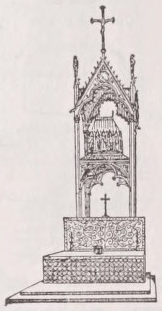
2. BALD'AQUIN, noun In architecture, a building in form of a canopy, supported by columns, and often used as a covering to insulated altars; sometimes used for a shell over a door.
2. A structure in form of a canopy, sometimes supported by columns, and sometimes suspended from the roof or projecting from the wall; generally placed over an altar; as, the baldachin in St. Peter's.
BALDE, Jakob, a modern Latin poet of considerable repute, was born at Ensisheim in Alsace in 1603, and died in 1668. He entered the Society of the Jesuits in 1624, and for the greater part of his life acted as court-preacher and professor of rhetoric at Munich. His Latin poems were very numerous, and those in imitation of Horace are particularly successful. Although Balde has received some attention since Herder translated several of his best pieces, and although some of his poems are by no means deficient in lightness, grace, and skilful versification, it would be a mistake to look upon him as a poet of high rank. A collected edition of his works in 4 vols, was published at Cologne in 1650; a more complete edition in 8 vols.,.at Munich, 1729. Extracts have been given by Orelli, 1805, 1818; and some detached poems have been published by various editors.
9th ed. Encyclopædia Britannica, vol. 3, p. 274 [152 words — estimated reading time: 1 minute]
BALDI, Bernardino, a distinguished mathematician and miscellaneous writer, was descended of a noble family at Urbino, in which city he was born on the 6th of June 1533. He pursued his studies at Padua with extraordinary zeal and success, and is said to have acquired, during the course of his life, no fewer than sixteen languages, though according to Tiraboschi, the inscription on his tomb limits the number to twelve. The appearance of the plague at Padua obliged him to retire to his native city, whence he was, shortly afterwards, called to act as tutor to Ferrante Gonzaga, from whom he received the rich abbey of Guastalla. He held office as abbot for twenty-five years, and then retired to his native town. In 1612 he was employed by the duke as his envoy to Venice, where he distinguished himself by the congratulatoryoration ho delivered before the Venetian senate on the election of the new doge, Andrea Memmo. Baldi died at Urbino on the 12 th of October 1617. He was, perhaps, the most universal genius of his age, and is said to have written upwards of a hundred different works, the chief part of which have remained unpublished. His various works give satisfactory evidence of his abilities as a theologian, mathematician, geographer, antiquary, historian, and poet. The Cronica dei Afatematici is an abridgment of a larger work, on which he had bestowed twelve years of labour, and which was intended to contain the lives of more than two hundred mathematicians. His life has been written by Affo, Mazzuchelli, and others.
9th ed. Encyclopædia Britannica, vol. 3, p. 274 [262 words — estimated reading time: 2 minutes]
BALDINGER, EbnestGottfried, a German physician of considerable eminence, and the author of a great number of medical publications, was born near Erfurt, 13th May 1738. He studied medicine at Erfurt, Halle, and Jena, and in 1761 was intrusted with the superintendence of the military hospitals connected with the Prussian encampment near Torgau. He published, in 1765, a dissertation on the diseases of soldiers, which met with so favourable a reception that he published an enlarged edition, under the title of Treatise on the Diseases that prevail in Armies, Langensalza, 1774, 8vo. In 1768 he became professor of medicine at Jena, whence he removed, in 1773, to Göttingen, and in 1785 to Marburg, where he died of apoplexy on the 21st of January 1804. Among his pupils were Akermann. Sömmering, and Blumenbach. Some eighty-four separate treatises are mentioned as having proceeded from his pen, in addition to numerous papers scattered through various collections and journals.
9th ed. Encyclopædia Britannica, vol. 3, p. 275 [157 words — estimated reading time: 1 minute]
BALDINUCCI, Filippo, a distinguished Italian writer on the history of the arts, was born at Florence about 1624, and died in 1696. His chief work is entitled Notizie de Professori del Disegno da Cimabue in quà (dal 1260 sino al 1670), and was first published, in six vols. 4to, 1681-1728. The capital defect of this work is the attempt to derive all Italian art from the schools of Florence. A good edition is that by Ranalli (5 vols. 8vo, Florence, 1845-47). Baldinucci’s whole works have been published in fourteen vols, at Milan, 1808-12.
9th ed. Encyclopædia Britannica, vol. 3, p. 275 [97 words — estimated reading time: 1 minute]
is a natural effect of old age, in which period of life the hair of the head, wanting nourishment, falls off, and leaves the head naked. Artificial baldness was used as a token of mourning; it is threatened to the voluptuous daughters of Israel, instead of well set hair, Isaiah iii, 24. See Mic. i, 16; and instances of it occur, Isaiah xv, 2; Jer. xlvii, 5. See Ezek, vii, 18; Amos viii, 10.
The insult offered to Elisha by the young people of Bethel, improperly rendered “little children,” who cried out after him, “Go up, thou bald head,” may here be noticed. The town of Bethel was one of the principal nurseries of Ahab’s idolatry, and the contempt was offered to Elisha in his public character as a prophet of the Lord. If in the expression, “Go up,” there was also a reference to the translation of Elijah, as turning it into jest, this was another aggravation of the sin, to which these young people were probably instigated by their parents. The malediction laid upon them by the prophet was not an act of private resentment, but evidently proceeded from prophetic impulse.
BALDOVINETTI, Alessio, was a distinguished painter of Florence in the 15th century, whose works have now become very scarce. Hogarth takes him as a type of those obscure artists to whom the affected amateurs of his time were wont to ascribe old paintings—“, Tis a fine piece of Alessio Baldovinetti, in his third manner.” His father, Baldovinetti, belonged to a merchant family of good standing and fortune. Alessio was born in 1422, and took to painting, according to Vasari, against his father’s desire. His art was distinguished rather for study than for genius. It represents completely some of the leading characters of the Florentine school in that age. It was an age of diligent schoohng and experiment, in which art endeavoured to master more of the parts and details of nature than she had mastered heretofore, and to improve her technical means for their representation. Among the parts of nature especially studied in the 15th century, were landscape and natural history, the particulars of scenery, and the characters of birds, beasts, and plants. Alessio Baldovinetti surpassed all his contemporaries in attention to these matters. In Vasari’s words, you see in his paintings “rivers, bridges, stones, grasses, fruits, roads, fields, cities, castles, arenas, and an infinity of suchlike things.” From this quality of his art it has been guessed, without sufficient cause, that he was the pupil of Paolo Uccelli, the first Florentine master who devoted himself to such matters. For the rest, this extreme care and minuteness renders his manner somewhat hard. Like many other painters of his time, he treats draperies, hair, and Buch parts, with a manner that shows the influence of the goldsmith, and is more proper to metal work than to painting. His principal extant works ...are a nativity in the church of the Annunziati, an altar-piece, No. 24, in the gallery of the Uffizi, and another, No. 2, in the gallery of ancient pictures in the Academy of Arts at Florence. The great work of his Hfe was a series of frescoes from the Old Testament in the chapel of the Gιanfigliazzi family in the church of Sta Trinita, containing many interesting contemporary portraits; but these were destroyed about 1760. He also designed a likeness of Dante for the cathedral of Florence in 1465. His technical experiments were of the same nature as those made by his contempo raries—Pesellino, Pollaiuolo, and Domenico Venizianυ, who endeavoured to find out an oil medium at Florence before Antonello da Messina had brought to Venice the secrets of the Flemish practice. Vasari relates how Alessio thought he had made a great discovery with the mixture of yolk of egg and heated vemice liquida, but how the work so painted presently became discoloured. He understood mosaic as well as painting, and between 1481 and 1484 was engaged in repairing ancient mosaics, first in the church of San Miniato, next in the baptistery at Florence. He is said to have instructed Dominico Ghirlandaio (see Bigordi) in this art. He died on the 29th of August 1499, within two years and a half of the completion of his frescoes in the Gianfigliazzi chapel. (Vasari, ed. Lemonnier, vol. iv. pp. 101-107; Crowe and Cavalcaselle, Hist, of Painting in Italy, vol. ii. pp. 372-381.) (s. c.)
9th ed. Encyclopædia Britannica, vol. 3, p. 275 [549 words — estimated reading time: 4 minutes]
Adj.divested, bare, naked, nude, undressed, undraped, denuded, exposed, in dishabille, bald, threadbare, ragged, callow, roofless, in a state of nature, in nature's garb, in the buff, in native buff, in birthday suit, in puris naturalibus, with nothing on, stark naked, stark raving naked, bald as a coot, bare as the back of one's hand, out at elbows, barefoot, bareback, barebacked, leafless, napless, hairless
V.weary, tire, bore, bore to death, weary to death, tire to death, bore out of one's skull, bore out of one's life, weary out of one's life, tire out of one's life, bore out of all patience, weary out of all patience, wear out one's patience, tire out of all patience, set to sleep, send to sleep, buttonhole, pall, sicken, nauseate, disgust, harp on the same string, drag its slow length along, drag its weary length along, never hear the last of, be tired of, be sick of, be tired with, yawn, die with ennui, mego, my eyes glaze over
Even these of them ye may eat; the locust after his kind, and the bald locust after his kind, and the beetle after his kind, and the grasshopper after his kind.
Then the priest shall look upon it: and, behold, if the rising of the sore be white reddish in his bald head, or in his bald forehead, as the leprosy appeareth in the skin of the flesh;
The priest is to examine him, and if the swelling of the infection on his bald head or forehead is reddish-white like a skin disease,
And he went up from thence unto Bethel: and as he was going up by the way, there came forth little children out of the city, and mocked him, and said unto him, Go up, thou bald head; go up, thou bald head.
From there, Elisha went up to Bethel, and as he was walking up the road, a group of boys came out of the city and jeered at him, chanting, “Go up, you baldhead! Go up, you baldhead!”
And it shall come to pass, that instead of sweet smell there shall be stink; and instead of a girdle a rent; and instead of well set hair baldness; and instead of a stomacher a girding of sackcloth; and burning instead of beauty.
Instead of fragrance there will be a stench; instead of a belt, a rope; instead of styled hair, baldness; instead of fine clothing, sackcloth; instead of beauty, shame.
He is gone up to Bajith, and to Dibon, the high places, to weep: Moab shall howl over Nebo, and over Medeba: on all their heads shall be baldness, and every beard cut off.
Dibon goes up to its temple to weep at its high places. Moab wails over Nebo, as well as over Medeba. Every head is shaved, every beard is cut off.
Both the great and the small shall die in this land: they shall not be buried, neither shall men lament for them, nor cut themselves, nor make themselves bald for them:
“Both great and small will die in this land. They will not be buried or mourned, nor will anyone cut himself or shave his head for them.
And they shall make themselves utterly bald for thee, and gird them with sackcloth, and they shall weep for thee with bitterness of heart and bitter wailing.
Son of man, Nebuchadrezzar king of Babylon caused his army to serve a great service against Tyrus: every head was made bald, and every shoulder was peeled: yet had he no wages, nor his army, for Tyrus, for the service that he had served against it:
“Son of man, Nebuchadnezzar king of Babylon caused his army to labor strenuously against Tyre. Every head was made bald and every shoulder made raw. But he and his army received no wages from Tyre for the labor they expended on it.
And I will turn your feasts into mourning, and all your songs into lamentation; and I will bring up sackcloth upon all loins, and baldness upon every head; and I will make it as the mourning of an only son, and the end thereof as a bitter day.
I will turn your feasts into mourning and all your songs into lamentation. I will cause everyone to wear sackcloth and every head to be shaved. I will make it like a time of mourning for an only son, and its outcome like a bitter day.
Make thee bald, and poll thee for thy delicate children; enlarge thy baldness as the eagle; for they are gone into captivity from thee.
Shaveyourselves bald and cut off your hair in mourning for your precious children; make yourselves as bald as an eagle, for they will go from you into exile.
This site uses cookies to remember your display preferences (search sources and editions, Bible version, auto-link, images, light/dark theme). No personal data whatsoever is collected. Privacy Policy