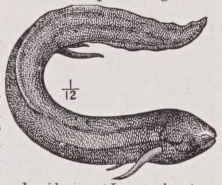
An eel-shaped ganoid fish of the order Dipnoi, having both gills and lungs. It inhabits the rivers of South America. The name is also applied to a related African species (Protopterus annectens). The lepidosirens grow to a length of from four to six feet. Called also doko.
LEPIDOSIREN is the name of one of the most remarkable genera of fishes, of which one species (Lepidosiren paradoxa) has been found in tributaries of the river Amazon, and the other (Lepidosiren annectens) occurs in the systems of all the large rivers of tropical Africa. The latter species differs in some points, notably in having six instead of five branchial arches, from L. paradoxa, and therefore has been generically separated by Owen under the name of Prοtopterus,— which name likewise is in common use. Together with the Australian Ceratodus, the lepidosirens are the only living representatives of a very old type of fishes, the Dipnoi, which reaches back to the Devonian age, thus giving us an insight into the organization of fishes of which nothing but some obscure and fragmentary impressions of the hard parts are preserved. The body of Lepidosiren is eel-shaped, and covered with small thin scales. A single vertical fin surrounds the posterior part of the body and the tail; the paired fins are reduced to two pairs of long threads, internally supported by a series of small cartilages. The dentition is very characteristic, and consists of a pair of conical pointed vomerine teeth, and a pair of large cuspidate and ribbedmolar teeth on the palate and in the lower jaw. The skeleton is notochordal; and lungs are present in addition to gills. From this latter fact it may be inferred that the lepidosirens can breathe air as well as water; and, although they have never been observed to leave the water voluntarily, either in a state of nature or in captivity, they rise from time to time to the surface to fill their lungs with a fresh supply of air; further, when, during the hot season, the water of the tanks in which they live changes into mud, branchial respiration is ...entirely superseded by pulmonal. Of the habits of Lepidosiren paradoxa scarcely anything is known; only a few specimens have been found by naturalists, and neither Bates nor Wallace succeeded in obtaining one. This species, therefore, is one of the greatest desiderata in zoological museums. The African species, on the other hand, is common in the upper Nile, in the central lake-region, on the Zambesi, and in all the rivers of the west coast. Baker states that in some districts of central Africa the lepidosiren is so abundant as to form an article of food, fresh and dried. Specimens living in pools which dry up during the hot season bury themselves in the mud, and form an oval cavity, the inside of which is lined with a protecting coat of hardenedmucus, and in which they wait, coiled up and in a torpid condition, for the return of the rainy season. These retreats are discovered by the natives by a circular opening at the upper surface, which is closed by the mucous film. If the capsules are not broken, the fishes, imbedded in the clayballs, can be transported to Europe, and emerge from their prison on being placed in tepid water. Both species attain to a length of 6 feet, and feed on frogs, fishes, and other of aquatic animals, For the details of the organization the Lepidosiren see the article Ichthyology.
9th ed. Encyclopædia Britannica, vol. 14, p. 468 [540 words — estimated reading time: 4 minutes]
No thesaurus entries found for "Lepidosiren".
No Bible verses found for "Lepidosiren".
This site uses cookies to remember your display preferences (search sources and editions, Bible version, auto-link, images, light/dark theme). No personal data whatsoever is collected. Privacy Policy