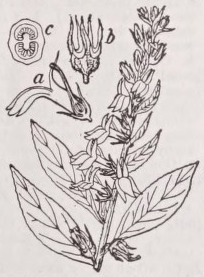
A genus of plants, including a great number of species. Lobelia inflata, or Indian tobacco, is an annual plant of North America, whose leaves contain a poisonous white viscid juice, of an acrid taste. It has often been used in medicine as an emetic, expectorant, etc. L. cardinalis is the cardinal flower, remarkable for the deep and vivid red color of its flowers.
LOBELIA, L., the typical genus of the tribe Lobelieae, of the order Campanulaceae, named after Matthias de Lobel, a native of Lille, botanist and physician to James I. It numbers about two hundred species, natives of nearly all the temperate and warmer regions of the world, excepting central and eastern Europe as well as western Asia. For the sections into which the genus is divided, see Genera Plantarum, by Bentham and Hooker, vol. ii. p. 551; and for species, De C., Prod., vii. p. 357. Two species are British, L. Dortmanna, L., named after Dortmann, a Dutch druggist, which occurs in gravelly mountain lakes; and L. urens, L., which is only found on heaths, àc., near Axminster (see Baxter’s Brit. Gen,, No. 79). The genus is distinguished from Campanula by the irregular corolla and completely united anthers, and by the excessive acridity of the milky juice. The species earliest described and figured appears to be L. cardinalis, L., under the name Trachelium americanum sive cardinalis planta, “the rich crimson cardinal’s flower”,· Parkinson {Paradisus, 1629, p. 356) says, “it groweth neere the riuer of Canada, where the French plantation in America is seated”; De Candolle records it from New England to Carolina {Prod., vii. 382). This species, as well as several others, are in cultivation as ornamental garden plants, e.g., the dwarf blue E. Ervnus, L, from the Cape, which, with its varieties, forms a familiar Bedding plant. L. splendens, Willd., and L. folgens, Willd., growing from 2 to 4 feet high, from Mexico, have scarlet flowers; while L. amoena, Mich., from North America, as well as L. syphilitica, L., and its hybrids, from Virginia, have blue flowers. The last-named was introduced in 1665, according to Paxton {Bot. Diet., p. 340), but is not mentioned ...by Parkinson. Certain species of lobelia are used medicinally, the chief being L. inflata, L., a native of north-eastern America, called “Indian tobacco,” as its effects are very similar to those of tobacco; for its localities, &c., see Pickering, Chrom Hist, of Ph, p. 1015. It is expectorant and diaphoretic in small doses, but in full medicinal doses is nauseating and emetic. It is used for spasmodicasthma, and as an adjunct to diuretics. See Bentley and Trimen’s Med. Pl., No. 162; Pharmacographia, p. 357; and Pereira’s Mat. Med., vol. ii. pt. ii. p. 8. For active principles, see Pharm. Jourm, vol. x. pp. 270, 456. Another medicinal species is L. syphilitica, L., the blue cardinal, of which the root is used by the North American Indians for the purpose implied in the specific name. The value, however, is said to have no foundation in fact (Pearson, Obs. on var. Art. of Mat. Med., p. 70), but see Amer. Dispens., p. 494. A third species is L. decurrens, Cav., from near Arequipa in Peru, where the Indians use it as an emetic {Pharm. Jourm [1], vol. xiii. p. 14).
9th ed. Encyclopædia Britannica, vol. 14, p. 743 [490 words — estimated reading time: 3 minutes]
Of or pertaining to a natural order of plants of which the genus Lobelia is the type.
No thesaurus entries found for "Lobelia".
No Bible verses found for "Lobelia".
This site uses cookies to remember your display preferences (search sources and editions, Bible version, auto-link, images, light/dark theme). No personal data whatsoever is collected. Privacy Policy