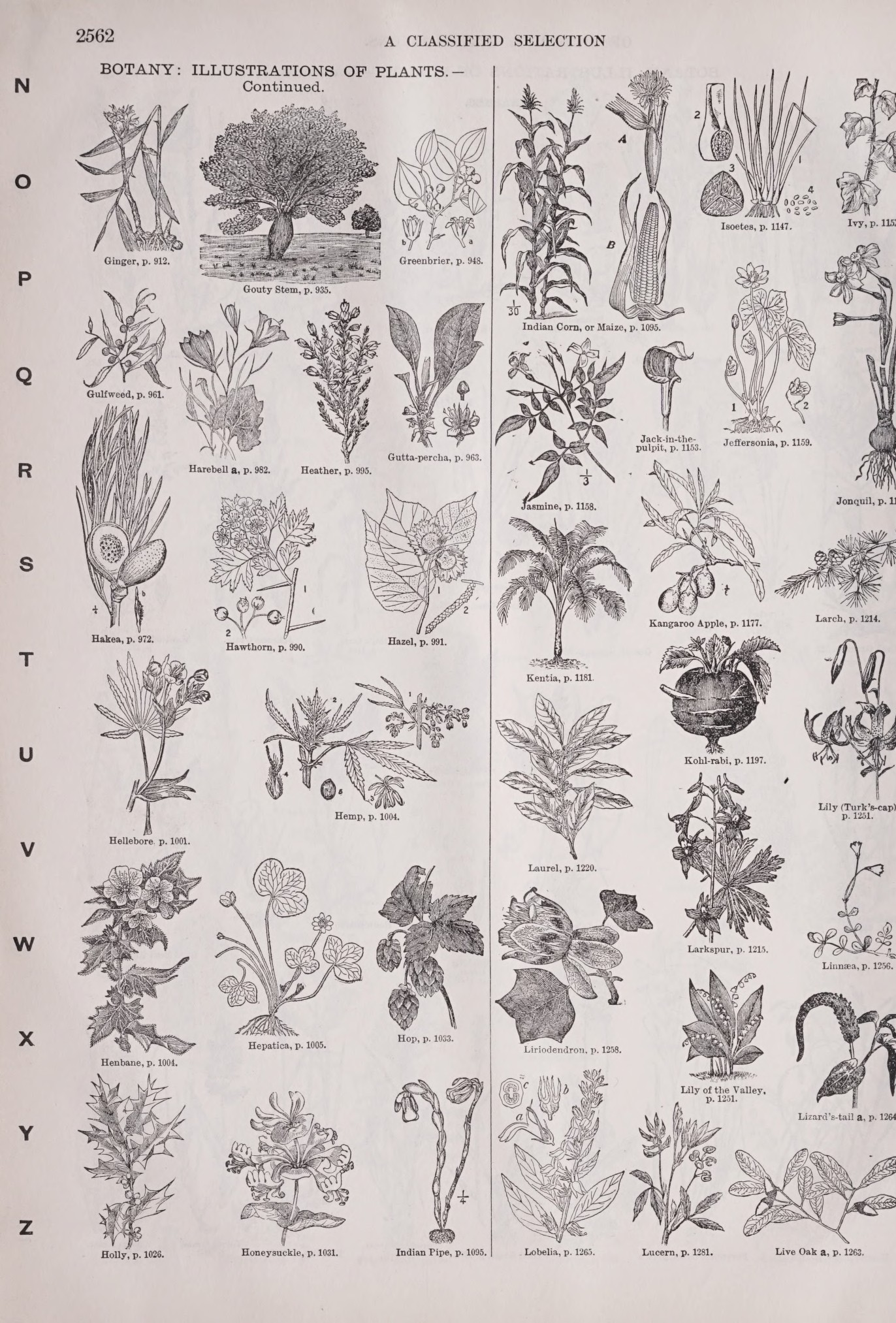
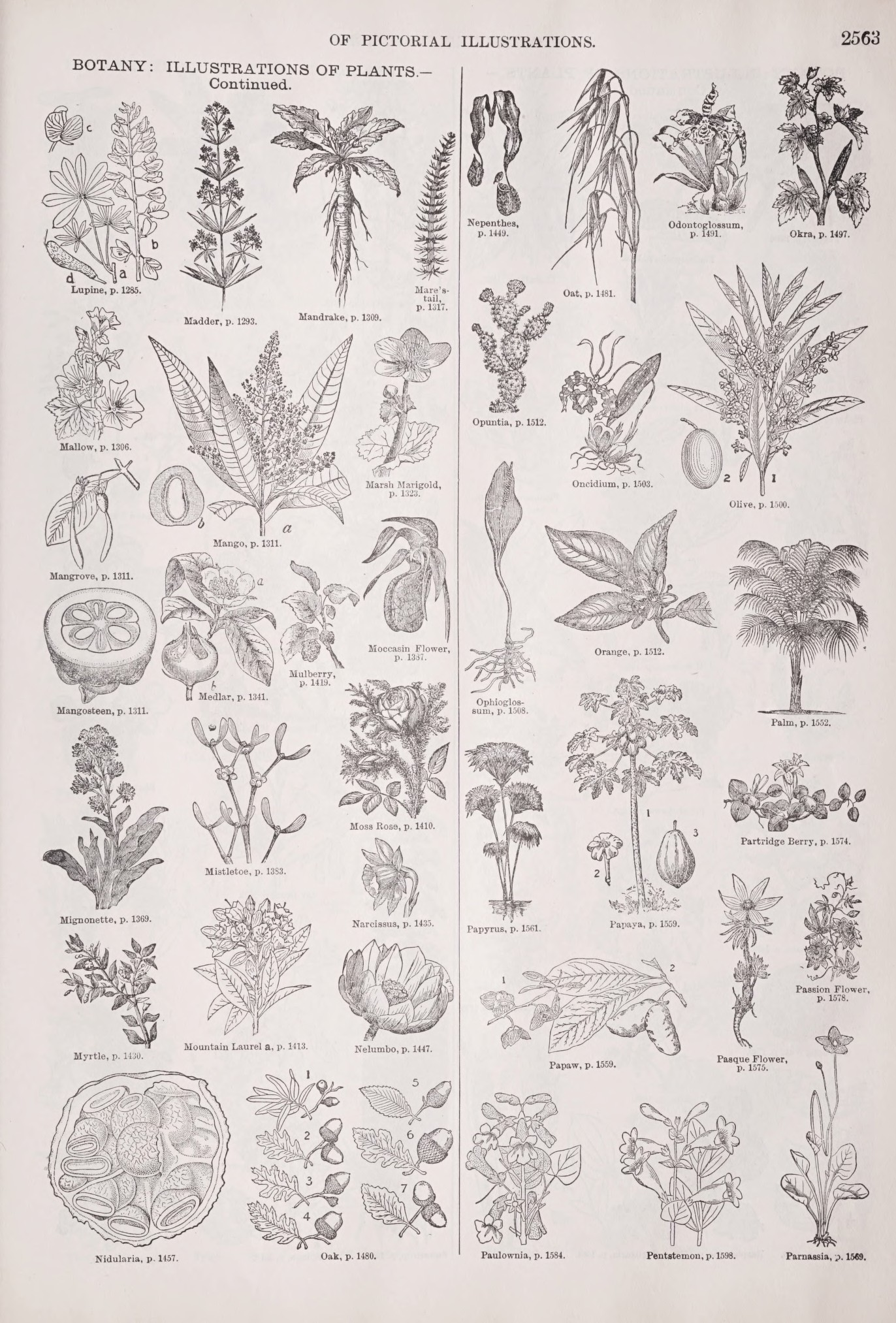
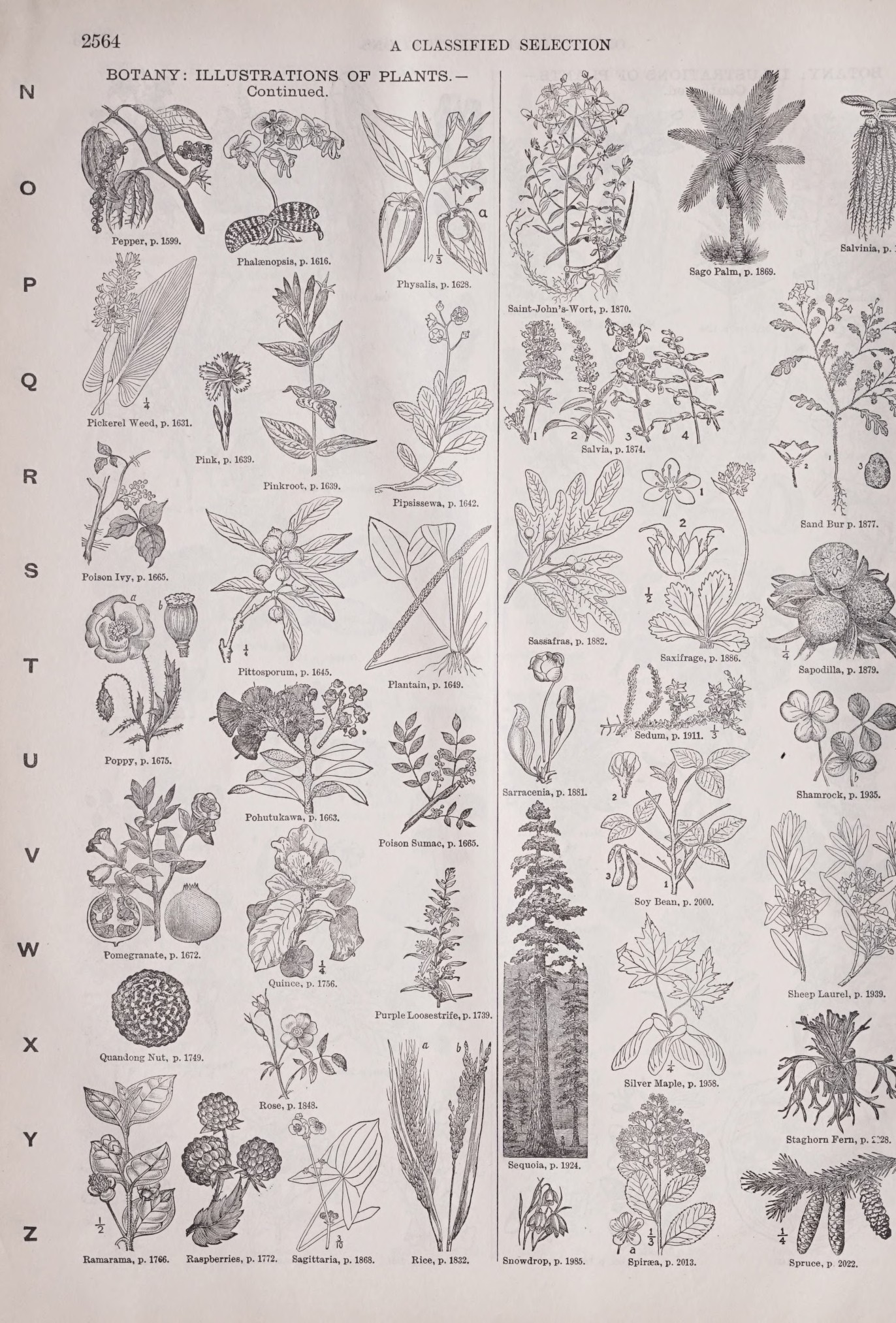
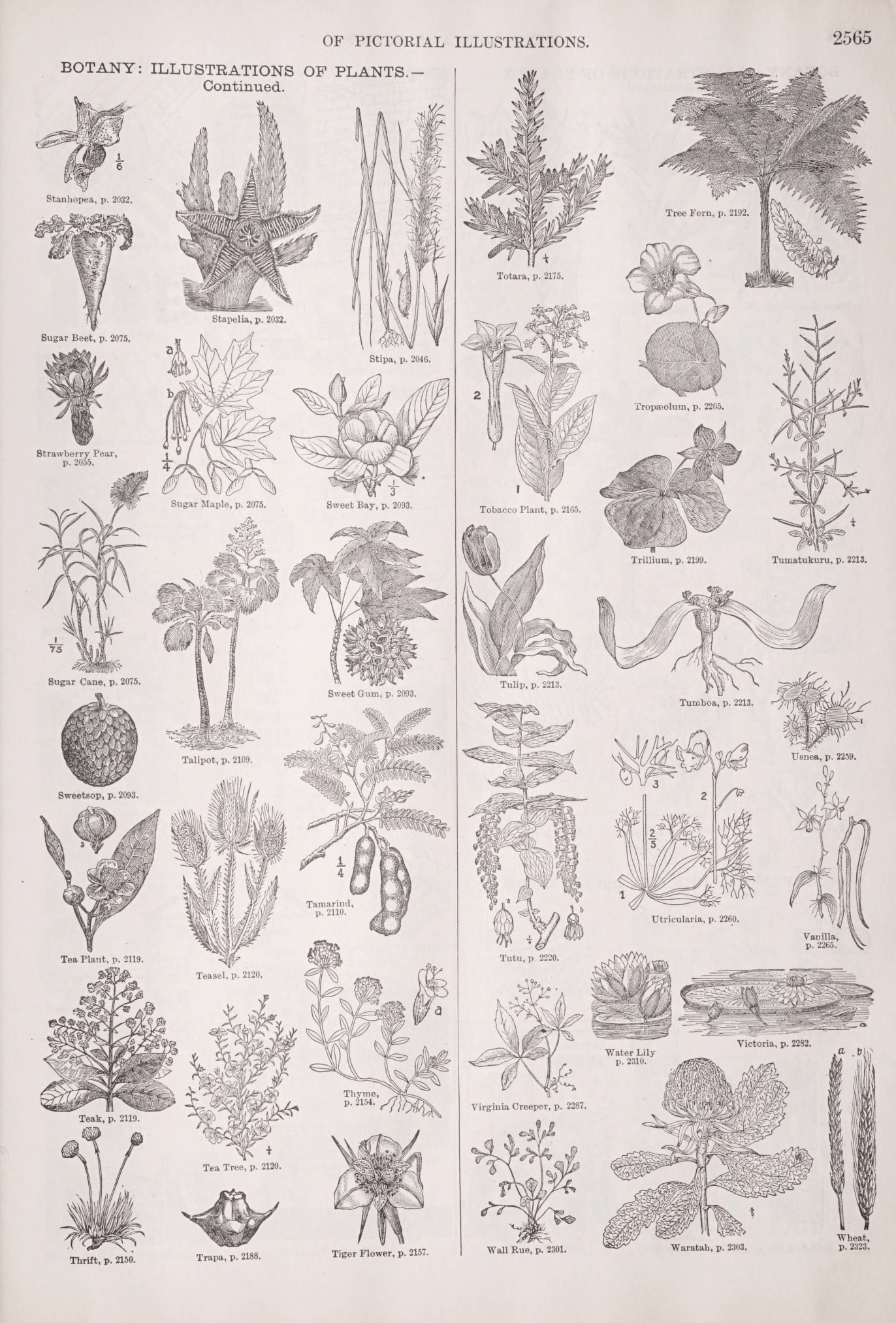
BOT . [ See Bots .]
Word of the Day: Catachrestical
Pertaining to botany; relating to plants in general; also, containing plants, as a botanic garden.
Of or pertaining to botany; relating to the study of plants; as, a botanical system, arrangement, textbook, expedition.
According to the system of botany.
1. One skilled in botany; one versed in the knowledge of plants or vegetables, their structure, and generic and specific differences.
2. The botanist is he who can affix similar names to similar vegetables, and different names to different ones, so as to be intelligible to every one.
One skilled in botany; one versed in the knowledge of plants.
1. To seek for plants; to investigate the vegetable kingdom; to study plants.
2. He could not obtain permission to botanize upon mount Sabber.
To seek after plants for botanical investigation; to study plants.
One who botanizes.
of Botanize
A botanist.
A discourse upon plants.
The science of botany.
An ancient species of divination by means of plants, especially sage and fig leaves. Persons wrote their names and questions on leaves, which they exposed to the wind, and as many of the letters as remained in their places were taken up, and being joined together, contained an answer to the question.
An ancient species of divination by means of plants, esp. sage and fig leaves.
1. That branch of natural history which treats of vegetables; a science which treats of the different plants, and of the distinguishing marks by which each individual species may be known from every other.
2. Or, botany is the science of the structure, functions, properties, habits and arrangement of plants, and of the technical characters by which they are distinguished.
1. The science which treats of the structure of plants, the functions of their parts, their places of growth, their classification, and the terms which are employed in their description and denomination. See Plant.
2. A book which treats of the science of botany.
Botany
Encyclopedia Britannica
BOTANY
THE science of Botany includes everything relating to the Vegetable Kingdom, whether in a living or in a fossil state. Its object is not, as some have supposed, merely to name and arrange the vegetable productions of the globe. It embraces a consideration of the external forms of plants —of their anatomical structure, however minute—of the functions which they perform—of their arrangement and classification—of their distribution over the globe at the present and at former epochs—and of the uses to which they are subservient. It examines the plant in its earliest state of development, when it appears as a simple cell, and follows it through all its stages of progress until it attains maturity. It takes a comprehensive view of all the plants which cover the earth, from the minutest lichen or moss, only visible by the aid of the microscope, to the most gigantic productions of the tropics. It marks the relations which subsist between all members of the vegetable world, and traces the mode in which the most despised weeds contribute to the growth of the mighty denizens of the forest....
The plants which adorn the globe more or less in all countries must necessarily have attracted the attention of mankind from the earliest times. The science that treats of them dates back to the days of Solomon, for that wise monarch “spake of trees,” from the cedar of Lebanon to the hyssop on the wall. The Chaldeans, Egyptians, and Greeks were the early cultivators of science, and Botany was not neglected, although the study of it was mixed up with crude speculations as to vegetable life, and as to the change of plants into animals. Aescu- )dpius and his priests, the Asclepiades, who studied the art of medicine, had their attention directed to plants in a pharmaceutical point of view. About 300 years before Christ Theophrastus wrote a History of Plants, and described about 500 species used for the treatment of diseases. Dioscorides, a Greek writer, who appears to have flourished about the time of Nero, issued a work on Materia Medica. The elder Pliny described about a thousand plants, many of them famous for their medicinal virtues. Asiatic and Arabian writers also took up this subject. Little, however, was done in the science of botany, properly so called, until the 16th century of the Christian era, when the revival of learning dispelled the darkness which had long hung over Europe. Brunfels, a physician of Bern, has been looked upon as the restorer of the science in Europe. He published a History of Plants, illustrated by figures, about the beginning of the 16th century.
One of the earliest attempts at a methodical arrangement of plants was made in Florence by Andreas Caesalpinus, a native of Arezzo, some time professor of botany at Padua, and afterwards physician to Pope Clement VIII. He is called by Linnaeus primus vents systematic™. In his work De Plantis, published at Florence in 1583, he distributed the 1520 plants then known into fifteen classes— the distinguishing characters being taken from the fruit.
John Ray, a native of Essex, did much to advance the science of botany. He was born in 1628, and died in 1705. He promulgated a system which may be considered as the dawn of the “natural system” of the present day (Ray, Methodus Plantarum, 1682). He separated flowering from flowerless plants, and divided the former into Dicotyledons and Monocotyledons. His orders were founded on a correct idea of the affinities of plants, and he far outstripped his contemporaries in his enlightened views of arrangement.
About the year 1670 Dr Robert Morison of Aberdeen published a systematic arrangement of plants. He divided them into eighteen classes, distinguishing plants according as they were woody or herbaceous, and taking into account the nature of the flowers and fruit. In 1690 Rivinus promulgated a classification founded chiefly on the forms of the flowers. Tournefort about the same time took up the subject of vegetable taxonomy. He was a contemporary of Ray, and was professor of botany at Paris in 1683. He was long at the head of the French school of botany, and published a systematic arrangement in 1694-1700. He described about 8000 species of plants, and distributed them into twenty-two classes, chiefly according to the form of the corolla, distinguishing herbs and under-shrubs on the one hand from trees and shrubs on the other. The system of Tournefort was for a longtime adopted on the Continent, but was ultimately displaced by that of Linnaeus.
Carl von Linné, or, as he is commonly called, Linnaeus, was born on the 23d of May 1707, at the village of Rooshoolt (Râshult),in Smaland, a province of Sweden, where his father, Nicholas Linnaeus, was clergyman. He entered as a pupil at the University of Lund, and about the years 1727-28 was received into the house of Stobaeus, a physician in that city, where he had abundant opportunities of prosecuting natural history. He afterwards proceeded to Upsal, and had to struggle with great difficulties during his studies there. He aided Celsius in his Hierobotanicon, or account of the plants of Scripture, and he became assistant to Rudbeck, professor of botany. He afterwards travelled in Lapland, took his degree in Holland, visited England, and commenced practice in Stockholm, where he lectured on botany aud mineralogy. He finally became professor of botany at Upsal, and was one of the most popular lecturers of the day. He died on the 8th of January 1778, in the 71st year of his age. His herbarium is now in the possession of the Linnean Society.
One of his biographers, in summing up his merits, says, —“Educated in the severe school of adversity, accustomed from his earliest youth to put a high value on verbal accuracy and logical precision, endowed with a powerful understanding, and capable of undergoing immense fatigue, both of body and mind, Linnaeus produced a most important revolution in botanical science. He improved the distinctions of genera and species, introduced a better nomenclature on the binomial method, and invented a new and comprehensive system founded on the stamens and pistils. His verbal accuracy and the remarkable terseness of his technical language reduced the crude matter that was stored up in the folios of his predecessors into a form which was accessible to all men. He separated with singular skill the important from the unimportant in their descriptions. He arranged their endless synonyms with a patience and a lucid order that were quite inimitable. By requiring all species to be capable of a rigorous definition, not exceeding twelve words, he purified botany from the endless varieties of the gardeners and herbalists; and by applying the same strict principles to genera, and reducing every character to its differential terms, he got rid of the cumbrous descriptions of the old writers. It is said of Linnaeus, that, although no man of science ever exercised a greater sway, or had more enthusiastic admirers, yet his merit was not so much that of a discoverer as of a judicious and strenuous reformer. The knowledge which he displayed, and the value and simplicity of the improvements which he proposed, secured the universal adoption of his suggestions, and crowned him with a success altogether unparalleled in the annals of science.”
The system of Linnaeus is founded on the sexes of plants, and hence it is often denominated the sexual system. It is called an artificial method, because it takes into account only a few marked characters in plants, and does not propose to unite them by natural affinities. It is an index to a department of the book of nature, and as such is useful to the student. It does not aspire to any higher character, and although it cannot be looked upon as a scientific and natural arrangement, still it has a certain facility of application which commends it to the tyro. In using it, however, let it ever be remembered, that it will not of itself give the student any view of the true relations of plants as regards structure and properties, and that by leading to the discovery of the name of a plant, it is only a stepping-stone to the natural system. Linnaeus himself claimed nothing higher for it. He says—“Methodi Naturalis fragmenta studiose inquirenda sunt. Primum et ultimum hoc in botanicis desideratum est. Natura non facit saltus. Plantae omnes utrinque affinitatem monstrant, uti territorium in mappa geographica.” Accordingly, besides his artificial index, he also promulgated fragments of a natural method of arrangement.
The Linuean system was strongly supported by Sir James Edward Smith, who adopted it in his English Flora, and who also became possessor of the Linnean collection. The system was for a long time the only one taught in the schools of Britain, even after it had been discarded by those in France and in other Continental countries.
The foundation of Botanic Gardens during the 16th and 17th centuries did much in the way of advancing botany. They were at first appropriated chiefly to the cultivation of medicinal plants. This was especially the case at universities, where medical schools existed. The first Botanic Garden was established at Padua in 1545, and was followed by that of Pisa. The garden at Leyden dates from 1577, that at Leipsic from 1579. Gardens also early existed at Florence and Bologna. The Montpellier Garden was founded in 1592, that of Giessen in 1605, of Strasburg in 1620, of Altorf in 1625, and of Jena in 1629. The Jardin des Plantes at Paris was established in 1626, and theUpsal Garden in 1627. The Botanic Garden at Oxford was founded in 1632. The garden at Edinburgh was founded by Sir Andrew Balfour and Sir Robert Sibbald in 1670, and, under the name of the Physic Garden, was placed under the superintendence of James Sutherland, afterwards professor of botany in the university. The park and garden at Kew date from about 1730. The garden of the Royal Dublin Society at Glasnevin was opened about 1796; that of Trinity College, Dublin, in 1807; and that of Glasgow in 1818. The Madrid Garden dates from 1763, and that of Coimbra from 1773. Gesner states that at the end of the 18th century there were 1600 Botanic Gardens in Europe.
A new era dawned on botanical classification when Antoine Laurent de Jussieu appeared. He was born at Lyons in 1748, and was educated at Paris under the care of his uncle, Bernard de Jussieu. At an early age he became botanical demonstrator in the Jardin des Plantes, and was thus led to devote his time to the science of botany. Being called upon to arrange the plants in the garden, he necessarily had to consider the best method of doing so, and adopted a system founded in a certain degree on that of Ray, in which he embraced all the discoveries in organography, adopted the simplicity of the Linnean definitions, and displayed the natural affinities of plants. His Genera Plantarum, begun in 1778, and finally published in 1789, indicated an important advance in the principle of classification. Jussieu subsequently became professor of rural botany; he died in 1836 at the age of 88.
The system of Jussieu made its way slowly in Great Britain, and it w as not until Robert Brown brought it under notice that it was adopted. It is now the basis of all natural classifications. One of the early supporters of this natural method was Augustin Pyrame De Candolle, who was born in 1778, aud who, after attending the lectures of Vaucher at Geneva, devoted himself to botanical pursuits. He subsequently prosecuted his studies at Paris, and lectured on botany at the College of France. He commenced his publications in 1802, and in 1804 he promulgated his Elementary Principles of Botany. In 1807 he became professor of botany at Montpellier, and in 1816 he was appointed to the chair of natural history at Geneva, with the charge of the Botanic Garden. In that city he carried on his future botanical labours, and began his Prodromus Systematis Naturalis Regni Vegetabilis, which was intended to embrace an arrangement and description of all known plants. He was enabled to complete eight volumes of the work before his death, aud it has since been carried on by his son Alphonse De Candolle, with the aid of other eminent botanists. It now embraces descriptions of the genera and species of Dicotyledonous plants. The system followed by De Caudolle is a modification of that of Jussieu, and it is adopted more or less at the present day. De Candolle’s own herbarium was extremely rich. He had visited and carefully examined many of the most extensive collections, especially those of Paris; and many entire collections, as well as separate families, on which he was specially engaged, were from time to time submitted to his examination by their possessors. He had thus opportunities of comparison greatly beyond what in ordinary circumstances fall to the lot of an individual. His library, too, was stored with almost every important publication that could be required for his undertaking. With such ample materials, aided by his untiring zeal and the persevering energy of his character, he steadily pursued his allotted task, and only ceased to labour at it when he ceased to live. For some years his health declined, and it is to be feared that the severe and incessant attention which he paid to the elaboration of the great family of Compositae had made a deep inroad upon it. As a relaxation from his labours he undertook in the last years of his life a long journey, and attended the scientific meeting held at Turin; but he did not derive from this the anticipated improvement in his health, which gradually failed until his death on the 9th September 1841. Since De Candolle’s time various modifications of his system have been introduced by Endlicher, Lindley, Hooker, and Bentham.
In arranging plants according to a natural method, we require to have a thorough knowledge of structural and morphological botany, and hence we find that the advances made in these departments have materially aided the efforts of systematic botanists.
Robert Brown, a Scottish botanist, was the first in this country to support and advocate the natural system of classification. The publication of his Prodroimιs Florae Novae Hollandiae, according to the natural method, led the way to the adoption of that method in the universities and schools of Britain. Sir William (then Dr) Hooker, in his prelections in the University of Glasgow, and in his numerous writings, ably supported Brown. John Lindley also came into the field, and in 1830 published the first edition of his Introduction to the Natural System. Dr Robert Kaye Greville and Dr Walker Arnott were able coadjutors, more especially in the department of Cryptogamie Botany. From the year 1832 up to 1859 great advances were made in systematic botany, both in Britain and on the continent of Europe. Endlicher’s Enchiridion and Genera Plantarum, De Candolle’s Prodromus, and Lindley’s Vegetable Kingdom became the guides in systematic botany, according to the natural system.
The following remarks embrace the views of Mr Bentham on the change from the Linnean to the natural system of classification :—“The change from the technical to the scientific study of plants was now complete. The Linnean platform, established on the relation of genera and species, had now been so long and so universally adopted as the basis or starting point, that the credit due to its founder was almost forgotten, and it was superseded by the Jussiean method, although it was chiefly by the consistent following out the principles laid down by Linnaeus himself that the change had been effected. Plants were now grouped upon a philosophical study of their affinities, whether morphological, structural, or physiological.”
In all classification it is necessary to define what is meant by species. The usual definition of the term has been that a species (as regards the present epoch of the earth’s history) is an assemblage of individuals having characters in common, and coming from an original stock or protoplast, and their seeds producing similar individuals. It was also supposed that variation in species was restrained within certain limits, and that varieties had a tendency to revert to the parent form. The view, however, adopted by many now-a-days is, that the tendency to variation is continuous, and that, after a lapse of long periods of time, and under the influence of varying external conditions, the descendants from a common stock may exhibit the differences which characterize distinct species. These are the views which are advanced by Darwin, and which imply a complete revolution in our idea of species. This theory is thus stated by Bentham :—
1. That although the whole of the numerous offspring of an individual plant resemble their parent in all main points, there are slight individual differences.
2. That among the few who survive for further propagation, the great majority, under ordinary circumstances, are those which most resemble their parent, and thus the Species is continued without material variation.
3. That there are, however, occasions when certain individuals, with slightly diverging characters, may survive and reproduce races, in which these divergencies are continued even with increased intensity, thus producing Varieties.
4. That in the course of an indefinite number of generations circumstances may induce such an increase in this divergency, that some of these new races will no longer readily propagate with each other, and the varieties become Νeιv Species, more and more marked as the unaltered or less altered races, descendants of the common parent, have become extinct.
5. That these species have in their turn become the parents of ≡of species, that is Genera, Orders, he., of a higher and grade, according to the remoteness of the common parent, and more or less marked, according to the extinction or preservation of unaltered primary, or less altered intermediate, forms.
As there is thus no difference but in degree between a variety and a species, between a species and a genus, between a genus and order, all disputes as to the precise grade to which a group really belongs are vain. It is left in a great measure to the judgment of the systematist, with reference as much to the use to be made of his method as to the actual state of things, how far he should go in dividing and subdividing, and to which of the grades of division and subdivision he shall give the names of Orders, Sub-orders, Tribes, Genera, Subgenera, Sections, Species, Sub-species, Varieties, &c., with the consequent nomenclature.
Such a systematic arrangement is founded on a hypothesis which, so far as the present flora of the globe is concerned, cannot be demonstrated. Conjecture is hazarded as to the present epoch of the earth’s history, by extending back to unlimited ages. If the theory is consistent with what we see around us, and is founded on plausible grounds, then we must think that we have ascertained the plan followed by the great Creator, Designer, and Upholder of all things, that we have been able to ascertain and follow His workings, and the mode an which He has created the diverse plants which have covered our globe in time and space. This new phase of systematic botany, however, requires more definite data to lead to its adoption as an explanation of the plan of creation.
The Physiology of plants did not keep pace with the advance in Classification. Grew and Malpighi were the earliest discoverers in this department of botany. Hales also contributed to it by his observations on the motion of fluids in plants. The subject of fertilization was one which early excited attention.
The idea of the existence of separate sexes in plants was entertained in early times, long before separate male and female organs had been demonstrated. The production of Dates in Egypt, by bringing two kinds of flowers into contact, proves that in very remote periods some notions were entertained on the subject. Female Date I ’ alms only were cultivated, and wild ones were brought from the desert in order to fertilize them. Herodotus informs us that the Babylonians knew of old that there were male and female Date-trees, and that the female required the concurrence of the male to become fertile. This fact was also known to the Egyptians, the Phoenicians, and other nations of Asia and Africa. The Babylonians suspended male clusters from wild Dates over the females; but they seem to have supposed that the fertility thus produced depended on the presence of small flies among the wild flowers, which, by entering the female flowers, caused them to set and ripen. The process was called palmification. Theophrastus, who succeeded Aristotle in his school in the 114th Olympiad, frequently mentions the sexes of plants, but he does not appear to have determined the organs of reproduction. Pliny, who flourished under Vespasian, speaks particularly of a male and female Palm, but his statements were not founded on...
9th ed. Encyclopædia Britannica, vol. 4, p. 79
[83,911 words — estimated reading time: 8.0 hours]
[83,911 words — estimated reading time: 8.0 hours]
Botany bay
Webster's Dictionary 1913
Botany bay
Encyclopedia Britannica
BOTANY BAY, an inlet on the eastern coast of Australia, to the S. of the city of Sydney, in the Cumberland district of New South Wales, in 34° S. lat. and 151° 15' E. long. In was first visited by Captain Cook in 1770, and received its name from Joseph Banks, the botanist of the expedition, on account of the variety of its flora. When, on the revolt of the New England colonies, the convict establishments in America were no longer available, the attention of the British Government, then under the leadership of Pitt, was turned to Botany Bay; and in 1787 Commodore Phillip was commissioned to form a penal settlement there. Finding, on his arrival, however, that the locality was ill-suited for such a purpose, he removed northwards to the site of the present city of Sydney. The name of Botany Bay seems to have struck the popular fancy, and continued to be used in a general way for any convict establishment in Australia. The transportation of criminals to New South Wales was discontinued in 1840.
9th ed. Encyclopædia Britannica, vol. 4, p. 164
[178 words — estimated reading time: 2 minutes]
[178 words — estimated reading time: 2 minutes]
1. A swelling on the skin; a large ulcerous affection.
2. BOTCH es and blains must all his flesh imboss.
5. That which resembles a botch; a part added clumsily; adventitious or ill-applied words.
1. To mend or patch with a needle or awl, in a clumsy manner, as a garment; to mend or repair awkwardly, as a system of government.
2. To put together unsuitable, or unskillfully; to make use of unsuitable pieces.
4. To mark with botches.
5. Young Hylas botched with stains.
3. Work done in a bungling manner; a clumsy performance; a piece of work, or a place in work, marred in the doing, or not properly finished; a bungle.
4. To mark with, or as with, botches.
5. To repair; to mend; esp. to patch in a clumsy or imperfect manner, as a garment; -- sometimes with up.
6. To put together unsuitably or unskillfully; to express or perform in a bungling manner; to spoil or mar, as by unskillful work.
No thesaurus entries found for "Bot".
King James Bible KJV Bible
Berean Standard Bible BSB Bible
499 KJV and 319 BSB verses contain “Bot” — showing the first 20. Show all 668 verses (searchable)
Thorns also and thistles shall it bring forth to thee; and thou shalt eat the herb of the field;
Both thorns and thistles it will yield for you, and you will eat the plants of the field.
And the LORD said, I will destroy man whom I have created from the face of the earth; both man, and beast, and the creeping thing, and the fowls of the air; for it repenteth me that I have made them.
And God said unto Noah, The end of all flesh is come before me; for the earth is filled with violence through them; and, behold, I will destroy them with the earth.
Then God said to Noah, “The end of all living creatures has come before Me, because through them the earth is full of violence. Now behold, I will destroy both them and the earth.
And all flesh died that moved upon the earth, both of fowl, and of cattle, and of beast, and of every creeping thing that creepeth upon the earth, and every man:
And every living thing that moved upon the earth perished—birds, livestock, animals, every creature that swarms upon the earth, and all mankind.
Bring forth with thee every living thing that is with thee, of all flesh, both of fowl, and of cattle, and of every creeping thing that creepeth upon the earth; that they may breed abundantly in the earth, and be fruitful, and multiply upon the earth.
Bring out all the living creatures that are with you—birds, livestock, and everything that crawls upon the ground—so that they can spread out over the earth and be fruitful and multiply upon it.”
And the land was not able to bear them, that they might dwell together: for their substance was great, so that they could not dwell together.
But the land was unable to support both of them while they stayed together, for they had so many possessions that they were unable to coexist.
And all the men of his house, born in the house, and bought with money of the stranger, were circumcised with him.
And all the men of Abraham’s household—both servants born in his household and those purchased from foreigners—were circumcised with him.
Thus were both the daughters of Lot with child by their father.
Thus both of Lot’s daughters became pregnant by their father.
And the water was spent in the bottle, and she cast the child under one of the shrubs.
When the water in the skin was gone, she left the boy under one of the bushes.