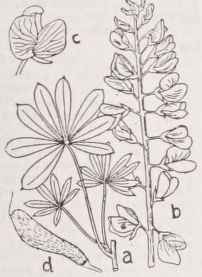
A kind of pulse. The genus Lupinus contains several species, mostly annual plants, bearing digitate leaves, and papilionaceous flowers. The seeds of the white lupine have a leguminous taste, accompanied with a disagreeable bitterness, and are said to be anthelmintic.
1. A leguminous plant of the genus Lupinus, especially L. albus, the seeds of which have been used for food from ancient times. The common species of the Eastern United States is L. perennis. There are many species in California.
LUPINE, Lupinus, L., a genus, of over eighty species, of the tribe Genistex of the order Leguminosae. Species with digitate leaves range along the west side of America from British Columbia to Bolivia, while a few occur in the Mediterranean regions. A few others with entire leaves are found in South Carolina, the Cape, and Cochin-China (DC., Prod, ii. p. 406; Benth. and Hook., Gen. Ρl., i. 480). The leaves are remarkable for “sleeping” in three different ways. From being in the form of a horizontal star by day, the leaflets either fall and form a hollow cone with their bases upwards (Z. pilosus'), or rise and the cone is inverted (Z. luteus), or else the shorter leaflets fall and the longer rise, and so together form a vertical star (many sp.); the object in every case being to protect the surfaces of the leaflets from radiation (Darwin, Movements of Pl., p. 340). The flowers are of the usual “papilionaceous” or pea-like form, blue, white, purple, or yellow, in long terminal spikes. The stamens are monadelphous and bear dimorphic anthers. The species of which earliest mention is made is probably L. Termis, Forsk., of Egypt. This is possibly the epe'/hvØos·of Homer {Il., xiii. 589). It is no longer found in Greece, but is extensively cultivated in Egypt. Its seeds are eaten by the poor after being steeped in water to remove their bitterness; the stems furnish fuel and the best charcoal for gunpowder (Pick., Chron. Hist, of Pl., 183). Two other species appear to have been cultivated by the ancients, L. sativus {albus, L.) allied to L. Termis, and L. hirsutus, L., this latter only about Sparta (Pick., l.c., p. 202); L. angustifolius, L., was a corn-field weed, the θlpgος άγριος of Dioscorides. The θepgoς ημepoς was used to counteract the effects of ...drink (Athen., 55, C.). The seeds were used as money on the stage (Plaut., Pan., 3, 2, 20; Hor., Lp., i. 7, 23). L. albus, L., was also cultivated as a field lupine, the L. sativus of the Romans, referred to by Cato, R. R., 34, 2; Virgil, Georg., i. 75; Pliny, xviii. 36; &c. In 1597 Gerard {HerbaU, p. 1042) writes :—“There be diners sortes of the fiat Beane called Lupine, some of the garden, and others wild”; and he figures three species, L. sativus (now L. albus, L.), L. luteus, L., and L. varius, L. Few species are in cultivation now, but the varieties are very numerous (see Paxton’s Dot. Diet., p. 345; Hemsley’s Hand, of Hardy Trees, &c., p. 115). Of species now grown, L. albus, L., is still extensively cultivated in Italy, Sicily, and other Mediterranean countries for forage, for ploughing in to enrich the land, and for its round flat seeds, which form an article of food. This, as well as the other two mentioned by Gerard, have been superseded as garden flowers by the American species, e.g., L. arboreus, Sims, and L. polyphyllus, from California; L. versicolor and L. tomentosus, from Peru.
9th ed. Encyclopædia Britannica, vol. 15, p. 66 [510 words — estimated reading time: 3 minutes]
V. take, catch, hook, nab, bag, sack, pocket, put into one's pocket, receive, accept, reap, crop, cull, pluck, gather, draw, appropriate, expropriate, impropriate, assume, possess oneself of, take possession of, commandeer, lay one's hands on, clap one's hands on, help oneself to, make free with, dip one's hands into, lay under contribution, intercept, scramble for, deprive of, take away, carry away, bear away, take off, carry off, bear off, adeem|, abstract, hurry off with, run away with, abduct, steal, ravish, seize, pounce upon, spring upon, swoop to, swoop down upon, take by storm, take by assault, snatch, reave, snap up, nip up, whip up, catch up, kidnap, crimp, capture, lay violent hands on, get hold of, lay hold of, take hold of, catch hold of, lay fast hold of, take firm hold of, lay by the heels, take prisoner, fasten upon, grip, grapple, embrace, gripe, clasp, grab, clutch, collar, throttle, take by the throat, claw, clinch, clench, make sure of, catch at, jump at, make a grab at, snap at, snatch at, reach, make a long arm, stretch forth one's hand, take from, take away from, disseize, deduct, retrench, dispossess, ease one of, snatch from one's grasp, tear from, tear away from, wrench from, wrest from, wring from, extort, deprive of, bereave, disinherit, cut off with a shilling, oust, divest, levy, distrain, confiscate, sequester, sequestrate, accroach, usurp, despoil, strip, fleece, shear, displume, impoverish, eat out of house and home, drain, drain to the dregs, gut, dry, exhaust, swallow up, absorb, draw off, suck the blood of, suck like a leech, retake, resume, recover
This site uses cookies to remember your display preferences (search sources and editions, Bible version, auto-link, images, light/dark theme). No personal data whatsoever is collected. Privacy Policy