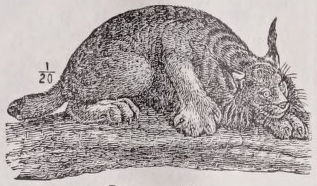
A quadruped of the genus Felis, resembling the common cat, but his ears are longer and his tail shorter. His hair is streaked with yellow, white and black colors. His air is sprightly; he howls like the wolf, and walks and leaps like a cat. This animal is celebrated for the sharpness of his sight.
1. Any one of several species of feline animals of the genus Felis, and subgenus Lynx. They have a short tail, and usually a pencil of hair on the tip of the ears.
LYNX, a name now appropriated to several animals forming a small section of the cats or genus Felis. It is not quite certain to which of these, if to any of them, the Greek name λυγ£ was especially applied, though it was more probably the caracal than any of the northern species. The so-called lynxes of Bacchus were generally represented as resembling panthers rather than any of the species now-known by the name. Various fabulous properties were attributed to the animal, w∙hatever it was, by the ancients, that of extraordinary powers of vision, including ability to see through opaque substances, being one; whence the epithet “lynx-eyed,” which has survived to the present day, although having no foundation in fact.
There are two forms of cats which are now called lynxes.
1. The caracal or Persian lynx, Feliscaracal, an animal about the size of a fox, is of slender build, with a moderately long tail, reaching down to the heels. It is of a uniform vinous or bright fulvous brown colour above, and is paler, sometimes almost white, beneath. It is quite or almost entirely unspotted. The tail has a black tip, and the ears are black externally, long and upright, pointed, and surmounted by a pencil of fine black hairs. It inhabits Central and North-West India, Persia, Arabia, Syria, and the greater part of Africa....
2. The name lynx is given to various species or varieties of animals found in the northern and temperate regions of both the Old and New World, all of moderate size, that is, smaller than the lions, tigers, and leopards, and larger than the true cats, with long limbs, short stumpy tail, ears tufted at the tip, and pupil of the eye linear when contracted. Their fur is generally long and soft, varying, however, according to season and locality, and always longish upon the cheeks. Their colour is always light brown or grey, and generally more or less spotted with a darker shade. The naked pads of the feet are more or less covered by the hair that grows between them. The skull and skeleton does not differ markedly from those of the other cats, but the small anterior upper premolar tooth found in many other species is usually wanting. Their habits are exactly those of the other wild cats; they are excelled by none in the untameable savageness of their disposition. They capture their prey in the same manner, either lying in wait, or noiselessly stealing within reach, and then making a sudden rush or spring upon it. Their food consists of any mammals or birds which they can overpower. In inhabited countries they commit extensive ravages upon sheep, lambs, and poultry. They generally frequent rocky places and forests, being active climbers, and passing much of their time among the branches of the trees. Their skins are of considerable commercial value in the fur trade.
Zoologists are by no means agreed at present as to the specific distinctions, if any really exist, between the various modifications of this group. As many as eight species are sometimes recognized, four belonging to the Old and four to the New World. The former are Felis lynx, of Scandinavia, Russia, northern Asia, and till lately the forest regions of central Europe (it has not inhabited Britain during the historic period, but its remains have been found in cave deposits of Pleistocene age); F. cervaria, Siberia; F pαrdina, Turkey, Greece, Sicily, Sardinia, and Spain; and F. isabellina, Tibet. The American varieties are F. canadensis, the most northern species, and F. Tufa, the
American wild cat or bay lynx, extensively distributed from the Atlantic to the Pacific throughout nearly the whole latitude of the United States, but replaced in Texas and southern California by F. maculata, and in northern Oregon and Washington territory by F. fasciata.
In both cases, as might be supposed, specimens obtained from the more southern climates are shorter in their fur, more brightly coloured, and more distinctly spotted than those from colder regions. When only a few individuals of each most markedly different form are examined the distinctions are sufficiently evident. The occurrence, however, of transitional or intermediate forms makes it extremely difficult to draw the line between the different varieties or species, or to assign definite characters by which they can be separated. Wherefore it is best at present to accept the so-called species as only provisional, and wait until more abundant materials, with fuller knowledge of the localities from which they are derived, and of the variations due to age, sex, season, and climate, have been more carefully studied. We shall then probably come to the conclusion that all the existing forms of northern lynxes, whether American or Eurasian, belong to what may fairly be called a species, which is becoming by degrees differentiated into several more or less strongly marked local varieties. (w. h. f.)
9th ed. Encyclopædia Britannica, vol. 15, p. 109 [819 words — estimated reading time: 5 minutes]
V. see, behold, discern, perceive, have in sight, descry, sight, make out, discover, distinguish, recognize, spy, espy, ken, get a sight of, have a sight of, catch a sight of, get a glimpse of, have a glimpse of, catch a glimpse of, command a view of, witness, contemplate, speculate, cast the eyes on, set the eyes on, be a spectator of, look on, see sights, see at a glance, look, view, eye, lift up the eyes, open one's eye, look at, look on, look upon, look over, look about one, look round, survey, scan, inspect, run the eye over, run the eye through, reconnoiter, glance round, glance on, glance over turn one's looks upon, bend one's looks upon, direct the eyes to, turn the eyes on, cast a glance, observe, watch, see with one's own eyes, watch for, peep, peer, pry, take a peep, play at bopeep, look full in the face, look hard at, look intently, strain one's eyes, fix the eyes upon, rivet the eyes upon, stare, gaze, pore over, gloat on, leer, ogle, glare, goggle, cock the eye, squint, gloat, look askance
Adv.visibly, in sight of, with one's eyes open at sight, at first sight, at a glance, at the first blush, prima facie
Phr. the scales falling from one's eyes, "an eye like mars to threaten or command", "her eyes are homes of silent prayer", "looking before and after", "thy rapt soul sitting in thine eyes"
Int. look, &c. (attention) 457
No Bible verses found for "Lynx".
This site uses cookies to remember your display preferences (search sources and editions, Bible version, auto-link, images, light/dark theme). No personal data whatsoever is collected. Privacy Policy