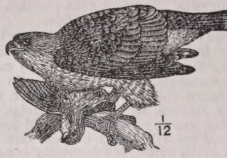
HAWK (Anglo-Saxon, Hafoc), a word of somewhat indefinite meaning, being often used to signify all diurnal Birds-of-prey which are neither Vultures nor Eagles, and again more exclusively for those of the remainder which are not Buzzards, Falcons, Harriers, or Kites. Even with this restriction it is comprehensive enough, and will include more than a hundred species, which have been arrayed in genera varying in number from a dozen to above a score, according to the fancy of the systematizer. Speaking generally, Hawks may be characterized by possessing comparatively short wings and long legs, a bill which begins to decurve directly from the cere (or soft bare skin that covers its base), and has the cutting edges of its maxilla (or upper mandible) sinuated but never notched. To these may be added as characters, structurally perhaps of less value, but in other respects quite as important, that the sexes differ very greatly in size, that in most species the irides are yellow, deepening with age into orange or even red, and that the immature plumage is almost invariably more or less striped or mottled with heart-shaped spots beneath, while that of the adults is generally much barred, though the old males have in many instances the breast and belly quite free from markings. Nearly all are of small or moderate size—the largest among them being the Gos- Hawk (vol. X. p. 788) and its immediate allies, and the male of the smallest, Accipiter times, is not bigger than a Song-Thrush. They are all birds of great boldness in attacking a quarry, but if foiled in the first attempt they are apt to leave the pursuit. Thoroughly arboreal in their habits, they seek their prey, chiefly consisting of birds (though reptiles and small mammals are also taken), among trees or bushes, patiently ...waiting for a victim to shew itself, anl gliding upon it when it appears to be unwary with a rapid swoop, clutching it in their talons, and bearing it away to eat it in some convenient spot.
It is of course impossible here to enter into details of the numerous forms which, notwithstanding the limitation above adopted, are to be called Hawks, or to describe the distinguishing characters, so far as any have been given, of the different groups or sections into which it has pleased systematic ornithologists to break them up, since hardly any two are agreed in the latter respect. There is at the outset a difference of opinion as to the scientific name which the largest and best known of these sections should bear—some authors terming it Nisus, and others, who seem to have the most justice on their side, Accipiter. In Europe there are two species—first, A. nisus, the common Sparrow-Hawk, which has a wide distribution from Ireland to Japan, extending also to northern India, Egypt, and Algeria, and secondly, A. δreviyes (by some placed in the group Micro- nisus and by others called an Astur), which only appears in the south-east, and the adjoining parts of Asia Minor and Persia. In North America the place of the former is taken by two very distinct species, a small one, A. fuscus, usually known in Canada and the United States as the Sharp-shinned Hawk, and Stanley’s or Cooper’s Hawk, A. cooperi (by some placed in another genus, Cooperastur), which is larger and has not so northerly a range. In South America there are four or five more, including A. tinus, before mentioned as the smallest of all, while a species not much larger, A. miηullus, together with several others of greater size, inhabits South Africa. Madagascar and its neighbouring islands have three or four species sufficiently distinct, and India has A. badius. A good many more forms are found in South-eastern Asia, in the Indo-Malay Archipelago, and in Australia three or four species, of which A. cirrhocephalus most nearly represents the Sparrow-Hawk of Europe and Northern Asia, while A. radiatus and A. approximans shew some affinity to the Cos-Hawks (Astur) with which they are often classed. The differences between all the forms above named and the much larger number here unnamed are such as can be only appreciated by the specialist, and could not possibly be pointed out within the limits of this article. It may be observed in conclusion that the so-called “Sparrow-Hawk” of New Zealand (Hieracidea) does not belong to this group of birds at all, and by many authors has been deemed akin to the Falcons. For Hawking, see Falconry. (a. n.)
[768 words — estimated reading time: 5 minutes]
נץ, from the root נצה, _to fly_, because of the rapidity and length of flight for which this bird is remarkable, Lev. xi, 16; Deut. xiv, 15; Job xxxix, 26. _Naz_ is used generically by the Arabian writers to signify both falcon and hawk; and the term is given in both these senses by Meninski. There can be little doubt that such is the real meaning of the Hebrew word, and that it imports various species of the falcon family, as jer-falcon, goshawk, and sparrow-hawk. As this is a bird of prey, cruel in its temper, and gross in its manners, it was forbidden as food, and all others of its kind, in the Mosaic ritual. The Greeks consecrated the hawk to Apollo; and among the Egyptians no animal was held in so high veneration as the ibis and the hawk. Most of the species of hawk, we are told; are birds of passage. The hawk, therefore, is produced, in Job xxxix, 26, as a specimen of that astonishing instinct which teaches birds of passage to know their times and seasons, when to migrate out of one country into another for the benefit of food, or a warmer climate, or both. The common translation does not give the full force of the passage: “Doth the hawk fly by thy wisdom?” The real meaning is, “Doth she know, through thy skill or wisdom, the precise period for taking flight, or migrating and stretching her wings toward a southern or warmer climate?” The passage is well rendered by Sandys:-- “Doth the wild haggard tower into the sky, And to the south by thy direction fly?” Her migration is not conducted by the wisdom and prudence of man, but by the superintending and upholding providence of the only wise God.
[297 words — estimated reading time: 2 minutes]
HAWKE, Edward Hawke, Baron (1705-1781), an English admiral, was the son of a barrister and was born in 1705. He entered the navy at an early age, and in 1733 became commander of the “Wolf.” In the engagement off Toulon in 1744, he broke from the line of battle in order to engage the “Poder,” and although he succeeded in causing her to strike her colours, his breach of discipline was punished by dismissal from the service. He was, however, almost immediately restored by the king’s commands, and in 1747 was promoted to the rank of rear-admiral of the white. In October of the same year he was sent in command of a squadron intended to intercept a fleet of merchant vessels bound for the West Indies under a convoy of nine men-of-war, and coming up with them on the 14th of the month near the isle of Aix, he succeeded after a severe struggle in capturing six of the men-of-war, but darkness coming on before the close of the contest the whole of the merchant vessels escaped. For his victory Hawke was created a knight companion of the Bath. In December of the same year he was chosen member of parliament for Bristol. In May 1748 he became vice-admiral of the blue, and in January 1755 admiral of the white. In the following year he succeeded Admiral Byng as commander of the fleet in the Mediterranean, but arrived too late to succour Minorca; and in none of the commands which he subsequently held did he have an opportunity of distinguishing himself till 1759, when he took charge of a squadron sent to cruise off Brest. On the morning of the 20th November he sighted the French fleet under Admiral Conflans off Belleisle, and notwithstanding that the French, trusting to their knowledge of the rocks and shallows, retired towards the shore, he determined to engage them, which he ...did with such impetuosity that their fleet was only saved from total destruction by the approach of nightfall. As it was, more than half their vessels were either disabled, captured, or driven on shore. For this brilliant victory, gained in such circumstances of difficulty and danger, with the loss of only two vessels, Hawke received the thanks of the House of Commons and a pension of £2000 per annum. In 1765 he was appointed vice-admiral of Great Britain and first lord of the admiralty. In 1776 he was raised to the peerage by the title of Baron Hawke of Towton. He died at Shepperton, Middlesex, 17 th October 1781.
[436 words — estimated reading time: 3 minutes]
HAWKESWORTH, John (c. 1715-1773), an author of the last century, was born in London, according to one account in 1715, but according to another in 1719. He is said to have been apprenticed first to a clockmaker and afterwards to an attorney, but at any rate he was indebted for the education requisite for the prosecution of a literary career chiefly to his own perseverance. In 1744 he succeeded Dr Johnson as compiler of the parliamentary debates for the Gentleman’s Magazine. Eight years later he started in company with Johnson, Bathurst, and Warton a periodical called the Adventurer. This journal had a great success, and ran to 140 numbers, of which 70 were from the pen of Hawkesworth himself. On account of what was regarded as its powerful defence of morality and religion, Hawkesworth was rewarded by the archbishop of Canterbury with the degree of LL.D. In 1761 he published a volume of fairy tales, and an edition of Swift’s works and letters, with a life prefixed which Johnson has referred to in highly laudatory terms in his Lives of the Poets. The reputation he obtained by these and other works was such that he was commissioned by Captain Cook to edit hÏ3 papers relative to his first voyage. The work appeared in 1773 in three volumes, and as a reward of his labours Hawkesworth received from the Government the sum of £6000. His descriptions of the manners and customs of the New World were, however, regarded by many critics as hurtful to the interests of morality, and the severity of their strictures is said to have hastened his death, which took place November 17, 1773. He was buried at Bromley in Kent, where a monument has been erected to his memory. Hawkesworth was a close imitator of Johnsen both in style and thought, but his independent literary talent is ...considerable.
[316 words — estimated reading time: 2 minutes]
HAWKINS, Sir John (c. 1532-1595), was born in Plymouth about 1532, and was bred a sailor. Learning that negroes from the coast of Guinea were good merchandize for traffic in the West Indies, he made trial of this in three voyages, the first in 1562, the second in 1564. Ths third, made in company with young Drake in 1567, ended in disaster, the story of which is related by Hawkins himself. He was returned M.P. for Plymouth in 1572; and the next year he was made treasurer and comptroller of the navy. In the expedition against the Armada he was appointed vice-admiral, hoisting his flag on board the “Victory,” and for his services on that occasion he was afterwards knighted. His last expedition (1595) was undertaken, once more with Drake, mainly with a view to rescue his son Richard, who three years before had fallen into the hands of the Spaniards off the coast of Quito. It was unsuccessful; and, worn out with fatigue and brokenhearted, he died off Puerto Rico on the 12th of November 1595. Hawkins was the first to use chain pumps and fighting nettings for ships. Stow speaks of him as a very wise, vigilant, and true-hearted man. Along with Sir Francis Drake, he founded in 1588 the “Chest at Chatham,” the forerunner of Greenwich Hospital, where it is now preserved. A portrait of Hawkins once adorned the Armada tapestry in the House of Lords....
HAWKINS, Sir John (1719-1789), will be permanently remembered as the author of an important work on the history of music. He was born March 30, 1719, in London, the son of an architect who destined his son for his own profession. Ultimately, however, Hawkins took to the law, devoting his leisure hours to his favourite study of music. A wealthy marriage in 1753 enabled him to indulge his passion for acquiring rare works of music, and he bought, for example, the collection formed by Dr Pepusch, and subsequently presented by Hawkins to the British Museum. It was on such materials that Hawkins founded his celebrated work on the General History of the Science and Practice of Music, in 5 vols, (republished in 2 vols., 1876). It was brought out in 1776, the same year which witnessed the appearance of the first volume of Burney’s work on the same subject. The relative merits of the two works were eagerly discussed by contemporary critics. Burney no doubt is infinitely superior as a literary man, and his work accordingly comes much nearer the idea of a systematic treatise on the subject than Hawkins’s, which is essentially a collection of rare and valuable pieces of music with a more or less continuous commentary. But by rescuing these from oblivion Hawkins has given a permanent value to his work. Of Hawkins’s literary efforts apart from music it will be sufficient to mention his occasional contributions to the Gentleman' 's Magazine, his edition of the Complete Angler, and his biography of Dr Johnson, with whom he was intimately acquainted. He was one of the original members of the Ivy Lane Club, and ultimately became one of Dr Johnson’s executors. If there were any doubt as to his intimacy with Johnson, it would be settled by the slighting way in which Boswell refers to him. Speaking of the Ivy Lane Club, he mentions amongst the members “Mr John Hawkins, an attorney,” and adds the following footnote, which at the same time may serve as a summary of the remaining facts of Hawkins’s life :—“He was for several years chairman of the Middlesex justices, and upon presenting an address to the king accepted the usual offer of knighthood (1772). He is the author of a History of Music in five volumes in quarto. By assiduous attendance upon Johnson in his last illness he obtained the office of one of his executors,—in consequence of which the booksellers of London employed him to publish an edition of Dr Johnson’s works and to write his life.” Sir John Hawkins died on the 21st of May 1789, and was buried in the cloisters of Westminster Abbey.
[243 words — estimated reading time: 2 minutes]
HAWKWOOD, Sir John (oδ. 1394), an English adventurer who attained great wealth and renown by his services as a condottiere in the Italian wars of the 14th century. According to the accepted if not the authenticated account of his life, he was the son of a tanner of Sible Hedingham in Essex, and was apprenticed to a tailor in London. Pressed into the army, he served with honour in France, obtained the favour of the Black Prince, and received knighthood from King Edward III. On the peace of Bretigny in 1360, he collected a band of men-at-arms, and moved southward to Italy, where we find him assisting the Pisans to defeat the Florentines in 1364. His services were sought in succession by Bernabo Visconti, by the legate of Bologna, and by Pope Gregory XI. In 1375 the Florentines entered into an agreement with him, by which they were to pay him and his companion 130,000 gold florins in three months on condition that he undertook no engagement against them; and in the same year the priors >of the arts and the gonfalonier decided to give him a pension of 1200 florins per annum for as long as he should remain in Italy. His subsequent services to Florence as captaingeneral of the city λvere numerous and important. Hawkwood married Donnana, an illegitimate daughter of Bernabo Visconti, and one of his own daughters became the wife of the count of Porziglia. His latter years were spent in a villa in the neighbourhood of Florence. On his death in 1394 the republic gave him a public funeral of great magnificence and decreed the erection of a marble monument in the cathedral. This, however, was never executed; but Paolo Uccelli painted his portrait in terre-verte on the inner façade of the building, where it still remains, though damaged by removal from the plaster to canvas. ...Richard II. of England, probably at the instigation of Hawkwood’s sons, who returned to their native country, requested the Florentines to let him remove the good knight’s bones, and the Florentine Government signified its consent.
The fullest account of Sir John Hawkwood in English is in Nichol’s Bibliotheca topographica Britannica, vol. vi. He is one of Richard Johnson’s Nine Worthies of London (published in Harleian Mise., 1808), and Fuller includes him in his Worthies of England. An'elaborate life by Manni is given by Tartini in Rerum ltal. Script.·, and Hawkwood is naturally treated of in Amm irato and the other Florentine chronicles. The compact with the Florentines is printed in Archivio Storico, 1868.
[434 words — estimated reading time: 3 minutes]