
1. MACAW '
2. MAC'CABEES, noun The name of two apocryphal books in the Bible.
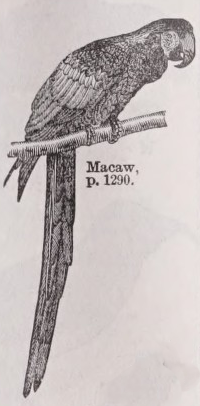
MACAW, or, as formerly spelt, Maccaw, excellunt magnitudine & pulchritudine, quos barbari Araras & Macaos vocant,” and again {loc. cit.) “Tertium locum meretur Araruna vel Machao.' , Webster, in his dictionary, says that Macaw, “written also Macâo,” is “the native name in the Antilles,” but gives no authority for his statement, which, considering that one West Indian island only is known to possess a Macaw (and that in that island the bird is known as Guacamayo), is very unlikely. Some of the older writers, Buffon {Oiseaux, vi. p. 278) for instance, say that Makaνouanne was the name given by natives of Guiana to one species of Macaw found in that country; but the Antillean origin of the name cannot at present be accepted. ] the name given to some fifteen or more species of large, long-tailed birds of the Parrot Family, natives of the Neotropical Region, and forming a very well-known and easily-recognized group to which the generic designation Ara is usually applied by ornithologists, though some prefer for it Hacrocercus or Sittace. Most of the Macaws are remarkable for their gaudy plumage, which exhibits the brightest scarlet, yellow, blue, and green in varying proportion and often in violent contrast, while a white visage often adds a very .peculiar and expressive character. With one exception the known species of Ara inhabit the mainland of America from Paraguay to Mexico, being especially abundant in Bolivia, where no fewer than seven of them (or nearly one half) have been found (Proc. Zool. Soc., 1879, p. 634). The single extra-continental species, A. tricolor, is one of the most brilliantly coloured, and is peculiar to Cuba, where, according to Dr Gundlach {Ornitologia Gubana, p. 126), its numbers are rapidly decreasing, so that there is every chance ...of its becoming extinct.
It will perhaps be enough here to dwell on the best known species of the group, and first the Blue-and-yellow Macaw, A. ararauηa, which has an extensive range in South America from Guiana in the east to Colombia in the west, and southwards to Paraguay. Of large size, it is a bird to be seen in almost every zoological garden, and is very frequently kept alive in private houses, for its temper is pretty good, and it will become strongly attached to those who tend it. Its richly-coloured plumage, sufficiently indicated by its common English name, has the additional recommendation of supplying feathers which are eagerly sought by salmon-fishers for the making of artificial flies. Next may be mentioned the Red-and-blue Macaw, A. macao, which is even larger and more gorgeously clothed, for, besides the colours expressed in its ordinary appellation, yellow and green enter into its adornment. It inhabits Central as well as South America as far as Bolivia, and is also a common bird in captivity, though perhaps less often seen than the foregoing. The Red-and-yellow species, A. chloroptera, ranging from Panama to Brazil, is smaller, or at least has a shorter tail, and is not quite so usually met with in menageries. The Red-and-green, A. militaris, smaller again than the last, is not unfrequent in confinement, and presents the colours of the name it bears. This has the most northerly extension of habitat, occurring in Mexico and thence southwards to Bolivia. All the other species are comparatively rare in a reclaimed condition. Four of them, A. hyacinthina, A. leari, A. glauca, and A. spixi, are almost entirely blue, while in A. mandata and A. nobilis the prevailing colour is green, and A. severa is green and blue.
As is the case with most Neotropical birds, very little is known of the life history of Macaws in a state of nature. They are said to possess considerable power of flight, rising, high in the air and travelling long distances in search of their food, which consists of various kinds of fruits; but of any special differences of habit we are wholly ignorant. The sexes appear in all cases to be alike in colouring, and the birds, though constantly paired, are said to live in companies. As with others of the Order Psittaci, the nest is made in a hollow tree, and the eggs, asserted to be two in number, are white without any lustre. Of the habits of these birds in confinement it is needless to speak, as they are so extremely well known. If caged, their long tailfeathers are sure to suffer, but chained by the leg to a perch, Macaws seem to enjoy themselves as well as any captive can, and will live for many years.
In our present state of ignorance as to the best mode of classifying Parrots, it would be premature to hazard any guess as to the place occupied in the Order by the genus Ara. (a. n.)