
A chattering bird of the genus Corvus.
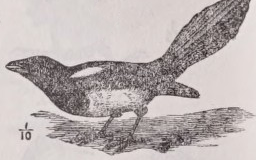
MAGPIE, or simply Pie (French, Pie), the prefix being the abbreviated form of a human name (Margaret) applied as in so many other instances to familiar animals, as this bird once was throughout Great Britain, though of late years almost exterminated in many parts, and now nearly everywhere scarce. Its pilfering habits have led to this result, yet the injuries it causes are unquestionably exaggerated by common report; and in many countries of Europe it is still the tolerated or even the cherished neighbour of every farmer, as it formerly was in England if not in Scotland also. There is ample evidence to prove that it did not exist in Ireland in 1617, when Fynes Morison wrote his Itinerary, and that it had appeared there within a hundred years later, when Swift mentions its occurrences in his Journal to Stella, under date of 9th July 1711. It is now common enough in that country, and there is a widespread but of course unfounded belief that it was introduced by the English out of spite. It is a species that when not molested is extending its range, as Wolley ascertained in Lapland, where within the last century it has been gradually pushing its way along the coast and into the interior from one fishing-station or settler’s house to the next, as the country has been peopled....
Since the persecution to which the Pie has been subjected in Great Britain, its habits have undoubtedly altered greatly in character. It is no longer the merry, saucy hanger-on of the homestead, as it was to writers of former days, who were constantly alluding to its disposition, but is become the suspicious thief, shunning the gaze of man, and knowing that danger may lurk in every bush. Hence opportunities of observing it fall to the lot of few, and most persons know it only as a curtailed captive in a wicker cage, where its vivacity and natural beauty are lessened or wholly lost. At large few European birds possess greater beauty, the pure white of its scapulars and inner web of the flightfeathers contrasting vividly with the deep glossy black on the rest of its body and wings, while its long tail is lustrous with green, bronze, and purple reflexions. The Pie’s nest is a wonderfully ingenious structure, placed either in high trees or low bushes, and so massively built that it will stand for years. Its foundation consists of stout sticks, turf, and clay, wrought into a deep, hollow cup, plastered with earth, and lined with fibres; but around this is erected a firmly-interwoven, basket-like outwork of thorny sticks, forming a dome over the nest, and leaving but a single hole in the side for entrance and exit, so that the whole structure is rendered almost impregnable. Herein are laid from six to nine eggs, of a pale bluish-green freckled with brown and blotched with ash-colour. Superstition as to the appearance of the Pie still survives even among many educated persons, and there are several versions of a rhyming adage as to the various turns of luck which its presenting itself, either alone or in company with others, is supposed to betoken, for some of these versions contradict one another in details, though all agree in this that the sight of a single Pie unquestionably presages sorrow.
The Pie belongs to the same Family of birds as the Crow (vol. vi. p. 617), and is the Corvus pica of Linnaeus, the Pica caudata, P. melaηoleuca, or P. rustica of modern ornithologists, who have recognized it as forming a distinct genus, but the number of species thereto belonging has been a fruitful source of discussion. Examples from the south of Spain differ slightly from those inhabiting the rest of Europe, and in some points more resemble the P. mauritanica of north-western Africa; but that species has a patch of bare skin of a fine blue colour behind the eye, and much shorter wings. No fewer than five species have been discriminated from various parts of Asia, extending to Japan; but only one of them, the P. leucoptera of Turkestan and Tibet, has of late been admitted as valid. In the west of North America, and in some of its islands, a Pie is found which extends to the upper valleys of the Missouri and the Yellowstone, and has long been thought entitled to specific distinction as P. hudsonia ; but its claim thereto is now disallowed by some of the best ornithologists of the United States, and it can hardly be deemed even a geographical variety of the Old-World form. In California, however, there is a permanent race if not a good species, P. nuttalli, easily distinguishable by its yellow bill and the bare yellow skin round its eyes; and it is a curious fact that on two occasions in the year 1867 a bird apparently similar was observed in Great Britain (Zoologist, ser. 2, pp.
706, 1016). (a. n.)