
An extinct gigantic quaternary mammal, allied to the ant-eaters and sloths. Its remains are found in South America.
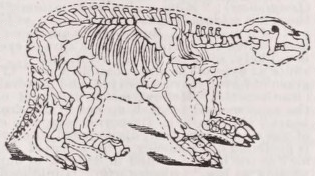
MEGATHERIUM is the name given by Cuvier to a large extinct animal belonging to the order Edentata (see Mammalia, p. 384). A nearly complete skeleton, found on the banks of the river Luxan, near Buenos Ayres, and sent in 1789 to the Royal Museum at Madrid, long remained the principal if not the only source of information with regard to the species to which it belonged, and furnished the materials for many descriptions, notably that of Cuvier, who determined its affinities with the Sloths. In 1832 an important collection of bones of the Megatherium were discovered near the Rio Salado, and were secured for the museum of the College of Surgeons of England, and these, with another collection found at Luxan in 1837, and now in the British Museum, supplied the materials for the complete description of the skeleton published by Professor Owen in 1861. Other skeletons have subsequently been received by several of the Continental museums, as Milan and Paris, and, consequently, our knowledge of the organization of the Megatherium, so far as it can be deduced from the bones and teeth, is as complete as that of any other animal, recent or extinct.
The remains hitherto spoken of are all referred to one species, Megatherium americanum of Blumenbach, Μ. cuvier i of Desmarest, and are all from the newest or ρost-Tertiary geological formations of the Argentine Republic and Paraguay, or the lands forming the basin of the Rio de la Plata. Dr Leidy has described, from similar formations in Georgia and South Carolina, bones of a closely allied species, about one-fourth smaller, which he has named Μ. mirabile. A third species, Μ. laurillardi of Lund, is founded upon remains found in Brazil....
The following description will apply especially to the best known South American form, Megatherium americanum. In size it exceeded any existing land animal except the elephant, to which it was inferior only in consequence of the comparative shortness of its limbs, for in length and bulk of body it was its equal, if not superior. The full length of a mounted skeleton from the fore part of the head to the end of the tail is 18 feet, of which the tail occupies 5 feet. The head, which is small for the size of the animal, presents a general resemblance to that of the Sloth; the anterior part of the mouth is, however, more elongated, and the malar bone, though branched posteriorly in the same way as that of the Sloth, meets the zygomatic process of the squamosal, completing the arch. The lower jaw has the middle part of its horizontal ramus curiously deepened, so as to admit of implantation of the very long-rooted teeth. In number the teeth exactly resemble those of the Sloths, being five above and four below on each side, and they are limited to the lateral parts of the mouth, front teeth being entirely wanting. They resemble those of the Sloths also in their persistent growth, and in their composition of three tissues — vaso-dentine, true dentine, and cement; but they are of prismatic or quadrate form, and the constituent materials of different densities are so arranged that, as they wear, two transverse ridges of hard dentine remain at a greater elevation than the rest of the tooth, producing a very efficient triturating apparatus (see figs. 35 and 36, article Mammalia, p. 385). The vertebral column consists of seven cervical, sixteen dorsal, three lumbar, five sacral, and eighteen caudal vertebrae. The spinous processes are much better developed than in the Sloths, and are all directed backwards, there being no reversing of the inclination near the posterior end of the dorsal series, as in most active-bodied mammals. In the lumbar region, the accessory zygapophyses, rudimentary in Sloths, are fully developed, as in the Anteaters.
The tail is large, and its basal vertebrae have strong lateral and spinous processes and chevron bones, indicating great muscular development. The scapula resembles that of the Sloths in the union of the acromion with the coracoid, and in the bridging over of the supra-scapular notch. The clavicle is complete and very large much resembling that of man on a large scale. I he fore limbs are longer than the hind limbs. The radius and ulna are both well-developed, and have a considerable amount of freedom of movement. The hand is singularly modified. The first digit is represented only by a rudimentary metacarpal, but the next three are large, and terminate in phalanges adapted for the support of immense claws, the middle one being especially large. The outer or fifth digit has no claw, and it may be considered as certain that the weight of the foot was, in standing and walking, chiefly thrown upon this, and that it was protected by a callous pad below as in the existing great Anteater, while the other toes were curved inwards towards the palm, only coming in contact with the ground by their outer surfaces. The mechanical arrangements by which the weight of the body was thrown entirely upon the outer side, of the foot are very curious, and are fully described in Professor Owen’s memoir. The pelvis is remarkably wide, even more so than that of the Elephant, but it is formed on the same principle as in the Sloths. The femur is extremely broad and flattened; the tibia and fibula are short and strong, and united together at each end. The hind foot, contrary to the usual rule in the Edentata, is even more singularly modified than the hand. The ankle-joint is formed upon a peculiar plan, quite unlike that of the Sloths, or of any other mammal, except the Megatherium’s nearest allies. The calcaneum projects nearly as far backwards as the fore part of the foot does forwards. There is no trace of great toe or hallux, or of its corresponding cuneiform bone. The second toe is rudimentary. The third has an enormous ungual phalanx, which, like those of the hand, is remarkable for the immense development of the bony sheath which is reflected from its proximal end around the base of the claw. The two outer toes have large and very peculiarly-shaped metatarsals, but only small phalanges, and no claws. The creature probably walked upon the outer edge of the sole, so that the great falcate claw of the third toe did not come into contact with the ground, and so was kept in a state of sharpness ready for use. The foot was therefore formed upon quite a different principle from that of the Anteaters or Sloths, though somewhat like the latter in having two of the toes aborted.
Taking all the various points of its structure together, they clearly indicate affinities both with the existing Sloths and with the Anteaters, the skull and teeth more resembling those of the former, and the vertebral column and limbs the latter It is also not difficult to infer the food ând habits of this enormous creature. That it was a leaf-eater there can be little doubt, but the greater size and more complex structure of its teeth might have enabled it to crush the smaller branches as well as the leaves and succulent shoots which form the food of the existing Sloths. It is, however, very improbable that it climbed into the branches of the trees like its diminutive congeners, but it is far more likely that it obtained its subsistence by tearing them down with the great hook-like claws of its powerful prehensile fore limbs, being easily enabled to reach them by raising itself up upon the massive tripod formed by the two hind feet, firmly fixed to the ground by the one huge falcate claw, and the stout, muscular tail. The whole conformation of the hinder part of the animal is strongly suggestive of such an action. There can also be little doubt but that all its movements were as slow and deliberate as those of its modern representatives.
An idea at one time prevailed that the Megatherium was covered externally with a coat of bony armour like that of the Armadillos, but this originated in dermal plates belonging to the Glyptodon, a totally distinct animal, having been accidentally associated with bones of the Megatherium. Similar plates, on a smaller scale, have indeed been found in connexion with the skeleton of both Mylodon and Scelidotherium, animals of the same family, but never yet with the Megatherium, which we may therefore imagine with a covering of coarse hair like that of its nearest living allies, the Sloths and Anteaters.
Bibliography.— J. Garriga and J. B. Bry, Description del esque∙ leto de un cuadrupedo muy corpulento y raro, que se conserva en el Real Gabinete de Historia Natural de Madrid, con 5 laminas, fol., 1796; G. Cuvier, in Annales du Muséum, vol. v. p. 376, 1804; Pander and D’Alton, Das Riesenfaulthier abgebildet und beschrieben, 1821; R Owen, “On the Megatherium,” in Philosophical Transactions for 1851, 1855, 1856, and 1858, republished as a separate work in 1861; J. Leidy, “Memoir on the Extinct Sloth Tribe of North America,” Smithsonian Contributions to Knowledge, vol. vii. 1855; H. Burmeister, Description physique de la République Argentine, t. iii. pt. 1, “Mammifères vivants et éteints,” 1879, p. 285.