
A genus of perennial, herbaceous, endogenous plants of great size, including the banana (Musa sapientum), the plantain (M. paradisiaca of Linnaeus, but probably not a distinct species), the Abyssinian (M. Ensete), the Philippine Island (M. textilis, which yields Manila hemp), and about eighteen other species. See Illust. of Banana and Plantain.
Word of the Day: Catachrestical
Of, pertaining to, or resembling, plants of the genus Musa.
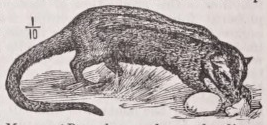
A small animal of Java (Paradoxirus fasciatus), allied to the civets. It swallows, but does not digest, large quantities of ripe coffee berries, thus serving to disseminate the coffee plant; hence it is called also coffee rat.
A dreamer; one who is apt to be absent in mind.
A dreamer; an absent-minded person.
MusÄus
Encyclopedia Britannica
MUSÄUS, J. K. A. (1735-1787), a German author. He studied theology at Jena, his birthplace, and would have become the pastor of a parish but for the resistance of some peasants, who objected that he had been known to dance. In 1760 to 1762 he published in three volumes his first work, Grandison der Zweite, afterwards (in 1781-82) rewritten and issued with a new title, Der deutsche Grandison. The object of this book was to show the comic aspects of Richardson’s hero, who had many sentimental admirers in Germany. In 1763 Musäus was made tutor of the court pages at Weimar, and in 1770 he became a professor at the Weimar gymnasium. His second book— Physiognomische Reisen —did not appear until 1778-79. It was directed against Lavater, and attracted much favourable attention. In 1782 to 1786 he published his most famous work, Volksmärchen der Deutschen. Even in this series of tales, the substance of which Musäus collected among the people, he could not refrain from expressing the satirical tone which had marked his previous writings. The stories, therefore, lack the unconscious simplicity which characterizes genuine folk-lore. Still, they are very brightly written, and retain at the present day some of their original popularity. In 1785 was issued Freund Hein's Erscheinungen in Holbein's Manier by J. R. Schellenberg, with explanations in prose and verse by Musäus. A collection of stories entitled Straussfedern, of which a volume appeared in 1787, Musäus was prevented from completing by his death, which occurred on the 28th of October 1787. After his death appeared his Moralische Kinderklapper and Nachgelassene Schriften, the latter edited byJιis friend and relative Kotzebue. Musäus was a man of cheerful and genial temperament, and this dominant characteristic is ...reproduced in his writings, in which, although satirical, he is never morose. His style is animated, light, and graceful.
See Miiller, Johann Karl August Musäus (1867).
9th ed. Encyclopædia Britannica, vol. 17, p. 64
[328 words — estimated reading time: 2 minutes]
[328 words — estimated reading time: 2 minutes]
No thesaurus entries found for "Musa".
No Bible verses found for "Musa".