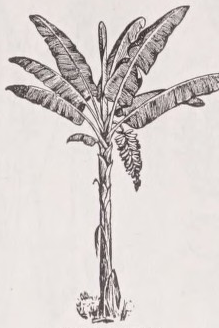
1. A species of the genus Musa, or plantain tree, and its fruit. It rises 15 or 20 feet high, with a soft stalk, marked with dark purple stripes and spots, with leaves six feet long, and a foot broad. The flowers grow in bunches, covered with a sheath of a fine purple color.
2. The fruit is four or five inches long, and an inch or more in diameter; the pulp soft and of a luscious taste. When ripe, it is eaten raw, or fried in slices. Bananas grow in large bunches weighing a dozen pounds or more. This tree is the native of tropical countries, and on many isles, constitutes an important article of food.
BANANA(Musa sapientum), a gigantic herbaceous plant belonging to the natural order Hfusaceoe, originally a native of the tropical parts of the East, but now cultivated in all tropical and sub-tropical climate3. It forms a spurious kind of stem, rising 15 or 20 feet by the sheathing bases of the leaves, the blades of which sometimes measure as much as 10 feet in length by 2 feet across. The stem bears several clusters of fruit, which somewhat resemble cucumbers in size and form; it dies down after maturing the fruit. The weight of the produce of a single cluster is sometimes as much as 80 ft>, and it was calculated by Humboldt that the productiveness of the banana as compared with wheat is as 133 to 1, and as against potatoes 44 to 1. The varieties of banana cultivated in the tropics are as numerous as the varieties of apples in temperate regions, and the best authorities now agree that no specific difference exists between it and the plantain. The fruit is extensively used as food; and in many of the Pacific islands it is the staple on which the natives depend. In its immature condition it contains much starch, which on ripening changes into sugar; and as a ripe fruit it has a sweet but somewhat flavourless taste. From the unripe fruit, dried in the sun, a useful and nutritious flour is prepared. The following represents the percentage composition of the pulp of the ripe fruit :—Nitrogenous matter, 4'820; sugar, pectin, &c., 19'657; fatty matter, 0'632; cellulose, 0'200; saline matter, 0'791; water, 73'900. An analysis of the flour by Dr Murray Thomson yielded the following results :—Water, 12'33; starch, 7Γ60; gum and sugar, 6'82; nitrogenous matter, 2'01; cellulose, 5'99; oil, 0'50; salts, 0∙64....
' BANAT, a district in the south-east of Hungary, consisting of the three counties of Thorontai, Temeswar, and Krasso i which has strangely acquired this title, though it was never governed by a “ban.” It is bounded by the Theiss, the Maros, and the Danube, forming almost a regular parallelogram. The soil is in many parts a remarkably rich alluvial deposit. Under the Turkish yoke it was allowed to lie almost desolate in marsh and heath and forest; but Joseph II. determined to render it, if possible, a populous and prosperous district. He accordingly offered land, at a very low rate, to all who were willing to settle within its borders. Germans, Greeks, Turks, Servians, Italians, and Frenchmenresponded to his call, and soon developed the agricultural resources of the region. Canals were formed at great expense of labour; marshes and forests were cleared; and now the Banat is one of the most highly cultivated parts of the Austrian empire. Wheat, barley, oats, rye, rice, maize, flax, hemp, rape, sun-flowers, tobacco, grapes, and, in short, nearly all the productions of Europe, are successfully raised. The climate in summer is very like that of Italy, and in winter is milder than in other parts of Hungary. Nor is it any longer unhealthy, though, in 1777, Born spoke of it with horror as a realm of death, and the account given of it in 1802 by Dr Samuel Clarke was not much better. The scenery is extremely diversified, from the plains of Thorontai to the snowy mountains of Krasso. The mineral wealth is considerable, including copper, tin, lead, zinc, iron, and especially coal. Among its numerous mineral springs the most important are those of Menadia, which were known to the Romans as Thermae, Herculis. Not only there but in other parts of the Banat numerous remains of the Roman occupation still exist. The various origin of its inhabitants may still be easily traced,—the separate settlements having kept remarkably distinct, and in many cases preserving their native languages and customs. The chief town is Temeswar, and other places of importance are Lugos, Kikinda, Becskereh, and Werschitz. Population about 1,500,000.
See Griselini, Versuch einer Gesch. des Temeswar Banats, Vienna, 1785; Hietzinger, Versuch einer Statistik der Militärgrenze des Oesterreich. Kaiserth., Vienna, 1781; Böhm, Geschichte des Temeswar Banats, Leipsic, 1861; Paget, Hungary, 1855.
9th ed. Encyclopædia Britannica, vol. 3, p. 307 [701 words — estimated reading time: 5 minutes]
This site uses cookies to remember your display preferences (search sources and editions, Bible version, auto-link, images, light/dark theme). No personal data whatsoever is collected. Privacy Policy