
A species of shark (Lamna cornubica), about eight feet long, having a pointed nose and a crescent-shaped tail; -- called also mackerel shark.
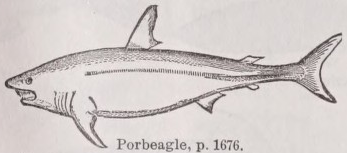
PORBEAGLE, the name of a shark (Lamna cornubica), mentioned in the works of older British authors as “Beaumaris Shark.” The short and stout form of its body contrasts strikingly with its much attenuated tail, which, however, is strengthened by a keel on each side and terminates in a large and powerful caudal fin. The snout is pointed, and the jaws are armed with strong lanceolate teeth, each of which bears a small cusp on each side of the base (see fig.). The teeth are not adapted for cutting, like the flat triangular teeth of man-eating sharks, but rather for seizing and holding the prey, which consists chiefly of various kinds of fishes and cephalopods. In the upper jaw there are from thirteen to sixteen teeth on each side, the third being remarkable for its small size; in the lower jaw from twelve to fourteen. The gill-openings are very wide. The porbeagle attains to a length of 10 or 12 feet, and is a pelagic fish, not rare in the North Atlantic and Mediterranean, and frequently wandering in pursuit of its prey to the British and more rarely to the American shores. The same species has been found in Japan and New Zealand, and perhaps also on the coast of California, so that the completion of the evidence as to its cosmopolitan range is merely a matter of time. Other closely-allied species (Z. spallanzanii, L. glauca) are known to occur in the southern parts of the Atlantic, from the Mediterranean to the Cape of Good Hope. Very little is known of the mode of propagation of the porbeagle, beyond the isolated statement by Pennant that two embryos were found in a female. No opportunity should be lost of making further observations on this point, and of preserving if possible the foetuses in their enveloping tunics.