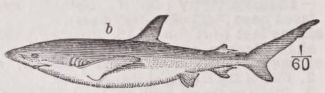
SHARK. The systematic position of the group of Sharks or Selachoidei in the class of Fishes, their classification, and their general external and anatomical characteristics have been already sufficiently noticed under Ichthyology (vol. xii. pp. 630 sq. ), and we have here to supplement that article only by a fuller reference to the natural history of the more common and more important types of the group.
Sharks are almost exclusively inhabitants of the sea, but some species freely enter the mouths of large rivers, and one species (Carcharias gangeticus) occurs frequently high up in the large rivers of India, and in the Tigris about Baghdad, at a distance of 350 miles from the Persian Gulf in a straight line, and has even been reported from a lake in Viti Levu (Fiji Islands) which is shut off from the sea by a cataract. Sharks are found in all seas; most numerous between the tropics, they become scarcer beyond, a few only reaching the Arctic circle; it is not known how far they advance southwards in the Antarctic region. Altogether some hundred and fifty different species have been described.
The majority of the littoral species live on the bottom, sometimes close inshore, and feed on small marine animals or on any animal substance. The following are deserving of special notice.
The Tope (Galeus) is common on the coasts not only of England, Ireland, and of the more southern parts of Europe, but also of South Africa, California, Tasmania, and New Zealand. Its teeth are equal in both jaws, of rather small size, flat, triangular, with the point directed towards the one side, and with a notch aud denticulations on the shorter side (fig. 1). It is of a uniform slaty-grey colour, and attains to a length of 6 feet. The female brings forth some thirty living young at one birth in May. It cannot be regarded as a very destructive fish, but becomes troublesome at times to fishermen by taking their bait and driving away other fish they desire to catch.
The Hounds proper (Mustelus) possess a very different dentition, the teeth being small, obtuse, numerous, arranged in several rows like pavement (fig. 2). Five or six species are known from the shores of the various temperate and subtropical seas, one (M. vulgaris) being common on the coasts of Great Britain and the United States on the Pacific as well as the Atlantic side. It is of a uniform grey colour or sparingly spotted with white, and attains to a length of 3 or 4 feet. The young, about twelve in number, are brought forth alive in November. It is a comparatively harmless fish, which feeds on shells, crustaceans, and decomposing animal substances.
Of the Dog-Fishes proper (Scyllium, Chiloscyllium, &c.) some twenty species are known, which are spread over nearly all the temperate and tropical seas. Their teeth are small, in several series, with a longer pointed cusp in the middle, and generally one or two smaller ones on each side (figs. 3 and 5). They are ail oviparous, their oblong egg-shells being produced at each corner into a long thread by which the egg is fastened to some fixed object. Some of the tropical species are ornamented with a pretty pattern of coloration.
The two British species, the
Lesser and the Larger Spotted
Dog-Fish (Sc. canicula and Sc. catulus), belong to the most common fishes of the coast, and are often con founded with each other.
But the former is finely dotted with brown above, the latter having the same parts covered with larger rounded brown spots, some of which are nearly as large as the eye. As regards size, the latter exceeds somewhat the other species, attaining to a length of 4 feet. Dogfishes may become extremely troublesome by the large numbers in which they congregate at fishing stations; nor do they compensate for the injury they cause to fishermen, being but rarely used as food, ex cept at certain seasons by the poorer classes of the Mediterranean countries, in China and
Japan, and in the Ork neys, where they are dried for home consumption.
The Black-mouthed Dog-Fish (Pristiurus melanostomus) is another European species which is rarely caught on the British coasts, and is recognized by a series of small, fiat spines with which each side of the upper edge of the caudal fin is armed.
The Tiger-Shark (Stegostoma tigrinum) is one of the commonest and handsomest sharks in the Indian Ocean. The ground colour is a brownish-yellow, and the whole fish is ornamented with black or brown transverse bands or rounded spots. It is a littoral species, but adult specimens, which are from 10 to 15 feet long, are not rarely met far from land. It is easily recognized by its enormously long bladelike tail, which is half as long as the whole fish. The teeth are small, trilobed, in many series. The fourth and fifth gill-openings are close together.
The genus Crossorhinus, of which three species are known from the coasts of Australia and Japan, is remarkable as the only instance in this group of fishes in which the integuments give these inactive ground-sharks, whilst they lie concealed watching for their prey, what may be called a “celative” rather than a “protective” resemblance to their surroundings. Skinny frond-like appendages are developed near the angle of the mouth, or form a wreath round the side of the head, and the irregular and varied coloration of the whole body closely assimilates that of a rock covered with short vegetable and coralline growth. This peculiar development reminds us of the similar condition in the sea-devil (Lophius), where it serves also to conceal the fish from its prey, rather than to protect it from its enemies. The species of Crossorhinus grow to a length of 10 feet.
The so-called Port Jackson Shark (Cestracion) is likewise a littoral form. Besides the common species (C. philippi), three other closely allied kinds from the Indo-Pacific are known. This genus, which is the only existing type of a separate family, is one of special interest, as similar forms occur in Primary and Secondary strata. The jaws are armed with small obtuse teeth in front, which in young individuals are pointed, and provided with from three to five cusps. The lateral teeth are larger, pad-like, twice as broad as long and arranged in oblique series (fig. 7),—an arrangement admirably adapted for the prehension and mastication of crustaceans and hard-shelled animals. The fossil forms far exceeded in size the living, which scarcely attain to a length of 5 feet. The shells of their eggs are not rare in collections, being found thrown ashore like those of our dog-fishes. The shell is pyriform, with two broad lamellar ridges each wound edgewise five times round it (fig. 8). .
The Spiny or Piked Dog-Fish (Acanthias) inhabits, like the majority of littoral genera of sharks, the temperate seas of both the northern and southern hemispheres. For some part of the year it lives in deeper water than the sharks already noticed, but at uncertain irregular times it appears at the surface and close inshore in almost incredible numbers. Couch says that he has heard of 20,000 having been taken in a sean at one time; and in March 1858 the newspapers reported a prodigious shoal reaching westward to Uig, whence it extended from 20 to 30 miles seaward, and in an unbroken phalanx eastward to Moray, Banff, and Aberdeen. In the deep fjords of Norway, and indeed at every station of which a shoal of these fishes has taken temporary possession, line-fishing has to be suspended during the time of their visit, as they cut the lines with their scissors-like teeth. As expressed by the name, these fishes are distinguished from the other British littoral sharks by each of the two dorsal fins being armed in front by an acute spine. They do not possess an anal fin. Their teeth are rather small, placed in a single series, with the point so much turned aside that the inner margin of the tooth forms the cutting edge (fig. 9). The spiny dogfish are of a greyish colour, with some whitish spots in young specimens, and attain to a length of 2 or 3 feet. They are viviparous, the young being pro duced throughout the summer months.
It is stated that in the northern islands of Great Britain they are dried for food, and that their livers yield a large quantity of oil.
Finally, we have to notice among the littoral sharks the “Angel-Fish” or “Monk-Fish” (Rhina squatina), which, by its broad flat head and expanded pectoral fins approaches in general appearance the rays. It occurs in the temperate seas of the southern as well as the northern hemisphere, and is not uncommon on sandy parts of the coast of England and Ireland. It does not seem to exceed a length of 5 feet, is not used as food, and is too rare to do any perceptible injury to other fish. It is said to produce about twenty young at a birth.
Pelagic Sharks.— All these are of large size, and some are surpassed in bulk and length only by the larger kinds of cetaceans. Those armed with powerful cutting teeth are the most formidable tyrants of the ocean and dangerous to man, whilst others, which are provided with numerous but very small teeth, feed on small fishes only or marine invertebrates, and are otherwise almost harmless and of a timid disposition, which causes them to retire into the solitudes of the open sea. On this account we know very little of their life; indeed, some are known from a few individuals only which have accidentally come ashore. All pelagic sharks have a wide geographical range, and many are found in all seas within the limits of the equatorial zone,—some being almost cosmopolitan. All seem to be viviparous.
Of the more remarkable forms which we propose to notice here the genus most abundantly represented in species and individuals is Carckarias. Perhaps nine-tenths of the sharks of which we read in books of travel belong to this genus. Between thirty and forty species have been distinguished, all of which are found in tropical seas. They are the sharks which so readily attach themselves to sailing vessels, following them for weeks, and thus exhibiting an endurance of muscular power scarcely found in any other class of animals. Others affect more the neighbourhood of land, congregating at localities where nature or the vicinity of man provides them with an abundant supply of food. One of the most common species, and one of those which extend far into the temperate zones, is the Blue Shark (Carcharias glaucus), of which small specimens (4 to G feet long) are frequently caught on the south coasts of England and Ireland. Other species of Carcharias attain a length of 25 feet. The mouth of all is armed with a series of large flat triangular teeth, which have a sharp, smooth, or serrated edge (fig. 10).
Galeocerdo is likewise a large shark very dangerous to man, differing from the preceding chiefly by having the outer side of its teeth deeply notched. It has long been known to occur in the North Atlantic, close to the Arctic Ocean (G. arcticus), but its existence in other parts has been ascertained within a recent period; in fact, it seems to be one of the most common and dangerous sharks of the Indo-Pacific, the British Museum having obtained specimens from Mauritius, Kurrachee, Madras, and the west coast of Australia.
Hammerheaded Sharks (Zygaena) are sharks in which the anterior portion of the head is produced into a lobe on each side, the extremity of which is occupied by the eye. The relation of this unique configuration of the head to the economy of the fish is unknown. Otherwise these sharks resemble Carcharias, and are equally formidable, but seem to be more stationary in their habits. They occur in all tropical and subtropical seas, even in the Mediterranean, where Z. malleus is by no means rare. In the Indian Ocean it is common, and Cantor states that specimens of this species may be often seen ascending from the clear blue depths of the ocean like a great cloud.
The Porbeagles (Lamna) differ from the preceding sharks in their dentition (fig. 11), the teeth being large, lanceolate in shape, not adapted for cutting, but rather for seizing and holding the prey, which consists chiefly in fish. These sharks are therefore not dangerous to man; at least, there is no instance known of a person having been attacked by the species common on the British coast (L . cornubiea). It grows to a length of 10 feet, and ranges to New Zealand and Japan. See vol. xix. p. 518.
To the genus Carcharodon particular interest is attached, because the single still existing species is the most formidable of all sharks, as were those which preceded it in Tertiary times. The existing species (C. rondeletii) occurs in almost all tropical and subtropical seas, but seems to be verging towards extinction. It is known to attain to a length of 40 feet. The tooth figured here of the natural size (fig. 12) is taken from a jaw much shrunk in drying, but still 20 inches wide in its transverse dia meter, and taken from a specimen 36 1/2 feet long. The extinct spe cies must have been still more gigantic in bulk, as we may judge from teeth which are found in the crag or which have been dredged up from the bottom of the Pacific
Ocean by the naturalists of the “Challenger”
expedition, and which are 4 inches wide at the base and 5 inches long measured along their lateral margin. In some Tertiary strata these teeth are extremely abundant, so much so that—for instance, in Florida—the strata in which they occur are quarried to obtain the fossil remains for export to England, where they are con verted into artificial manure.
The Fox-Shark or Thresher (Alopecias vulpes), of which every year specimens frequently seen during the summer months, generally in companies, at a distance of from three to a hundred miles off the shore, it is chased by the more courageous of the fishermen for the sake of the oil which is extracted from the liver, one fish yielding from a ton to a ton and a half. Its capture is not unattended with danger, as one blow from the enormously strong tail is sufficient to stave in the sides of a large boat. The simple method used at present of harpooning the fish entails much patience and loss of time upon the captors, as the fish generally sinks to the bottom and sulks for many hours before it rises again in a more or less exhausted condition; and the use of more modern appliances could not fail of securing more speedy and better success. The basking shark is gregarious, and many individuals may be seen in calm weather lying are captured on the British coast, but which is common in all the temperate seas of the northern and southern hemispheres, is readily recognized by its extremely slender tail, the length of which exceeds that of the remainder of the body. Its teeth are small, flat, triangular, and without serrature (fig. 13; the single tooth is of the natural size). It follows the shoals of herrings, pilchards, and sprats in their migrations, destroying incredible numbers and frequently injuring the nets by getting entangled in them. When feeding it uses the long tail in splashing the surface of the water, whilst it swims in gradually decreasing circles round a shoal of fishes which are thus kept crowded together, falling an easy prey to their enemy. Sometimes two threshers may be seen working together. Statements that it has been seen to attack whales and other large cetaceans rest upon erroneous observations; its dentition is much too weak to bite through their skin, although, as Couch says, by one splash of its tail on the water it may put a herd of dolphins or porpoises to flight like so many hares. The same effect may be produced by the splash of an oar. The thresher attains to a length of 15 feet, the tail included.
The Basking Shark (Selache maxima), sometimes erroneously called “Sun-Fish,” is the largest fish of the North Atlantic, growing to a length of more than 30 feet. It is one of the few types of sharks which up to a very recent time were considered to be peculiar to the North-Atlantic fauna; but Prof. F. M'Coy has just recorded its occurrence on the Australian coast, a specimen 30 feet long having been captured in November 1883 at Portland, on the west coast of Victoria. The mouth is of an extraordinary width, and, like the gill-cavity, capable of great expansion, so as to enable the fish to take at one gulp an enormous quantity of the small fish and other marine creatures on which it subsists. Also the gill-openings are of great width. The teeth are very small, numerous, arranged in several series, conical, and probably without use in feeding. This shark is therefore quite harmless if not attacked. On the west coast of Ireland, where it is together motionless, with the upper part of the back raised above the surface of the water, a habit which it has in common with the true sun-fish (Orthagoriscus), and from which it has derived its name.
A shark similar in many points to the basking shark (which it exceeds in size), and an inhabitant of the Indo-Pacific Ocean, is Rhinodon typicus. In fact, so far as our present knowledge goes, it is the largest of all sharks, as it is known to exceed a length of 50 feet, but it is stated to attain that of 70. The captures of only a few specimens are on record, viz., one at the Cape of Good Hope, one or two near the Seychelles, where it is known as the “chagrin,” one on the coast of California, and one (quite recently) on the coast of Peru. The snout is extremely short, broad, and flat, with the mouth and nostrils placed at its extremity; the gill-openings very wide, and the eye very small. The teeth are, as in the basking shark, extremely small and numerous, conical in shape. No opportunity should be lost of obtaining exact information on this shark.
The Greenland Shark (Laemargus borealis) belongs to the same family as the spiked dog-fish, but grows to a much larger size, specimens 15 feet long being frequently met with. The two dorsal fins are small and destitute of spines. The teeth (fig. 11) in the upper jaw are small, narrow, conical in shape; those of the lower flat, arranged in several series, one on the top of the other, so that only the uppermost forms the sharp dental edge of the jaw. The points of these lower teeth are so much turned aside that the inner margin only enters the dental edge.
The Greenland shark is an inhabitant of the Arctic regions, sometimes straying to the latitudes of Great Britain and of Cape Cod in the western Atlantic; it is one of the greatest enemies of the whale, which is often found with large pieces bitten out of the tail·by this shark. Its voracity is so great that, as Scoresby tells us, it is absolutely fearless in the presence of man whilst engaged in feeding on the carcase of a whale, and that it will allow itself to be stabbed with a lance or knife without being driven away.
The Spinous Shark (Echinorhinus spinosus) is readily recognized by the short bulky form of its body, its short tail, and the large round bony tubercles which are scattered all over its body, each of which is raised in the middle into a pointed conical spine. More frequent in the Mediterranean, it has been found also not very rarely on the English coasts and near the Cape of Good Hope. It is always living on the ground, and probably descends to some depth. It does not seem to exceed a length of 10 feet.
Bathybial Sharks.— Sharks do not appear to have yet reached the greatest depths of the ocean; and so far as we know at present we have to fix...