
A South African wild ass (Equus, / Hippotigris, quagga). The upper parts are reddish brown, becoming paler behind and behind and beneath, with dark stripes on the face, neck, and fore part of the body.
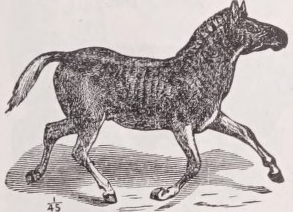
QUAGGA, or Couagga, an animal of the genus Equus (see Horse, vol. xii. p. 175), nearly allied to the zebra, which formerly was met with in vast herds on the great plains of South Africa between the Cape Colony and the Vaal river, but now, in common with most of the larger wild animals of that region, becoming extremely scarce, owing to the encroachments of European civilization. In length of ears and character of tail it more resembles the horse than it does the ass, although it agrees with the latter in wanting the small bare callosity in the inner side of the hind leg, just below the hock, characteristic of the horse. The colour of the head, neck, and upper parts of the body is reddish-brown, irregularly banded and marked with dark brown stripes, stronger on the head and neck and gradually becoming fainter until lost behind the shoulder. There is a broad dark median dorsal stripe. The under surface of the body, the legs, and tail are nearly white, without stripes. The crest is very high, surmounted by a standing mane, banded alternately brown and white. Though never really domesticated, quaggas have occasionally been trained to harness. The accompanying figure is reduced from a painting made from one of a pair which were driven in Hyde Park by Mr Sheriff Parkins in the early part of the present century. The name is an imitation of the shrill barking neigh of the animal, “ouag-ga, ouag-ga,” the last syllable very much prolonged. It must be remembered, however, in reading books of African travel that the same word is very commonly applied by hunters to another and more completely striped species, called by zoologists Burchell’s zebra.