3. The distance from a point in a curve to the chord; also, the versed sine of an arc; -- so called from its resemblance to an arrow resting on the bow and string.
4. The larger of the two otoliths, or ear bones, found in most fishes.
5. A genus of transparent, free-swimming marine worms having lateral and caudal fins, and capable of swimming rapidly. It is the type of the class Chaetognatha.
SAGITTA. The name “Sagitta” was given by Martin Slabber in 1775 to a small marine worm which is now known as the type of a distinct group, the Chaetognatha (Leuckart). The group comprises two genera (Sagitta and Spodella) and a considerable number of species; they are small transparent pelagic animals, varying in length from a few lines up to two inches, and are universally distributed. The body (see fig.) is elongated and furnished with a tail and lateral fins, which are prolongations of the chitinouscuticle; the head is provided with a great number of variously shaped chitinoussetae. The body is divided by transverse septa into three distinct segments: the first septum is placed just behind the head (st), the second (st) about the middle of the body, separating the ovaries and testes. The body-cavity is likewise separated into right and left halves by a continuous vertical mesentery, 'which suspends the gut. The alimentary canal is a simple straight tube of uniform structure passing from the mouth to the anus, which is placed ventrally and at the second transverse septum; the alimentary tube is ciliated and is unprovided with glands of any kind. The body-wall is composed of (1) an outer layer of epidermis, which secretes the chitinouscuticle already referred to,—the thickness of the epidermis varying from five or six cells in the region of the head to a single layer of cells in the “fins ”; (2) a delicate structureless supporting lamella; (3) a layer of longitudinal muscles. These last have a peculiar arrangement and structure: they are disposed in four bands, two dorsal and two ventral, the action of which is evidently favourable to producing the onward movements of the creature. The muscular fibres, which are transversely striated, are arranged in a ...series of lamellae whose direction is perpendicular to the longitudinal axis of the body. Projections inward of the supporting lamella bear on either side a single row of muscular fibres; a similar muscular structure occurs in the Nematoidea and in many Oligoehaeta. In the anterior region of the body the muscular layer is differentiated into special muscles for the movement of the setae. (4) The body-cavity is lined by a delicate peritonealepithelium closely applied to the muscular layer of the body-wall and to the gut. The nervous system consists of a cerebralganglion and a large ventral ganglion—the two united by commissures which pass round the gut; both ganglia are embedded in the epidermis. This primi tive condition of the nervous system is retained in other lowly organized worms (e.g., Polygordius). The ventral ganglion is connected with an intra-epidermic nervous plexus which surrounds the whole body. Eyes are present, besides a number of tactile cells upon the outer surface of the body; anteriorly is a ring-shaped structure (r ) which is supposed to be olfactory in function. The generative organs consist of ovaries and testes, which are united in the same individual; the ovaries (e ), placed anterior to the testes, are furnished with oviducts, which appear to terminate in a caecal extremity. The testes (ho) are placed behind the second septum; they are each furnished with a vas deferens opening on to the exterior and into the body-cavity by a ciliatedfunnel.
In spite of the detailed knowledge which we now possess of the structure and development of the Chaetognatha, the systematic position of the group remains a matter of the greatest uncertainty. That they are an archaic group is shown by their hermaphroditism, by the primitive condition of the nervous system, and by the persistence of the vertical mesentery among other characters; in all these points and in others they agree with such primitive Annelida as Protodrilus and Polygordius. On the other hand, their similarity to the Ncmatoidea has been dwelt upon; the disposition of the muscles is the same in both groups, and the Gordiacese have the gut suspended by a dorsal and ventral mesentery in the same fashion as has been described above in Sagitta; the Chaetognatha differ, however, from the Nematoidea in the important fact of their segmentation. On the whole, it appears that the Chaetognatha are best regarded as a special phylum equivalent to such groups as Annelida, Platyhelminthcs, Ncmatoidea, but having no special relation to any one of them.
9th ed. Encyclopædia Britannica, vol. 21, p. 148 [730 words — estimated reading time: 5 minutes]
1. Of or pertaining to an arrow; resembling an arrow; furnished with an arrowlike appendage.
2. Of or pertaining to the sagittal suture; in the region of the sagittal suture; rabdoidal; as, the sagittal furrow, or groove, on the inner surface of the roof of the skull.
3. In the mesial plane; mesial; as, a sagittal section of an animal.
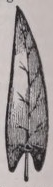
In botany, shaped like the head of an arrow; triangular, hollowed at the base, with angles at the hinder part; or with the hinder angles acute, divided by a sinus; applied to the leaf, stipula or anther.
This site uses cookies to remember your display preferences (search sources and editions, Bible version, auto-link, images, light/dark theme). No personal data whatsoever is collected. Privacy Policy