History.— The honour of inventing the thermometer has been given to several natural philosophers of the 16th century; the claims of Robert Fludd are more tangible than those of Drebbel and Santorio, but the instrument invented by Galileo before 1597 seems best entitled to be considered the precursor of accurate thermometers. All the early instruments were air thermoscopes, and, until the variations of atmospheric pressure were discovered, their use was only deceptive. Galileo’s thermometer (fig. 1) consisted of a glass bulb containing air, terminating below in a long glass tube which dipped into a vessel containing a coloured fluid. The variations of volume of the enclosed air caused the fluid to fall or rise in the tube, to which an arbitrary scale was attached. The great step in advance of inventing the alcohol thermometer is also due to Galileo, but the date (probably 1611 or 1612) is not precisely known. Rinieri certainly had alcohol thermometers made before 1647, and they are referred to as familiarly known in the oldest memoirs of the Accademia del Cimento (1667). In form they resembled those now in use; they had large spherical (or, occasionally, cylindrical or helical) bulbs, and the degrees intended to represent thousandths of the volume of the reservoir were marked with beads of enamel fused on to the stem (fig. 2). All the Florentine instruments were graduated in the same way, but the scale was arbitrary, and the recorded readings were accordingly supposed for a long time to be useless. In 1829 the fortunate discovery by Antinori of a number of those early Florentine thermometers enabled their scale to be ascertained and translated into known degrees. The temperature of melting ice was marked by them as 13 - 5, while 50 corresponded with 55° C. No means of comparing observations made by thermometers of different manufacture existed until certain fixed points of universal accessibility were discovered. The thermal conditions of freezing water were studied with great care, but natural congelation was generally supposed to take place at variable temperatures, until Fahrenheit proved that, however much water could be cooled down without freezing, the temperature when ice began to form was always the same. Hooke, in 1665 ÇMicrographia, p. 38), describes the manufacture and graduation of comparable spirit thermometers with the freezing point of water as the zero of their scales, and he evidently recognized it as fixed. Halley in 1693 stated that the temperature of boiling water is constant, and this was again proved by Amontons in 1702. In 1694 Renaldeni of Padua proposed to graduate thermometers by taking as standards of temperature mixtures of definite volumes of ice-cold and boiling water. This method, although theoretically admirable (see Heat, vol. xi. p. 559), is defective in practice. Seven years later Newton proposed anonymously {Phil. Trans., 1701, vol. xxii. p. 824) a thermometer scale on which the temperature of freezing water was 0°, and that of the blood of a healthy man 12°. Continuing the graduation of a linseed-oil thermometer above this point, he found that water boiled at 34°. Fahrenheit in 1714 took as fixed points the temperature of the human body and that of a mixture of ice and sal ammoniac or common salt. In 1721 he made a mercury thermometer according to Halley’s suggestion of 1693, and by means of it he proved the dependence of the boiling point on pressure. It was not until after Fahrenheit’s death that the freezing and boiling points of λvater were universally accepted as fixed points on the thermometric scale. The thermometer has remained unchanged in its main features since the middle of the 18th century. Mercury has been found the most convenient fluid for ordinary use, in spite of the advantages (Heat, vol. xi. p. 561 sqf presented by lighter and more volatile liquids. Graduation of thermometers, by marking off volumes of the stem equal to a given fraction of the capacity of the bulb, although reintroduced by Réaumur in 1730, has now been entirely discontinued.
The idea of a self-registering thermometer early presented itself. Many forms were devised by natural philosophers and instrument-makers. That of Sixe, in 1782, a precursor of which, dating from the 17th century, is preserved amongst the instruments of the Florentine Academy, was the most successful.
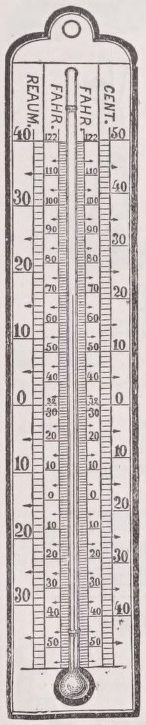
Scales.— The absolute zero of temperature is the logical beginning of a thermometric scale, but some point easy of reference is desirable, and this is found in the temperature at which ice melts and water freezes. The second accepted fixed point is that at which distilled water boils under the pressure of 760 millimetres (29’92 in.) of mercury. For the division of the space between the two fixed points into degrees of convenient length only three of the innumerable methods proposed have survived, and one of these, the centigrade, is rapidly becoming universal. The oldest system, that of Fahrenheit, dates from 1724. It is used for meteorological purposes, and popularly, in Great Britain, the British colonies, and the United States. The freezing point is marked 32° and the boiling point of water 212°. At first Fahrenheit employed a scale of 180 degrees; the zero was placed at “temperate” (9° C.); 90° at “blood-heat,” the point to which the alcohol rose when the thermometer was placed under the arm of a healthy man; and - 90° at the temperature of a mixture of ice and salt, then believed to be the greatest possible cold. In 1714 Fahrenheit changed his scale at the suggestion of the Danish astronomer Roemer, placed 0° at his “absolute zero,” and divided the space between that and the warmth of the human body into 24 degrees. The freezing point of water thus became 8°. For convenience, these long degrees were divided into quarters, which were afterwards termed degrees; thus the freezing point became 32° and blood heat 96°. A mercury thermometer graduated in this way, with divisions of equal length continued above blood heat, registered 212° in boiling water. Thus the Fahrenheit scale came from a duodecimal reckoning.
De Lisle, in 1724, introduced a scale in which the boiling point of water was marked 0° and the temperature of the cellars of the Paris Observatory 100°. He afterwards adopted the freezing point of water as his upper fixed point, and called it 150°. This scale was used for many years in Russia, but is now obsolete.
In 1730 Réaumur made alcohol thermometers with their zero at the freezing point of water, and degrees of one-thousandth of the volume of the bulb. On some of these the boiling point of water was 80°; but the instruments were defective in principle and very unequal in their indications. Deluc introduced mercury thermometers graduated from 0° in melting ice to 80° in boiling water, and these, with Réaumur’s name attached, are in use for popular purposes in Germany, Holland, and other parts of the Continent.
Celsius adopted a centesimal scale in 1742. The boiling point was marked 0° and the freezing point of water 100°. Linnaeus introduced the mode of reckoning from 0° in melting ice to 100° in boiling water, which is now known as the centigrade, and is used universally in laboratories, and in all except English-speaking countries for every scientific purpose.
Fahrenheit’s scale is convenient for meteorological work on account of its short degrees, admitting of great accuracy in reading and compactness in recording, and on account of its low zero, which makes it possible in temperate climates to dispense with negative quantities. On the other hand, the centigrade scale is on the whole so convenient, its use is so nearly universal, and the advantage of a uniform system is so great that it must ultimately be adopted for all purposes. Air Thermometer. —Under constant pressure gases expand equally for equal increments of heat. Hence, when an air thermometer is graduated between two fixed points the graduation may be continued above and below these points in degrees of the same length; and any number of air thermometers so made will agree amongst themselves at every temperature. The principle of air thermometers is treated of in Heat (nt sup.), and examples of special forms are described in that article and in Pyrometer. The air thermometer is the ultimate standard of reference to which all other thermometers are referred.
Alcohol Thermometer. —Alcohol, the first liquid used for thermometric purposes, possesses numerous advantages, and on account of its low freezing point it is always used for observations in polar regions. Alcohol thermometers are graduated by fixing the freezing point in melting ice and by comparison with a mercury or air thermometer at several higher and lower temperatures. Recently low-temperature thermometers have been verified at Kew in melting mercury at the temperature of - 40. The law of expansion of alcohol in glass at low temperatures is not known with such precision as to make the minimum indications of Arctic expeditions entirely trustworthy. The graduation of ordinary minimum alcohol thermometers used for meteorological purposes is effected by comparison with mercury standards, and their indications, so far as this source of uncertainty is concerned, may consequently be relied on.
Mercury in Glass Thermometer. —The simplest form is the Weight Thermometer, a large glass bulb terminating in a capillary tube, and filled with a known weight of mercury at 0° 0. The weight of mercury that escapes when the apparatus is heated to
100° is determined, and the temperature of any enclosure is then ascertained by placing in it the thermometer filled at zero, and weighing the liquid that runs out. Thermometers on this principle were used by Régnault in his celebrated researches on steam.
Standard Thermometers.— The tube is sometimes made with elliptical bore to ensure visibility of the mercury column, but it is usually circular in section. The internal diameter must be as nearly as possible uniform. This is tested by a preliminary calibration in which a short thread of mercury is measured in different parts of the tube. The length of stem and the range of the thermometer having been decided upon, the size of the bulb is calculated from the known expansibility of mercury and the section of the bore. The bulb is made as nearly as possible the required size, either by blowing it from a tube or preferably by forming it of a glass cylinder, and attached to the stem. The bulb is usually cylindrical in form and it must be uniform in thickness. The utmost care requires to be exercised to keep the bulb and stem dry and clean and to fill them with pure mercury recently distilled. The mercury is boiled in the thermometer for some time to drive out all traces of air and moisture, and the point of the stem is sealed off. If the thermometer is not intended to measure temperatures up to the boiling point of mercury, an expansion should be made at the top of the tube to prevent bursting from accidental overheating. Under Heat (vol. xi. p. 561) the changes of volume which thermometer bulbs undergo in cooling and for a long time afterwards are discussed. The process of annealing by heating to a temperature exceeding 400° C. for some hours as originally proposed by Person, or in vapour of mercury for several days as recently practised at Kew, renders the thermometer much less liable to suffer change of zero by the lapse of time or by heating to any lower temperature. All instruments of precision should be treated in this way, or kept for several years after they have been filled and sealed before they are graduated.
The first fixed point on the scale is marked at the place where the mercury stands when the thermometer is buried in melting ice from which the water is allowed to drain away, the second at the place where the mercury stands when the thermometer is immersed in steam of water boiling freely under the pressure of 760 mm. (29’92 inches) of mercury corrected to 0° C. The space between these may be graduated either in arbitrary equidistant divisions, as it is best to do in delicate instruments, or in degrees of any scale. Each degree centigrade is ¹∕₁₀₀ of the volume of the tube between the freezing and boiling points; if the tube is quite uniform in bore the degrees will be of equal length and may be marked off correctly by a dividing engine. If the preliminary calibration showed the tube to vary in diameter, the degree marks are often adjusted to correspond to intervals of equal volume. It is better in all cases, whether degrees or arbitrary divisions are adopted, to have them of equal length and correct the readings by the calibration curve. The scale may be continued above and beneath the fixed points in degrees or divisions of the same length.
Calibration consists in measuring the internal volume of the thermometer tube by means of a thread of mercury detached from the main column. There are several ways of doing this, for particulars of which reference may be made to the British Association Report on the subject (1882, pp. 145-204), where references to original memoirs are given. The best and simplest is Gay Lussac’s “step by step” method.
The most recent and approved processes of manufacturing, testing, and using standard thermometers of greÿ delicacy and high precision are described by Guillaume in his “Études Thermométriques” ( Travaux et Mémoires du Bureau International des Poids et Mesures, v., 1886); for additional information the work of Pickering cited below may also be consulted.
Comparison of Thermometers.— As the apparent expansion of mercury in glass from -39° to 100° C., xxii. 1886, p. 325. ] is very nearly proportional to the amount of heat imparted to it, a thermometer made and divided as indicated above is a natural standard. But the apparent expansion with different kinds of glass differs (see Heat, vol. xi. pp. 563-4), and, except at the fixed points or near them, mercury thermometers of different construction will only fortuitously agree absolutely among themselves or with the air thermometer. Bosscha states that at 50° C. the mercury thermometer shows an error of 0 o- 5, other experimenters place it as high as 1°, but Mascart found it to amount only to 0° ’ 06. For purposes of ordinary experiment thermometers are compared at several temperatures with some standard instrument of known value—that of the Kew observatory for Great Britain,—and all results are stated in terms of the standard. The methods of comparison at Kew are described by Welsh (Proc. R∙ S., vi. 181) and Whipple (Phil. Mag., [5], xxi., 1886, p. 27).
The reading of thermometers is greatly facilitated by the process of enamelling the back, and still more by that of entirely surrounding the instrument with enamel except over a narrow strip through which the mercury is seen. The enamel must not be allowed to encroach on the bulb, for that would endanger the homogeneity and strength of the glass.
Thermometers Employed for Special Purposes.— Physical and Chemical Work.—For all purposes of minute accuracy where thermometers are applicable standard instruments must be employed. They must be used in one position only. The stem is usually engraved with an arbitrary scale of equal divisions, the total range not exceeding 15° C., and readings are made by a cathetometer at some distance. The use of an intermediate bulb, first recommended by Person, enables the fixed points to be observed on instruments of very short range. Results of great accuracy, certainly to 0° ’ 005 C., may be obtained in this way for comparative purposes if sufficient care be taken; but the greater the sensitiveness of a thermometer the more difficult is it to obtain a series of concordant readings (Heat, vol. xi. p. 562). Pickering, xxl., 1886, p. 331; xxiii., 1887, pp. 401, 406. ] uses thermometers of extreme sensitiveness, in which, by conveying the excess of mercury into an expansion at the top of the stem, he secures that the same part of the short arbitrary scale is used for every temperature that has to be measured. In physical researches thermoelectric junctions are more often used than thermometers for measuring very small differences of temperature.
For ordinary work in a chemical or physical laboratory thermometers are used which can be read easily to one-tenth of a degree centigrade, and have a range from 0° to 100°, or in some cases to 350° C. They are always either engraved on the stem or graduated on an included scale (see Heat, figs. 4, 5), and are not mounted on frames of any kind. It is not necessary to calibrate such thermometers; but they should be compared with a standard at several temperatures and frequently verified in melting ice and steam of boiling water.
Zincke’s chemical thermometer for high temperature has a scale commencing at 100° C. In Geissler ’ s nitrogen thermometer the range is extended by raising the boiling point of the included mercury, the upper part of the tube being filled with rarefied nitrogen.
Meteorological.— The thermometer was early applied to the study of differences of climate, and this is still one of its most important uses. The wet and dry bulb thermometers placed in the shade give the temperature and humidity (see Hygrometry) of the surrounding air, but “shade” and “surrounding air” require to be defined. Shade is intended to exclude rain and prevent all radiation; and the surrounding air is that of the atmosphere in the neighbourhood of the thermometer outside any shelter that may be used. The simplest way of observing is to hang up a thermometer in the shadow of some rather distant object and leave it until it acquires a steady temperature; but this method has been found impracticable and does not give very exact results.
In different countries different patterns of thermometer shelter are employed and exposure takes place at a different height above the ground. Results so obtained cannot be critically compared, and the relative mean temperatures of the atmosphere in different countries are only known to within one or two degrees. The Stevenson double-louvred screen (see vol. xvi. p. 115), a box open below, provided with a solid roof, is used at all meteorological stations in Great Britain. It is placed 4 feet from the ground, and painted white outside and inside. The results derived from its use are comparable, because the conditions in which it is employed are the same, but the general introduction of a double roof would greatly add to its efficiency. Exposure outside windows or in wall boxes is the rule in Austria. In France the Renou screen is largely used; it is a flat roof one square metre in extent, and double; the thermometers are hung under it two metres from the ground. A similar roof, but of much larger size, is employed in Australia, in combination with a metal thermometer-box. A metallic box, constructed of double louvres with an air-space between, finds favour in Spain. In Russia and Switzerland Wild’s shelter is extensively employed. The thermometers are enclosed in a case composed of two or three concentric zinc cylinders perforated to admit air, and placed 11 feet above the ground. They are protected by a large shelter of wood, the south wall and roof of which are double and made of solid boards, between which air circulates; the east and west sides are louvred, and the north side entirely open. A similar shelter is used in Canada, to cover a box of single sheet-iron louvres in which the thermometers are placed 4⅛ feet from the ground. Various systems of exposure were authorized in the United States until 1885. It was then decided, as the result of experiments carried on for nearly two years, that a uniform pattern of shelter be adopted by the Signal Service. It is a single-louvred wooden box, 3 feet 6 inches long, 3 feet wide and high, with a movable bottom and a double roof. The louvres are provided with an upright flange on their inner side, designed to keep rain from the thermometers. The bottom of the shelter is to be fixed either 9 feet above a roof or 16 feet above grass.
All these screens are confessedly imperfect, although most of them are well adapted for the climates in which they are used. Numerous comparisons of different screens with each other have been made, but in some cases sufficient precautions in the way of using instruments precisely similar and only dissimilarly situated have not been observed, and the results are uncertain. A critical comparison of the leading forms of thermometer shelter in use is still a...