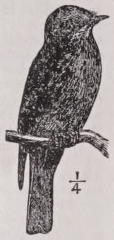
2. In zoology, a genus of birds, the Muscicapa, with a bill flatted at the base, almost triangular, notched at the upper mandible, and beset with bristles. These birds are of the order of Passers, and the species are very numerous.
FLYCATCHER, a name introduced in ornithology by Kay, being a translation of the Muscficapa of older authors, and applied by Pennant to an extremely common English bird, the Μ. grisola of Linnaeus. It has since been used in a general and very vague way for a great many small birds from all parts of the world, which have the habit of catching flies on the wing, and thus ornithologists who have trusted too much to this characteristic and to certain merely superficial correlations of structure, especially those exhibited by a broad and rather flat bill and a gapebeset by strong hairs or bristles, have associated under the title of Muscicapidae an exceedingly heterogeneousassemblage of forms that, though much reduced in number by later systematists, has scarcely yet been sufficiently revised. Great advance has been made, however, in establishing as independent Families the Todidae and EurylaemiAae, as well as in excluding from it various members of the Åmpelidae, Cotingidae, Tyrannidae, Vireondae, Mniotiltidae, and perhaps others, which had been placed within its limits. These steps have left the Muscicapidae a purely Old-World family of the Order Passeres, and the chief difficulty now seems to lie in separating it from the Campephagidae and the Laniidae. Every ornithologist must own that its precise definition is at present almost impossible, and must await that truer knowledge which comes of investigatingstructural characters more deeply seated than any afforded by the epidermis. But here want of space forbids the pursuit of this kind of inquiry, and for the same reason only a very few of the forms of Flycatchers (which, after all the deductions above mentioned, may be reckoned to include some 60 genera or subgenera, and perhaps 250 species) can be even named....
The best known bird of this Family is that which also happens to be the type of the Linnaean genus Muscicapa— the Spotted or Grey Flycatcher (JZ^. grisolast already mentioned. It is a common summer-visitant to nearly the whole of Europe, and is found throughout Great Britain, though less abundant in Scotland than in England, as well as in many parts of Ireland, where, however, it seems to be but locally and sparingly distributed. It is one of the latest of our migrants to arrive, and seldom reaches these islands till the latter part of May, when it may be seen, a small dust-coloured bird, sitting on the posts or railings of our gardens and fields, ever and anon springing into the air, seizing with an audible snap of its bill some passing insect as it flies, and returning to the spot it has quitted, or taking up some similar station to keep watch as before. It has no song, but merely a plaintive or peevish call-note, uttered from time to time with a jerkinggesture of the wings and tail. It makes a neat nest, built among the small twigs which sprout from the bole of a large tree, fixed in the branches of some plant trained against a wall, or placed in any hole of the wall itself that may be left by the falling of a brick or stone. The eggs are from four to six in number, of a pale greenish-blue, closely blotched or freckled with rust-colour. Silent and inconspicuous as is this bird, its constant pursuit of flies in the closest vicinity of our houses makes it a familiar object to almost everybody. A second British species is the Pied Flycatcher (3/. atriaeapilla) —called by some writers the Coldfinch—a much rarer bird, and in England not often seen except in the hilly country extending from the Peak of Derbyshire to Cumberland, and more numerous in the lake district than elsewhere. It is not common in Scotland, and has only once been observed in Ireland. More of a woodland bird than the former, the brightly-contrasted black and white plumage of the cock, together with his agreeable song, readily attracts attention where it occurs. It is a summer visitant to all Western Europe, but further eastward its place is taken by a nearly allied species (Μ. collaris) in which the white of the throat and breast extends like a collar round the neck. A fourth European species (Μ. parva), distinguished by its very small size and red breast, has also strayed some three or four times to the extreme south-west of England. This last belongs to a group of more eastern range, which has received generic recognition (possibly well deserved) under the name of Erythrosterna, and it has several relations in Asia and particularly in India, while the allies of the Pied Flycatchers (Ficedula of Brisson) are chiefly of African origin, and those of the Grey or Spotted Flycatcher (Muscicapa proper) are common to the two continents.
One of the most remarkable groups of Muscicapidae is that known as the Paradise^Flycatchers,-forming the genus Tchitrea of Lesson. In nearly all the species the males are distinguished by the growth of exceedingly long ^feathers in their tail, and by their putting on, for some part of the year at least, a plumage generally white, but almost always quite different from that worn by the females, which is of a more or less deep chestnut or bay colour, though in both sexes the crown is of a glossy steel-blue. They are found pretty well throughout Africa and tropical Asia to Japan, and seem to affect the deep shade of forests rather than the open country. The best-known species is perhaps the Indian T. paradisi ∖ but the Chinese T. incii, and the Japanese T. princeps, from being very commonly represented by the artists of those nations on screens, fans, and the like, are hardly less so; and the cock of the last named, with his bill of a pale greenish-blue and eyes surrounded by bare skin of the same colour—though these are characters possessed in some degree by all the species—seems to be the most beautiful of the genus. T. bourbonnensis, which is peculiar to the islands of Mauritius and Réunion, appears to be the only species in which the outward difference of the sexes is but slight. In P. corvina of the Seychelles, the adult male is wholly black, and his middle tail-feathers are not only very long but very broad. In 7 τ . mutata of Madagascar, some of the males are found in a blackishplumage, though with the elongated median rectrices white, while in others white predominates over the whole body; but whether this sex is here actually dimorphic, or whether the one dress is a passing phase of the other, is at present undetermined. Some of the African species, of which many have been described, seem always to retain the rufousplumage, but the long tail-feathers serve to mark the males; and the whole group deserves far more investigation than it has ever received, as it is likely to reveal facts of the highest importance in regard to the theory of “Sexual Selection.”
On the other groups of the Family there is not room to descant. A few are distinguished by the brilliant blue they exhibit, as Myiagτa azurea, and others as Monarcha (or Arses) chrysomela by their golden-yellow. The Australian forms assigned to the Muscicapidae are very varied, and probably require much further scrutiny. Sisura inquieta, for instance, has some of the habits of a Water-Wagtail (Motacüla), and hence has received from the colonists the name of “Dishwasher,” bestowed in many parts of England on its analogue; and the many species of Rhipidura or Fantailed Flycatchers, which occur in various parts of the Australian Region, have manners still more singular—turning over in the air, it is said, like a TumblerPigeon, as they catch their prey; but concerning the mode of life of the majority of the Muscicapidae, and especially of the numerous African forms, hardly anything is known. (a. n.)
9th ed. Encyclopædia Britannica, vol. 9, p. 351 [1,325 words — estimated reading time: 8 minutes]
No thesaurus entries found for "Flycatcher".
No Bible verses found for "Flycatcher".
This site uses cookies to remember your display preferences (search sources and editions, Bible version, auto-link, images, light/dark theme). No personal data whatsoever is collected. Privacy Policy