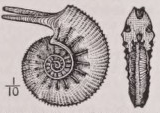
Serpent-stone, or cornu ammonis, a fossil shell, curved into a spiral, like a ram's horn; of various sizes, from the smallest grains to three feet in diameter. This fossil is found in stratums of limestone and clay, and in argillaceous iron ore. It is smooth or ridged; the ridges strait, crooked or undulated.
A fossil cephalopod shell related to the nautilus. There are many genera and species, and all are extinct, the typical forms having existed only in the Mesozoic age, when they were exceedingly numerous. They differ from the nautili in having the margins of the septa very much lobed or plaited, and the siphuncle dorsal. Also called serpent stone, snake stone, and cornu Ammonis.
AMMONITES, called also very frequently the children of Ammon, a people allied by descent to the Israelites, and living in their vicinity, sprung from Lot, Abraham’s nephew, by the younger of his daughters, as the immediately adjoining people, the Moabites, were by the elder (Gen. xix. 37-38). Both peoples are sometimes spoken of under the common name of the children of Lot (Deut, ii. 19; Ps. lxxxiii. 8); and the whole history shows that they preserved throughout the course of their national existence a sense of the closest brotherhood. The original territory of the two tribes was the country lying immediately on the east of the Dead Sea and of the lower half of the Jordan, having the Jabbok for its northern boundary; and of this tract the Ammonites laid claim to the northern portion, the “half mount Gilead” (Deut. iii. 12), lying between the Arnon and the Jabbok, out of which they had expelled the Zamzummim (Judg. xi. 13; Deut. ii. 20, 21 cf. Gen. xiv. 5), though apparently it had been held, in part at least, conjointly with the Moabites, or perhaps under their supremacy (Num. xxi. 26, xxii. 1; Josh, xiii. 32). From this their original territory they had been in their turn expelled by the Amorites, who were found by the Israelites after their deliverance from Egypt in possession of both Gilead and BashaD, that is, of the whole country on the left bank of the Jordan, lying to the north of the Arnon (Num. xxi 13). By this Amorite invasion, as the Moabites were driven to the south of the Arnon, which formed their northern boundary from that time so the Ammonites were driven out of Gilead across the upper waters of the Jabbok where it flows from south to north, which henceforth continued to be their western boundary (Num. xxi. 24; Deut. ii. 37, iii. 16). The other ...limits of the Ammonitis, or country of the Ammonites (’A/i/worns χωpα, 2 Mac. iv. 26), there are no means of exactly defining. On the south it probably adjoined the land of Moab (but cf. Ewald, Gesch. Israels, ii. 266); on the north it may have met that of the king of Geshur (2 Sam. xiii. 37); and on the east it probably melted away into the desert peopled by Amalekites and other nomadic races.
The chief city of the country, called Babbah, or Rabbath of the children of Ammon, i.e., the metropolis of the Ammonites (Deut. iii. 11), and Rabbathammana by the later Greeks (Polyb. v. 7, 4), whose name was changed into Philadelphia by Ptolemy Philadelphus, a large and strong city with an acropolis, was situated on both sides of a branch of the Jabbok, bearing at the present day the name of Moiet or N^ahr Amman, the water or river of Ammon, whence the designation “city of waters” (2 Sam. xii. 27; c∕. Burckhardt, Syria, p. 361). The ruins called Amman by the natives are extensive and imposing. The country to the south and east of Amman is distinguished by its fertility; and ruined towns are scattered thickly over it, attesting that it was once occupied by a population which, however fierce, was settled and industrious (see Burckhardt, op. dt., 357, cf. Lindsay, Holy Land, 5th ed., p. 279), a fact indicated also by the tribute of com paid annually to Jotham (2 Chron, xxvii. 5). The Israelites on their journey out of Egypt to the land of promise were forbidden to meddle with the territory of Ammon as of Moab (Deut. ii. 19); and it seems to indicate that friendly relations subsisted at first between this people and the chosen nation, that after the latter had conquered and slain Og, the giant king of Bashan, the enemy of both, his bedstead was placed in Rabbah (Deut. iii. 11). Like Moab, however, the Ammonites beheld with jealousy the rising greatness of Israel· They joined the former in hiringBalaam to curse them (Deut, xxiii. 4); and thenceforward their history, so far as known, reveals a spirit of bitter hostility against the people of Jehovah—shown in invasions repeated and violent, and cruelties the most outrageous and unsparing (Judg. x. 8; Amos i. 13). They could not forget that the Gileadite portion of the inheritance of Israel had once been their possession, nor cease to press their claim for its recovery (Judg. xi. 13). We find them joined first with Moab (Judg. iii. 12), and then with the Philistines (Judg. x. 7, 8), in the invasion and oppression for lengthened periods of the land of their enemies. Subdued by the prowess of Jephthah, they began again to act on the offensive in the days of Saul, laying siege to Jabesh-Gilead (1 Sam. xi. 1). David offered his friendship to the king of Ammon, but his offer was rejected with contumely and outrage, for which a terrible vengeance was exacted in the capture and overthrow of their metropolis, and the deliberate slaughter of the people (2 Sam. x.) They were united with Moab against Judah in the days of Jehoshaphat (2 Chron, xx. 1); they paid tribute to Uzziah and Jotham (2 Chron, xxvi. 8, xxvii. 5); and with the neighbouring tribes helped the Chaldean monarch against Jehoiakim (2 Kings xxiv. 2). When, after the destruction of Jerusalem, the poor remnants of the Israelites were gathered together under the protectorate of Nebuchadnezzar, it was by the instigation of a king of Ammon that Gedaliah, the ruler appointed over them, was murdered, and new calamities were incurred (Jer. xii. 14); and when Jerusalem was to be rebuilt, the foremost in opposing the patriotic Jews were a Moabite and an Ammonite (Neh. ii. 10, 19; iv. 1- 3). True to their antecedents, the Ammonites, with some of the neighbouring tribes, did their utmost to resist and check the revival of the Jewish power under Judas Maccabaeus (1 Macc. v. 6; cf. Jos. Ant. Jud. xiii. 8, 1). The last historical notice of them is in JustinMartyr {Dial, cum Tryph. § 119), where it is affirmed that they were still a numerous people. The Ammonites are repeatedly mentioned under the form Bit-Amman, i.e., house of Amman, in the inscriptions of Nineveh among the tributaries of the kings of Assyria (Schrader, Keilinschriften und d. A. T. 52). The names of their kings, so far as known,—in Scripture, Nahash, Hanun, Baalis, or Baalim (2 Sam. x. 2; Jer. xl. 14); in Assyrian, Puduilu (c∕. Pedahel (Num. xxxiv. 28), Basa (c∕ ’. Baasha, 1 Kings xv. 33), and Sanibi (of less obvious analogy),—testify, in harmony with other considerations, that their language was Semitic, closely allied to the Hebrew; and this fact is now placed beyond question by the discovery of the Mesha-stele, presenting the language of the Moabites, and doubtless that also of the brother tribe (see Moabites). Their national deity, Moloch or Milcom (sec Moloch), was worshipped with cruel rites,—a circumstance tending to foster that fierceness of character which distinguished this people throughout their history.
9th ed. Encyclopædia Britannica, vol. 1, p. 742 [1,176 words — estimated reading time: 7 minutes]
the descendants of Ammon, the son of Lot. They took possession of the country called by their name, after having driven out the Zamzummims, who were its ancient inhabitants. The precise period at which this expulsion took place is not ascertained. The Ammonites had kings, and were uncircumcised, Jer. ix, 25, 26, and seem to have been principally addicted to husbandry. They, as well as the Moabites, were among the nations whose peace or prosperity the Israelites were forbidden to disturb, Deut. ii, 19, &c. However, neither the one nor the other were to be admitted into the congregation to the tenth generation, because they did not come out to relieve them in the wilderness, and were implicated in hiringBalaam to curse them. Their chief and peculiar deity is, in Scripture, called Moloch. Chemosh was also a god of the Ammonites. Before the Israelites entered Canaan, the Amorites conquered a great part of the country belonging to the Ammonites and Moabites; but it was retaken by Moses, and divided between the tribes of Gad and Reuben. Previous to the time of Jephthah, B. C. 1188, the Ammonites engaged as principals in a war, under a king whose name is not given, against the Israelites. This prince, determining to recover the ancient country of the Ammonites, made a sudden irruption into it, reduced the land, and kept the inhabitants in subjection for eighteen years. He afterward crossed Jordan with a design of falling upon the tribes of Judah, Benjamin, and Ephraim. The Israelites resisted the invader; and, assembling at Mizpeh, chose Jephthah for their general, and sent an expostulatory message to the king of the Ammonites, Judges x, xi. The king replied, that those lands belonged to the Ammonites, who had been unjustly dispossessed of them by the Israelites, when they ...came out of Egypt, and exhortedJephthah to restore them peaceably to the lawful owners. Jephthahremonstrated on the injustice of his claim; but finding a war inevitable, he fell upon the Ammonites near Aroer, and defeated them with great slaughter. On this occasion the Ammonites lost twenty cities; and thus an end was put, after eighteen years’ bondage, to the tyranny of Ammon over the Israelites beyond Jordan. In the days of Saul, 1 Sam. xi, B. C. 1095, the old claim of the Ammonites was revived by Nahash their king, and they laid siege to the city of Jabesh. The inhabitants were inclined to acknowledge Nahash as their sovereign; but he would accept their submission only on condition that every one of them should consent to lose his right eye, and that thus he might fix a lasting reproach upon Israel: but from this humiliating and severe requisition they were delivered by Saul, who vanquished and dispersed the army of Nahash. Upon the death of Nahash, David sent ambassadors to his son and successor Hanun, to congratulate him on his accession; but these ambassadors were treated as spies, and dismissed in a very reproachful manner, 2 Sam. x. This indignity was punished by David with rigour. Rabbah, the capital of Hanun, and the other cities of Ammon, which resisted the progress of the conqueror, were destroyed and razed to the ground; and the inhabitants were put to death or reduced to servitude. In the reign of Jehoshaphat the Ammonites united with their brethren, the Moabites, and the inhabitants of Mount Seir, against the king of Judah; but they were completely routed. They were afterward overthrown by Uzziah, king of Judah, and made tributary, 2 Chron. xxvi, 8; and rebelling in the reign of his son Jotham, they were reduced to the necessity of purchasing peace at a very dear rate. After the tribes of Reuben, Gad, and the half tribe of Manasseh, were carried into captivity by Tiglath Pileser, B. C. 740, the Ammonites and Moabites took possession of the cities belonging to these tribes, and were reproached for it by Jeremiah, xlix, 1. Their ambassadors were exhorted to submit to Nebuchadnezzar, and threatened, on their refusal, with captivity and slavery, Jer. xxvii, 2, 3, 4. The Prophet Ezekiel, xxv, 4–10, denounces their entire destruction, and informs them, that God would deliver them up to the people of the east; and that the Ammonites should no more be mentioned among the nations: and this punishment they were to suffer for insulting the Israelites on account of their calamities, and the destruction of their temple by the Chaldeans. This malediction began to be inflicted upon them in the fifth year after the taking of Jerusalem, when Nebuchadnezzar made war against all the people around Judea, A. M. 3420 or 3421, B. C. 583. It is probable that Cyrus granted to the Ammonites and Moabites liberty to return into their own country, whence they had been removed by Nebuchadnezzar; for they were exposed to the revolutions that were common to the people of Syria and Palestine, and were subject sometimes to the kings of Egypt, and sometimes to the kings of Syria. Polybius informs us, that Antiochus the Great took Rabboth, or Philadelphia, the capital of the Ammonites, demolished the walls, and put a garrison into it, A. M. 3806, B. C. 198. During the persecutions of Antiochus Epiphanes, the Ammonites manifested their hatred to the Jews, and exercised great cruelties against such of them as lived in their parts. At length their city Jaser, and the neighbouring town, fell a prey to the Jews, who smote the men, carried their wives and children into captivity, and plundered and burned the city. Thus ended their last conflict with the descendants of Israel. Ammon was, however, a highly productive and populous country when the Romans became masters of all the provinces of Syria; and several of the ten allied cities, which gave name to the celebrated Decapolis, were included within its boundaries. Even when first invaded by the Saracens, this country, including Moab, was enriched by the various benefits of trade, covered with a line of forts, and possessed some strong and populous cities. Volney bears witness, “that in the immense plains of the Hauran, ruins are continually to be met with, and that what is said of its actual fertility perfectly corresponds with the idea given of it in the Hebrew writings.” The fact of its natural fertility is corroborated by every traveller who has visited it. And “it is evident,” says Burckhardt, “that the whole country must have been extremely well cultivated in order to have afforded subsistence to the inhabitants of so many towns,” as are now visible only in their ruins. While the fruitfulness of the land of Ammon, and the high degree of prosperity and power in which it subsisted long prior and long subsequent to the date of the predictions, are thus indisputably established by historical evidence and by existing proofs, the researches of recent travellers (who were actuated by the mere desire of exploring these regions and obtaining geographical information) have made known its present aspect; and testimony the most clear, unexceptionable, and conclusive, has been borne to the state of diredesolation to which it is and has long been reduced.
It was prophesied concerning Ammon, “Son of man, set thy face against the Ammonites, and prophesy against them. I will make Rabbah of the Ammonites a stable for camels and a couching place for flocks. Behold, I will stretch out my hand upon thee, and deliver thee for a spoil to the Heathen; I will cut thee off from the people, and cause thee to perish out of the countries; I will destroy thee. The Ammonites shall not be remembered among the nations. Rabbah” (the chief city) “of the Ammonites shall be a desolateheap. Ammon shall be a perpetual desolation,” Ezek. xxv, 2, 5, 7, 10; xxi, 32; Jer. xlix, 2; Zeph. ii, 9.
Ammon was to be delivered to be a spoil to the Heathen--to be destroyed, and to be a perpetual desolation. “All this country, formerly so populous and flourishing, is now changed into a vast desert.” (_Seetzen’s Travels._) Ruins are seen in every direction. The country is divided between the Turks and the Arabs, but chiefly possessed by the latter. The extortions of the one, and the depredations of the other, keep it in “perpetual desolation,” and make it “a spoil to the Heathen.” “The far greater part of the country is uninhabited, being abandoned to the wandering Arabs, and the towns and villages are in a state of total ruin.” (_Ibid._) “At every step are to be found the vestiges of ancient cities, the remains of many temples, public edifices, and Greek churches.” (_Burckhardt’s Travels._) The cities are left desolate. “Many of the ruins present no objects of any interest. They consist of a few walls of dwelling houses, heaps of stones, the foundations of some public edifices, and a few cisterns filled up; there is nothing entire, though it appears that the mode of building was very solid, all the remains being formed of large stones. In the vicinity of Ammon there is a fertile plain interspersed with low hills, which for the greater part are covered with ruins.” (_Burckhardt’s Travels in Syria._) While the country is thus despoiled and desolate, there are valleys and tracts throughout it which “are covered with a fine coat of verdant pasture, and are places of resort to the Bedouins, where they pasture their camels and their sheep.” (_Buckingham’s Travels in Palestine._) “The whole way we traversed,” says Seetzen, “we saw villages in ruins, and met numbers of Arabs with their camels,” &c. Mr. Buckingham describes a building among the ruins of Ammon, “the masonry of which was evidently constructed of materials gathered from the ruins of other and older buildings on the spot. On entering it at the south end,” he adds, “we came to an open square court, with arched recesses on each side, the sides nearly facing the cardinal points. The recesses in the northern and southern wall were originally open passages, and had arched door ways facing each other; but the first of these was found wholly closed up, and the last was partially filled up, leaving only a narrow passage, just sufficient for the entrance of one man and of the goats, which the Arab keepers drive in here occasionally for shelter during the night.” He relates that he lay down among “flocks of sheep and goats,” close beside the ruins of Ammon; and particularly remarks that, during the night, he “was almost entirely prevented from sleeping by the bleating of flocks.” So literally true is it, although Seetzen, and Burckhardt, and Buckingham, who relate the facts, make no reference or allusion whatever to any of the prophecies, and travelled for a different object than the elucidation of the Scriptures,--that “the chief city of the Ammonites is a stable for camels, and a couching place for flocks.”
“The Ammonites shall not be remembered among the nations.” While the Jews, who were long their hereditary enemies, continue as distinct a people as ever, though dispersed among all nations, no trace of the Ammonites remains; none are now designated by their name, nor do any claim descent from them. They did exist, however, long after the time when the eventualannihilation of their race was foretold; for they retained their name, and continued a great multitude until the second century of the Christian æra. (_JustinMartyr._) “Yet they are cut off from the people. Ammon has perished out of the countries; it is destroyed.” No people is attached to its soil; none regard it as their country and adopt its name: “And the Ammonites are not remembered among the nations.”
“Rabbah” (Rabbah Ammon, the chief city of Ammon) “shall be a desolateheap.” Situated, as it was, on each side of the borders of a plentiful stream, encircled by a fruitful region, strong by nature and fortified by art, nothing could have justified the suspicion, or warranted the conjecture in the mind of an uninspired mortal, that the royal city of Ammon, whatever disasters might possibly befal it in the fate of war or change of masters, would ever undergo so total a transmutation as to become a desolateheap. But although, in addition to such tokens of its continuance as a city, more than a thousand years had given uninterrupted experience of its stability, ere the prophets of Israel denounced its fate; yet a period of equal length has now marked it out, as it exists to this day, a desolateheap, a perpetual or permanent desolation. Its ancient name is still preserved by the Arabs, and its site is now “covered with the ruins of private buildings--nothing of them remaining except the foundations and some of the door posts. The buildings, exposed to the atmosphere, are all in decay,” (_Burckhardt’s Travels in Syria_,) so that they may be said literally to form a desolateheap. The public edifices, which once strengthened or adorned the city, after a long resistance to decay, are now also desolate; and the remains of the most entire among them, subjected as they are to the abuse and spoliation of the wild Arabs, can be adapted to no better object than “a stable for camels.” Yet these broken walls and ruined palaces, says Mr. Keith, which attest the ancient splendour of Ammon, can now be made subservient, by means of a single act of reflection, to a far nobler purpose than the most magnificent edifices on earth can be, when they are contemplated as monuments on which the historic and prophetic truth of Scripture is blended in one bright inscription.
And Israel smote him with the edge of the sword, and possessed his land from Arnon unto Jabbok, even unto the children of Ammon: for the border of the children of Ammon was strong.
And Israel put him to the sword and took possession of his land, from the Arnon to the Jabbok—but only up to the border of the Ammonites, because it was fortified.
And when thou comest nigh over against the children of Ammon, distress them not, nor meddle with them: for I will not give thee of the land of the children of Ammon any possession; because I have given it unto the children of Lot for a possession.
But when you get close to the Ammonites, do not harass them or provoke them, for I will not give you any of the land of the Ammonites. I have given it to the descendants of Lot as their possession.”
A people great, and many, and tall, as the Anakims; but the LORD destroyed them before them; and they succeeded them, and dwelt in their stead:
They were a people great and many, as tall as the Anakites. But the LORD destroyed them from before the Ammonites, who drove them out and settled in their place,
Only unto the land of the children of Ammon thou camest not, nor unto any place of the river Jabbok, nor unto the cities in the mountains, nor unto whatsoever the LORD our God forbad us.
But you did not go near the land of the Ammonites, or the land along the banks of the Jabbok River, or the cities of the hill country, or any place that the LORD our God had forbidden.
For only Og king of Bashan remained of the remnant of giants; behold, his bedstead was a bedstead of iron; is it not in Rabbath of the children of Ammon? nine cubits was the length thereof, and four cubits the breadth of it, after the cubit of a man.
(For only Og king of Bashan had remained of the remnant of the Rephaim. His bed of iron, nine cubits long and four cubits wide, is still in Rabbah of the Ammonites.)
And unto the Reubenites and unto the Gadites I gave from Gilead even unto the river Arnon half the valley, and the border even unto the river Jabbok, which is the border of the children of Ammon;
and to the Reubenites and Gadites I gave the territory from Gilead to the Arnon Valley (the middle of the valley was the border) and up to the Jabbok River, the border of the Ammonites.
An Ammonite or Moabite shall not enter into the congregation of the LORD; even to their tenth generation shall they not enter into the congregation of the LORD for ever:
No Ammonite or Moabite or any of their descendants may enter the assembly of the LORD, even to the tenth generation.
Sihon king of the Amorites, who dwelt in Heshbon, and ruled from Aroer, which is upon the bank of the river Arnon, and from the middle of the river, and from half Gilead, even unto the river Jabbok, which is the border of the children of Ammon;
Sihon king of the Amorites, who lived in Heshbon. He ruled from Aroer on the rim of the Arnon Valley, along the middle of the valley, up to the Jabbok River (the border of the Ammonites), that is, half of Gilead,
And the children of Israel did evil again in the sight of the LORD, and served Baalim, and Ashtaroth, and the gods of Syria, and the gods of Zidon, and the gods of Moab, and the gods of the children of Ammon, and the gods of the Philistines, and forsook the LORD, and served not him.
And again the Israelites did evil in the sight of the LORD. They served the Baals, the Ashtoreths, the gods of Aram, Sidon, and Moab, and the gods of the Ammonites and Philistines. Thus they forsook the LORD and did not serve Him.
Moreover the children of Ammon passed over Jordan to fight also against Judah, and against Benjamin, and against the house of Ephraim; so that Israel was sore distressed.
The Ammonites also crossed the Jordan to fight against Judah, Benjamin, and the house of Ephraim, and Israel was in deep distress.
And the LORD said unto the children of Israel, Did not I deliver you from the Egyptians, and from the Amorites, from the children of Ammon, and from the Philistines?
The LORD replied, “When the Egyptians, Amorites, Ammonites, Philistines,
Then the children of Ammon were gathered together, and encamped in Gilead. And the children of Israel assembled themselves together, and encamped in Mizpeh.
Then the Ammonites were called to arms and camped in Gilead, and the Israelites assembled and camped at Mizpah.
And the people and princes of Gilead said one to another, What man is he that will begin to fight against the children of Ammon? he shall be head over all the inhabitants of Gilead.
And the rulers of Gilead said to one another, “Whoever will launch the attack against the Ammonites will be the head of all who live in Gilead.”
And it came to pass in process of time, that the children of Ammon made war against Israel.
Some time later, when the Ammonites fought against Israel
This site uses cookies to remember your display preferences (search sources and editions, Bible version, auto-link, images, light/dark theme). No personal data whatsoever is collected. Privacy Policy