KNOT. In the scientific sense, a knot is an endless physical line which cannot be deformed into a circle. A physical line is flexible and inextensible, and cannot be cut,—so that no lap of it can be drawn through another.
The founder of the theory of knots is undoubtedly Listing. In his “Vorstudien zur Topologie” (Göttinger Studien, 1847), a work in many respects of startling originality, a few pages only are devoted to the subject. He treats knots from the elementary notion of twisting one physical line (or thread) round another, and shows that from the projection of a knot on a surface we can thus obtain a notion of the relative situation of its coils. He distinguishes “reduced” from “reducible” forms, the number of crossings in the reduced knot being the smallest possible. The simplest form of reduced knot is of two species, as in figs. 1 and 2. Listing points out that these are formed, the first by right-handed, the second by left-handed twisting. In fact, if three half twists be given to a long strip of paper, and the ends be then pasted together, the two edges become one line, which is the knot in question. We may free it by slitting the paper along its middle line; and then we have the juggler’s trick of putting a knot on an endless unknotted band. One of the above forms cannot be deformed into the other. The one is, in Listing’s language, the “perversion” of the other, i.e., its image in a plane mirror. He gives a method of symbolizing reduced knots, but shows that in this method the same knot may, in certain cases, be represented by different symbols. It is clear that the brief notice he has published contains a mere sketch of his investigations....
The most extensive dissertation on the properties of knots is that of Tait (Trans. Hoy. Soc. Pdin., 1876-7). It was for the most part written in ignorance of the work of Listing, and was suggested by an inquiry concerning vortex atoms (see Atom). Tait starts with the almost self-evident proposition that, if any plane closed curve have double points only, in passing continuously along the curve from one of these to the same again an even number of double points has been passed through. Hence the crossings may be taken alternately over and under. On this he bases a scheme for the representation of knots of every kind, and employs it to find all the distinct forms of knots which have, in their simplest projections, 3, 4, 5, 6, and 7 crossings only. Their numbers are shown to be 1, 1, 2, 4, and 8. The unique knot of three crossings has been already given as drawn by Listing. The unique knot of four crossings merits a few words, because its properties lead to a very singular conclusion. It can be deformed into any of the four forms—figs. 3 and 4 and their perversions. Knots which can be deformed into their own perversion Tait calls “amphi-cheiral,” and he has shown that there is at least one knot of this kind for every even number of crossings. He shows also that “links” (in which two endless physical lines are linked together) possess a similar property; and he then points out that there is a third mode of making a complex figure of endless physical lines, without either knotting or linking. This may be called “lacing” or “locking.” Its nature is obvious from fig. 5, in which it will be seen that no one of the three lines is knotted, no two are linked, and yet the three are inseparably fastened together.
The rest of Tait’s paper deals chiefly with numerical characteristics of knots, such as their “knottiness,” “beknottedness,” and “knotfulness.” He also shows that any knot, however complex, can be fully represented by three closed plane curves, none of which has double points, and no two of which intersect. It may be stated here that the notion of beknottedness is founded on a remark of Gauss, who in 1833 considered the problem of the number of interlinkings of two closed circuits, and expressed it by the electrodynamic measure of the work required to carry a unit magnetic pole round one of the interlinked curves, while a unit electric current is kept circulating in the other. This original suggestion has been developed at considerable length by Boeddicker {Erweiterung der Gaussschen Theorie der Verschlingungen, Stuttgart, 1876). This author treats also of the connexion of knots with Riemann’s surfaces.
It is to be noticed that, although every knot in which the crossings are alternately over and under is irreducible, the converse is not generally true. This is obvious at once from fig. 6, which is merely the three-crossing knot with a doubled string— what Listing calls “paradromic.”
Klein, in the Mathematische Annalen, ix. 478, has proved the remarkable proposition that knots cannot exist in space of four dimensions.
Sailors’ Knots. —The knots used by sailors are of many kinds. The following are the most useful Overhand. Knot (fig. 7).—Take the end a of the rope round the end b. Reef Knot (figs. 8, 9).—Form an overhand knot as above. Then take the end a over the end b and through the bight. If the end a were taken under the end b a granny would be formed. This knot is so named from being used in tying the reef-points of a sail.
Bowline (figs. 10-12).—Lay the end a of a rope over the standing part b. Form with b a bight c over a. Take a round behind b and down through the bight c. This is a most useful knot employed to form a loop which will not slip.
Half Hitch (fig. 13).—Pass the end a of the rope round the standing part b and through the bight.
Glove Hitch (figs. 14, 15).—Pass the end a round a sparand cross it over b. Pass it round the spar again and put the end a through the second bight.
Blackwall Hitch (fig. 16).—Form a bight at the end of a rope, and put the hook of a tackle through the bight so that the end of the rope may be jammed between the standing part and the back of the hook.
Timber Hitch (fig. 17). —Take the end a of a rope round a spar, then round the standing part b, then several times round its own part c. Fisherman's Bend (fig. 18). —Take two turns round a spar, then a half hitch round the standing part and between the spar and the turns, lastly a half hitch round the standing part.
Carrick Bend (fig. 19).—Lay the end of one rope over its own standing part so as to form a bight. Put the end of the other rope through this bight, under the standing part, over the end beyond the bight, under the standing part beyond the bight, and down through the bight over its own standing part.
Sheet Bend (fig. 20).—Pass the end of one rope through the bight of another, round both parts of the other, and under its own standing part.
Single Wall Knot (fig. 21).—Unlay the end of a rope, and with the strand a form a bight. Take the next strand b round the end of a. Take the last strand c round the end of b and through the bight made by a. Haul the ends taut.
Single Wall Crowned (fig. 22).—Form a single wall, and lay one of the ends, a, over the knot. Lay b over a, and c over b and through the bight of a. Haul the ends taut.
Double Wall and Double Croιon (fig. 23).—Form a single wall crowned; then let the ends follow their own parts round until all the parts appear double. Put the ends down through the knot.
Matthew Walker (figs. 24, 25).—Unlay the end of a rope. Take the first strand round, the rope and through its own bight; the second strand round the rope, through the bight of the first, and through its own bight; the third through all three bights. Haul the ends taut.
See Nares, Seamanship, 4th ed., 1868; Dana, Seaman's Manual, 9th ed., 1863; A. H. Alston, Seamanship, Portsmouth, 1871; Kipping, Masting and Rigging, 9th ed., 1864; Yachtsand Yachting, by “Vanderdecken” (William Cooper), 1873; Book of Knots, by “Tom Bowling” (J. Bonwiek), 1866.
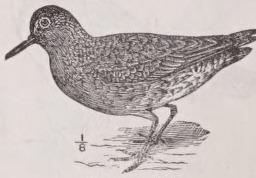
KNOT, a Limicoline bird very abundant at certain seasons on the shores of Britain and many countries of the northern hemisphere. Camden in the edition of his Britannia published in 1607 (p. 408) inserted a passage not found in the earlier issues of that work, connecting the name with that of King Canute, and this account of its origin has been usually received. But no other evidence in its favour is forthcoming, and Camden’s statement is merely the expression of an opinion, so that there is perhaps ground for believing him to have been mistaken, and that the clue afforded by Sir Thomas Browne, who (circa 1672) wrote the name “Gnatts or Knots,” may be the true one. Still the statement was so determinedly repeated by successive authors that Linnaeus followed them in calling the species Tnnga canutus, and so it remains with nearly all modern ornithologists. Rather larger than a Snipe, but with a short, Plover-like bill and legs, the Knot visits the coasts of some parts of Europe, Asia, and North America at times in vast flocks; and, though in temperate climates a good many remain throughout the winter, these are nothing in proportion to those that arrive towards the end of spring, in England generally about the 15th of May, and after staying a few days pass northward to their summer quarters, while early in autumn the young of the year throng to the same places in still greater numbers, being followed a little later by their parents. In winter the plumage is ashy-grey above (save the rump, which is white) and white beneath. In summer the feathers of the back are black, broadly margined with light orange-red, mixed with white, those of the rump white, more or less tinged with red, and the lower parts are of a nearly uniform deep bay or chestnut. The birds which winter in temperate climates seldom attain the brilliancy of colour exhibited by those which arrive from the south; the luxuriance generated by the heat of a tropical sun seems needed to develop the full richness of hue. The young when they come from their birthplace are clothed in ashy-grey above, each feather banded with dull black and ochreous, while the breast is more or less deeply tinged with warm buff. Much curiosity has long existed among zoologists as to the egg of the Knot, of which not a single identified or authenticated specimen is known to exist in collections. Yet more than sixty years ago the species was found breeding abundantly on the North Georgian (now commonly called the Parry) Islands by Parry’s memorable expedition, as well as soon after on Melville Peninsula by Captain Lyons, and again during the recent voyage of Sir
George Nares on the northern coast of Grinnell Land and the shores of Smith Sound, where Major Feilden obtained examples of the newly-hatched young (Ibis, 1877, p. 407), and observed that the parents fed largely on the buds of Saxifraga oppositifolia. These are the only localities in which this species is known to breed, for on none of the arctic lands lying to the north of Europe or Asia has it been unquestionably observed. In winter its wanderings are very extensive, as it is recorded from Surinam, Brazil, WalvischBay in South Africa, China, Queensland, and New Zealand. Formerly this species was extensively netted in England, and the birds fattened for the table, where they were esteemed a great delicacy, as witness the entries in the Northumberland and Le Strange Household Books; and the British Museum contains an old treatise on the subject—“The maner of kepyng of knotts, after Sir William Askew and my Lady, given to my Lord Darcy, 25 Hen. VIII.” (MSS. Sloane, 1592, 8 cat. 663). (a. n.)