CURLING, a game in which the players throw large rounded stones upon a rink or channel of ice, towards a mark called the tee. Where the game originated is not precisely known; but as it has been popular in North Britain for the last three centuries at least, and down till our own day been practised chiefly by natives of that country, it may correctly be spoken of as a Scottish .pastime. Some writers, looking to the name and technical terms of the game, trace its invention to the Low Countries: thus “curl” may have been derived from the German kurz weil, a game; “tee” from the Teutonic tighen, to point out; “bonspiel,” a district curling competition, from the Belgic bonne, a district, and spel, play; though the supposition that “rink” is just a modification of the Saxon hrink, a strong man, seems scarcely tenable. Then, it is further stated that, as curling is called “kuting” in some parts of Lanarkshire and Ayrshire, and very much resembles quoiting on the ice, the name may have some connection with the Dutch coete, a quoit; vhile Kilian in his Teutcnic Dictionary represents the teιm lleuyten to mean a pastime in which large globes of stone are thrown upon ice like the quoit or discus. Possibly enough some of the Flemish merchants who settled in Scotland towards the close of the 16th century may have brought the game to the country. Unfortunately, however, for the theory that assigns to it a far-away origin, we find no early mention of it in the literature of the Continent; while Camden, when describing the Orkney Islands in 1607, tells us that one of them supplies “plenty of excellent stones for the game called curling;” and incidental references to it as a game plaj cd in Scotland are made by several authors during the first half of the same ...century. If the game be not indigenous to Scotland it certainly owes its development to that country, and in the course of time it has come to be nearly as much the national sport of the Caledonians as “the rough bur thistle” their heraldic emblem.
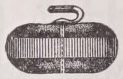
With very rude engines it was played at first,—random whin boulders fashioned by the finger of nature alone, or misshapen granite blocks, bored through to let in the thumb of the player, having been the channel-stones used by the primitive curlers of the country. Even before Bannockburn was fought the ice of the Scottish lochs may have been employed as the arena of a bloodless strife; though it is only as a piece of pardonable witticism that Ossian has been quoted as follows to show that curling was practised by his sòmewhat mythical heroes—“Fly, son of Morven, fly; amid the circle of stones Swaran, bends at the stone of might.” In course of years the rough block of the game was superseded by asymmetrical object usually made of whinstone or granite, beautifully rounded, brilliantly polished, and supplied with a convenient handle; so that the curling stone now used is as great an improvement on its remote predecessor as the Martini rifle is on the old matchlock which figured at Marston Moor and Culloden. It is circular in form, its weight from 35 to 50 B>, its circumference from 30 to 36 inches, and the height is about one-eighth of the girth. With engines of such shape and bulk, costing with handles from £2 to £2, 10s. per pair, all the societies, 472 in number, connected with the Royal Caledonian Curling Club play their spiels when “cauld cauld frosty weather” supplies the required arena. Most of these societies are located in the Land of Cakes and Curlers; but many of them are transatlantic, no few er than 37 belonging to the Ontario province branch alone; while there are many hundreds of independent curling fraternities north of the Tweed, who play for their own hand, under arrangements of their own, though the rules and usages of the Caledonian Curling Club form a code which largely regulates “the roaring game,” as Burns calls it, all over the world.
On a rink 42 yards long, or so, with a tee at each end, the stone is hurled, the hurler, or curler, when delivering it standing on one side of the goal or tee. so as to bring the stone over the tee when delivering it; or, according to another arrangement, he occupies a small circle a foot in diameter behind a ring of 7 feet radius drawn round the tee. To cover this goal or lie close to it is the player’s chief object; but often when he has realized his aim, a rival stone “up the rink like Jehu roars,” driving his stone nowhere, settling down in its pride of place, but only to be served perhaps in a similar way itself before the match is at an end. No stones that lie outside the large circles of 7 feet radius round the tee are allowed to count, and all laggard stones that manifest a piglike indolence, and do not pass the well-named hog score, which is drawn at a distance of one-sixth the rink from each tee, are removed as obstructive cumberers of the channel. Games can be played by two persons, but usually matches are arranged for with numerous competitors formed into rinks of four players a side, two stones being used by each player. It is customary for the parish clubs of a district, marshalled by their respective skips, or captains, to try their skill against each other once a year or so; while annually (when weather permits) a great contest, which is at least semi-national, is waged between the curlers north and south of the River Forth.
At first the game is remarkably simple, the leader, as we have said, endeavouring to top or closely neighbour the tee, and his immediate opponent having a similar object in view. When, during the progress of the game, one, two, or more stones have been well planted, the supporters of those who placed them there are usually directed by their skip rather to guard the winning stones than venture too near them at the risk of injuring their position. On the other hand the tactics of the opposing party will consist in efforts to knock off the guards, dislodge the well-planted stones, or get their own still better placed where that is possible. It sometimes happens that the stone nearest the tee—the winner, as it is called—is so well protected that it cannot be touched directly, and defies removal unless it be assailed by an ingenious master-stroke technically termed wicking or inringing, whereby a stone is sent in an oblique direction so as haply to hit the winner; and, if it not only does that, but becomes the winner in its stead, the man who throws it is sure to be hailed by his exulting comrades as a prince among curlers, if not “the king o’ a’ the core.” “Wicking, or inringing,” says the late Sir Richard Broun, Bart., in his admirable work Memorabilia Curliana (publishedin 1830), “the prettiest and most scientific point in the game by far, is to take the shot and leave yourself behind the rampart of your adversary’s barricade, when to all appearance their winner was impregnable;” and this is done “by taking an inner angle off a side shot in such a manner as to change and direct the course of your stone upon the one to be projected.” When, however, science fails, and the ice is so blocked up as almost to hide the tee, an effort of strength and hazard is resorted to in the hope of some benefit “turning up.” This, by the curlers of the south of Scotland, is called “rebutting.” The player in such cases is usually told by his skip to “put plenty of powder in the horn,” and the stone is delivered with tremendous force, so as to go crashing through guards and double guards, sometimes doing more harm than good, and sometimes also changing in a moment the whole fortunes of the game.
Many fine songs have been written about curling, from which lines might be quoted descriptive of all its leading points, its implements, “channel stones, crampets (flat pieces of iron with spikes below fastened on the sole of the shoe to keep the player from slipping), and besoms so green,” with which the rink is swept; also in praise of the game as a promoter of mental enjoyment, bodily health, and the best of good-fellowship. The late Dr Henry Duncan’s song on the subject has never been excelled; and he succeeds in packing into a single stanza some of its chief characteristics :—
“There draw a shot; there lay a guard;
And here beside him lie, man;
Now let him feel a gamester’s hand;
Now in this bosom die, man.
There fill the port, and block the ice;
We sit upon the tee, man!
Now take this in-ring sharp and neat, And make this winner flee, man.”
Ths Ettrick Shepherd also ranks among the laureates oi the rink.
The following rules of the game are abridged from the Annual of the Royal Caledonian Curling Club :—
1. The tees shall be set down 40 yards apart; and in an exact alignment with the tees aline shall be drawn on the rink. Seven feet behind each tee a circle 6 inches in diameter shall be also drawn on the ice on the left-hand side of said line (looking to the tee to be played to), the inner side of which shall be distant from said line 6 inches. Upon this circle, and as near as may upon the centre of it, eveiy player, whether standing on the ice or on a board or other rest, shall, in the delivery of his stone, place, or in stepping out, put down his left or fore foot, if he be a right hand player. For a lefthand player, another such circle shall be placed in like manner, and for the like purpose on the right hand side of said line. And in the event of a hack, hatch, trigger, &c., being used, it shall be right behind said circle, and not less distant therefrom than 2 feet, nor greater in length than 12 inches.
A circle of 7 feet radius to be described from each tee as a centre, and every stone to count which is either within, or resting on, this circle. All played stones passing the tee, and going beyond the 7 feet radius, shall be put off the ice. The hog-score to be distant from each tee one-sixth part of the length of the whole rink played on. Every stone to be a hog which does not clear this score; but no stone to be such which has struck another stone lying over the hog-score. A line shall be drawn on the ice, at a right angle to the rink, half-way betwixt the tees, called “the middle line." In no case shall the rink be less than 32 yards.
2. All matches to be of a certain number of heads, to be agreed on by the clubs, or fixed by the umpire, before commencement; or otherwise, by time, or shots, if mutually agreed on.
3. Every rink to be composed of four players a side, each using two stones. The rotation of play observed during the first head of a match shall not be changed.
4. The skips opposing each other shall settle by lot. or in any other way they may agree upon, which party shall lead at the first head, after which the winning party shall do so.
5. All curling stones shall be of a circular shape. No stone shall be of a greater weight than 50 lb imperial, or of greater circumference than 36 inches, or of less height than one-eighth part of its greatest circumference.
6. No stone, or side of a stone, shall be changed after a match has been begun, or during its continuance, unless by consent.
7. Should a stone happen to be broken, the largest fragment shall be considered in the game for that end—the player being entitled afterwards to use another stone, or another pair.
8. If a played stone rolls over, or stops, on its side or top, it shall be put off the ice. Should the handle quit the stðne in delivery, the player must keep hold of it, otherwise he shall not be entitled to replay the shot. φ
9. Players, during the course of each end, to be arranged along the sides of the rink, anywhere skips may direct; and no party, except when sweeping according to rule, shall go upon the middle of the rink, or cross it, under any pretence whatever. Skips alone to stand at or about the tee—that of the playing party having the choice of place, and not to be obstructed by the other.
10. If a player should play out of turn, the stone so played may be stopped in its progress, and returned to the player. Should the mistake not be discovered till the stone be at rest, or has struck another stone, the opposite skip shall have the option of adding one to his score, allowing the game to proceed, or declaring the end null and void. But if a stone bo played before the mistake has been discovered, the head must be finished as if it had been properly played from the beginning.
11. The sweeping shall be under the direction and control of the skips. The player’s party may sweep the ice anywhere from the centre line to the tee, and behind it,—the adverse party having liberty to sweep behind the tee, and in front of any of their own stones when moved by another, and till at rest. Skips to have full liberty to clean and sweep the ice behind the tee at any time, except when a player is being directed by his skip.
12. If in sweeping or otherwise, a running stone he marred by any of the party to which it belongs, it may, at the option of the opposite skip, be put off the ice; if by any of the adverse party, it may be placed where the skip of the party to which it belongs shall direct. If otherwise marred, it shall be replayed.
13. Every player to be ready to play when his turn comes, and not to take more than a reasonable time to play. Should he play a wrong stone, any of the players may stop it while running; but if not stopped till at rest, the one which ought to have been played shall be placed instead, to the satisfaction of the opposing skip.
14. No measuring of shots allowable previous to the termination of the end. Disputed shots to be determined by the skips, or, if they disagree, by the umpire, or, when there is no umpire, by some neutral person chosen by the skips. All measurements to be taken from the centre of the tee, to that part of the stone which is nearest it. No stone shall be considered without a circle, or over a line, unless it clear it;—and in every case, this is to be determined by placing a square on the ice, at the circle or line.
15. Skips shall have the exclusive regulation and direction of the game for their respective parties, and may play last stone, or in what part of it they please; and, when their turn to play comes, they may name one of their party to take charge for them.
16. If any player shall speak to, taunt, or interrupt another, not being of his own party, while in the act of delivering his stone, one shot shall be added to the score of the party so interrupted.
17. If from any change of weather after a match has been begun, or from any other reasonable cause, one party shall desire to shorten the rink, or to change to another one, and, if the two skips cannot agree, the umpire shall, after seeing one end played, determine whether the rink shall be shortened, and how much or whether it shall be changed, and his decision shall be final. (W. Μ ‘D. )