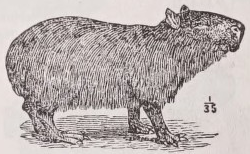
A large South American rodent (Hydrochaerus capybara) Living on the margins of lakes and rivers. It is the largest extant rodent, being about three feet long, and half that in height. It somewhat resembles the Guinea pig, to which it is related; -- called also cabiai and water hog.
CAPYBARA(Hydrochoerus capybara), the largest of existing Rodents, measuring about 4 feet in length and 3 in girth, and weighing usually over 100 lb. It is also known as the water-hog from the resemblance which it bears when walking to a pig, although when sitting on its haunches it reassumes the characteristic appearance of the Cavy family, to which it belongs. In the coarseness and scantiness of its fur, in the numerous enamel plates, embedded in cement, which stretch entirely across its molar teeth, like those of the elephant, and in the habit, when swimming, of carrying its young on its back like the hippopotamus, the capybara has been supposed to form a connecting link between the rodents and pachyderms, and in the Linnaean system of classification it was placed among the Suid(β. Its scanty fur is of a dark brown colour, its tail forms a small hornyprotuberance, and its feet are webbed, though not to the extremities of the toes. This pachydermatousrodent, as it has been called, is confined to South America, where it extends from Guiana southward to the Rio de la Plata, and westward to the eastern slopes of the Andes. It is a nocturnal animal, feeding on fruits and herbs, inhabiting the banks of rivers and fresh water lakes, and occasionally frequenting, according to Darwin, the mouths of such rivers as the Rio Plata where the water is entirely salt. Capybaras congregate in considerable numbers, browsing by night among aquatic plants, and in districts where they are not Hable to the attacks of the jaguar, are sufficiently tame to allow themselves to be approached within a few feet; while, under domestication, they are said to be capable of considerable attachment. When disturbed they utter a low abruptgrunt, “resembling,” says Darwin, “the first hoarse bark ...of a large dog,” apparently produced by a sudden expulsion of air; then, rushing at full speed into the water, they dive out of sight, remaining submerged for seven or eight minutes, and reappearing only to show the upper surface of their heads. They are readily killed, seldom attempting to defend themselves, although when driven to extremity they have been known to tear the flesh from the paw of a jaguar or the leg of a horse. Their skin is of little value, and their flesh, which is made into hams, is of indifferent quality. The missionary monks of Brazil were wont to eat it during Lent, along with their turtle, in virtue of the capybara’s amphibious habits. On land it is a favourite food of the jaguar, as it is of the alligator in the water. Fossil remains of this and of another species of capybara have been found in the caves of Brazil.
9th ed. Encyclopædia Britannica, vol. 5, p. 80 [458 words — estimated reading time: 3 minutes]
No thesaurus entries found for "capybara".
No Bible verses found for "capybara".
This site uses cookies to remember your display preferences (search sources and editions, Bible version, auto-link, images, light/dark theme). No personal data whatsoever is collected. Privacy Policy