
Word of the Day: Catachrestical
2. The first discovered asteroid.
Ceres
Encyclopedia Britannica
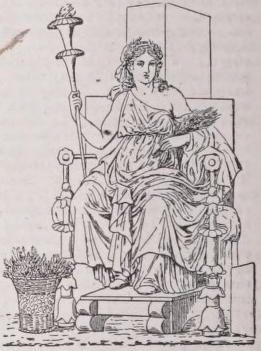
CERES, in Mythology, was the Roman goddess of seed and harvest, worshipped jointly with Liber (Bacchus) and Libera (Proserpine). No special myth or personal history is known to have been attached to her. But early in the times of the Republic, when Greek deities were introduced into Rome on the advice of the Sibylline books, Demeter, the Greek goddess of seed and harvest, whose worship was largely spread in Sicily and Lower Italy, usurped in Rome the divine position which Ceres held before; or rather to Ceres were added the religious rites which the Greeks paid to Demeter, and the mythological incidents which, originated with her. These rites were Greek in their language and forms, the priestesses were Greeks, and the temple was Greek in its architecture. Her principal festivals were (1) the Cerealia (April 12-19), corresponding in the main idea with the Eleusinia, and (2) the Jejunium Cereris (October 4), corresponding to the Thesmophoria of Demeter. The Cerealia included the spectacle of hunting a fox with a torch attached to his tail. Her temple in Rome had been destroyed by fire, and was rebuilt by Augustus. Claudius attempted to introduce the mysteries of Eleusis into Rome in connection with her worship....
As regards the Greek goddess, the chief interest of her worshippers was concentrated on the myth which told how her only daughter Persephone (Proserpine) had been carried off in a chariot by Pluto, the god of the lower world, from the fields of Enna in Sicily, where she was gathering flowers; other districts also were assigned for this incident, but the Romans naturally preferred Enna as being the nearest. Demeter wandered over the earth searching for her daughter in vain, in her anguish refusing food or drink, and threatening a famine for mankind, till Zeus agreed to allow Persephone in future to live half the year with her mother on the earth. The other half she must remain with Pluto in the lower world. From the myth so far it was a∣ obvious step to think of Demeter as a mother always anxious for her child, yearning through half the year to see her again, and sad through the other half at the prospect of her leaving again. But a deeper meaning appears to have been found in the myth by those who were initiated into the mysteries of Eleusis, in which seems to have been taught the principle of a new life after death, founded on the return of Persephone to the upper world, or rather on the process of nature by which seed sown in the ground must first die and rot before it can yield new life, a process which the annual going and coming of Persephone was designed to illustrate. To make more explicit this connection of Demeter with seed-sowing, the myth tells how, in searching for her daughter, she was hospitably received among other places at Eleusis in Attica, and how, when leaving Eleusis, she gave to Triptolemus, the king’s son, her chariot drawn by winged snakes, with the injunction to travel over the world teaching men to cultivate grain as she had then begun to teach them. At the Thesmophoria, a festival in which only married women took part, Demeter was regarded as having instituted certain laws (θeσμo[) for regulating life, in particular the married life of women. In the Cretan myth of Demeter she was connected with a hero Jasion, said to have been the first to sow grain, to whom she bore a son, Plutos. Poseidon, the god of the sea, appears as repugnant to her in the myth, according to which she took the form of a horse to escape him, but was overtaken, and finally bore to him the winged horse Arion. It may have been with reference to this that she was figured in . an ancient image at Phigaleia as having a horse’s in place of a human head. Her attributes were a veil and diadem on her head, ears of corn or poppies in her hand. Her principal sacrifice consisted of pigs. Demeter was a daughter of Kronos and Rhea. Zeus was the father of Persephone.
9th ed. Encyclopædia Britannica, vol. 5, p. 345
[695 words — estimated reading time: 4 minutes]
[695 words — estimated reading time: 4 minutes]
No thesaurus entries found for "ceres".
No Bible verses found for "ceres".