
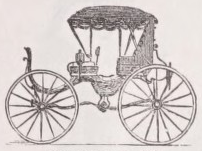
1. A half coach; a carriage with four wheels and one seat behind, used for convenience and pleasure.
Word of the Day: Catachrestical
To convey in a chariot
2. A four-wheeled pleasure or state carriage, having one seat.
To convey in a chariot.
Chariot
Encyclopedia Britannica
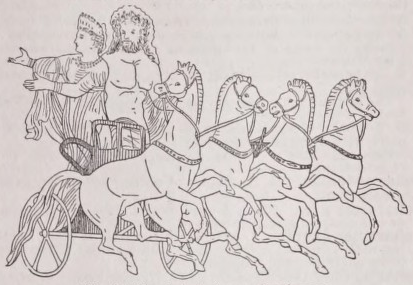
CHARIOT, in antiquity, was a conveyance used in battle, for the chase, in public processions, and in games. It had two wheels, and was made to be drawn by two horses; if a third or, more commonly, two reserve horses were added, they were attached on each side of the main pair by a single trace fastened to the front of the chariot, as may be seen on two prize vases iu the British Museum from the Panathenaic games at Athens, on which quadmgoe are represented. On the monuments there is no other sign of traces, from the want of which wheeling round must have been difficult. Immediately on the axle, without springs of any kind, rested the basket or body of the chariot, which consisted of a floor to stand on, and a semicircular guard round the front about half the height of the driver. It was entirely open at the back, so that the combatant might readily leap to the ground and up again as was necessary. There was no seat, and generally only room for the combatant and his charioteer to stand in. The pole was probably attached to the middle of the axle, though it appears to spring from the front of the basket; at the end of the pole was the yoke, which consisted of two small saddles fitting the necks of the horses, and fastened by broad bands round the chest. Besides this the harness of each horse consisted of a bridle and a pair of reins, mostly the same as in use now, made of leather and ornamented with studs of ivory or metal. The reins were passed through rings attached to the collar bands or yoke, and were long enough to be tied round the waist of the charioteer in case of his having to defend himself. The wheels and body of the chariot were usually of wood, strengthened in places with bronze or iron; the wheels had from four to eight spokes and tires of bronze or iron. ...This description applies generally to the chariots of all the nations of antiquity; the differences consisted chiefly in the mountings. The chariots of the Egyptians and Assyrians, with whom the bow was the principal arm of attack, were richly mounted with quivers full of arrows, while those of the Greeks, whose characteristic weapon was the spear, were plain except as regards mere decoration. Among the Persians, again, and more remarkably among the ancient Britons, there was a class of chariot having the wheels mounted with sharp sickle-shaped blades, which cut to pieces whatever came in their way. This was probably an invention of the Persians; Cyrus the younger employed these chariots in large numbers. Among the Greeks and Romans, on the other hand, the chariot had passed out of use in war before historical times, and was retained only for races in the public games, or for processions, without undergoing any alteration apparently, its form continuing to correspond with the descriptions of Homer, though it was lighter in build, having to carry only the charioteer. On two Panathenaic prize vases in the British Museum are figures of racing bigoe, in which, contrary to the description given above, the driver is seated with his feet resting on a board hanging down in front close to the legs of his horses. The biga itself consists of a seat resting on the axle, with a rail at each side to protect the driver from the wheels. The chariot was unsuited to the uneven soil of Greece and Italy, and it is not improbable that these nations had brought it with them as part of their original habits from their former seats in the East. In the remains of Egyptian and Assyrian art there are numerous representations of chariots, from which it may be seen with what richness they were sometimes ornamented. The “iron” chariots in use among the Jews appear to have been chariots strengthened or plated with metal, and no doubt were of the form above described, which prevailed generally among the other ancient nations.
9th ed. Encyclopædia Britannica, vol. 5, p. 401
[681 words — estimated reading time: 4 minutes]
[681 words — estimated reading time: 4 minutes]
The driver of a chariot. 2 Chronicles 18:1 .
A light, covered, four-wheeled pleasure carriage with two seats.
of Chariot
Chariots
Watson's Biblical & Theological Dictionary
OF WAR. The Scripture speaks of two sorts of these chariots, one for princes and generals to ride in, the other used to break the enemies battalions, by letting them loose armed with iron, which made dreadful havoc among the troops. The most ancient chariots of which we have any notice are Pharaoh’s, which were overwhelmed in the Red Sea, Exodus xiv, 7. The Canaanites, whom Joshua engaged at the waters of Merom, had cavalry and a multitude of chariots, Joshua xi, 4. Sisera, the general of Jabin, king of Hazor, had nine hundred chariots of iron in his army, Judges iv, 3. The tribe of Judah could not get possession of all the lands of their lot, because the ancient inhabitants of the country were strong in chariots of iron. The Philistines, in the war carried on by them against Saul, had thirty thousand chariots and six thousand horsemen, 1 Sam. xiii, 5. David, having taken one thousand chariots of war from Hadadezer, king of Syria, hamstrung the horses, and burned nine hundred chariots, reserving only one hundred to himself, 2 Sam. viii, 4. Solomon had a considerable number of chariots, but we know of no military expedition in which they were employed, 1 Kings x, 26. As Judea was a very mountainous country, chariots could be of no great use there, except in the plains; and the Hebrews often evaded them by fighting on the mountains. The kings of the Hebrews, when they went to war, were themselves generally mounted in chariots from which they fought, and issued their orders; and there was always a second chariot empty, which followed each of them, that if the first was broken he might ascend the other, 2 Chron. xxxv, 24. Chariots were sometimes consecrated to the sun; and the Scripture observes, that Josiah burned those which had been dedicated to the sun by his ...predecessors, 2 Kings xxiii, 11. This superstitious custom was borrowed from the Heathens, and principally from the Persians.
Watson's Biblical & Theological Dictionary
[332 words — estimated reading time: 2 minutes]
[332 words — estimated reading time: 2 minutes]
Vehicle Roget’s Thesaurus §272
N. vehicle, conveyance, carriage, caravan, van, common carrier, wagon, waggon, wain, dray, cart, lorry, truck, tram, cariole, carriole, limber, tumbrel, pontoon, barrow, wheel barrow, hand barrow, perambulator, bath chair, wheel chair, sedan chair, chaise, palankeen, palanquin, litter, brancard, crate, hurdle, stretcher, ambulance, black maria, conestoga wagon, conestoga wain, jinrikisha, ricksha, brett, dearborn, dump cart, hack, hackery, jigger, kittereen, mailstate, manomotor, rig, rockaway, prairie schooner, shay, sloven, team, tonga, wheel, hobbyhorse, go-cart, cycle, bicycle, bike, two-wheeler, tricycle, velocipede, quadricycle, equipage, turn-out, coach, chariot, phaeton, break, mail phaeton, wagonette, drag, curricle, tilbury, whisky, landau, barouche, victoria, brougham, clarence, calash, caleche, britzka, araba, kibitka, berlin, sulky, desobligeant, sociable, vis-a-vis, dormeuse, jaunting car, outside car, dandi, doolie, dooly, munchil, palki, roller skates, skate, runabout, ski, tonjon, vettura, post chaise, diligence, stage, stage coach, mail coach, hackney coach, glass coach, stage wagon, car, omnibus, fly, cabriolet, cab, hansom, shofle, four-wheeler, growler, droshki, drosky, dogcart, trap, whitechapel, buggy, four-in-hand, unicorn, random, tandem, shandredhan, char-a-bancs, motor car, automobile, limousine, car, auto, jalopy, clunker, lemon, flivver, coupe, sedan, two-door sedan, four-door sedan, luxury sedan, wheels, sports car, roadster, gran turismo, jeep, four-wheel drive vehicle, electric car, steamer, golf cart, electric wagon, taxicab, cab, taxicoach, checker cab, yellow cab, station wagon, family car, motorcycle, motor bike, side car, van, minivan, bus, minibus, microbus, truck, wagon, pick-up wagon, pick-up, tractor-trailer, road train, articulated vehicle, racing car, racer, hot rod, stock car, souped-up car, bob, bobsled, bobsleigh, cutter, double ripper, double runner, jumper, sled, sledge, sleigh, toboggan, train, accommodation train, passenger train, express trail, special train, corridor train, parliamentary train, luggage train, freight train, goods train, 1st class train, 2nd class train, 3rd class train, 1st class carriage, 2nd class carriage, 3rd class carriage, 1st class compartment, 2nd class compartment, 3rd class compartment, rolling stock, horse box, cattle truck, baggage car, express car, freight car, parlor car, dining car, pullman car, sleeping car, sleeper, dome car, surface car, tram car, trolley car, box car, box wagon, horse car, bullet train, shinkansen, cannonball, the wabash cannonball, lightning express, luggage van, mail, mail car, mail van, shovel, spool, spatula, ladle, hod, hoe, spade, spaddle, loy, spud, pitchfork, post hole digger, tractor, steamshovel, backhoe, fork lift, earth mover, dump truck, bulldozer, grader, caterpillar, trench digger, steamroller, pile driver, crane, wrecking crane
King James Bible KJV Bible
Berean Standard Bible BSB Bible
168 KJV and 149 BSB verses contain “chariot” — showing the first 20. Show all 171 verses (searchable)
And he made ready his chariot, and took his people with him:
So Pharaoh prepared his chariot and took his army with him.
And what he did unto the army of Egypt, unto their horses, and to their chariots; how he made the water of the Red sea to overflow them as they pursued after you, and how the LORD hath destroyed them unto this day;
When thou goest out to battle against thine enemies, and seest horses, and chariots, and a people more than thou, be not afraid of them: for the LORD thy God is with thee, which brought thee up out of the land of Egypt.
When you go out to war against your enemies and see horses, chariots, and an army larger than yours, do not be afraid of them; for the LORD your God, who brought you out of the land of Egypt, is with you.
And they went out, they and all their hosts with them, much people, even as the sand that is upon the sea shore in multitude, with horses and chariots very many.
And the children of Joseph said, The hill is not enough for us: and all the Canaanites that dwell in the land of the valley have chariots of iron, both they who are of Beth-shean and her towns, and they who are of the valley of Jezreel.
“The hill country is not enough for us,” they replied, “and all the Canaanites who live in the valley have iron chariots, both in Beth-shean with its towns and in the Valley of Jezreel.”