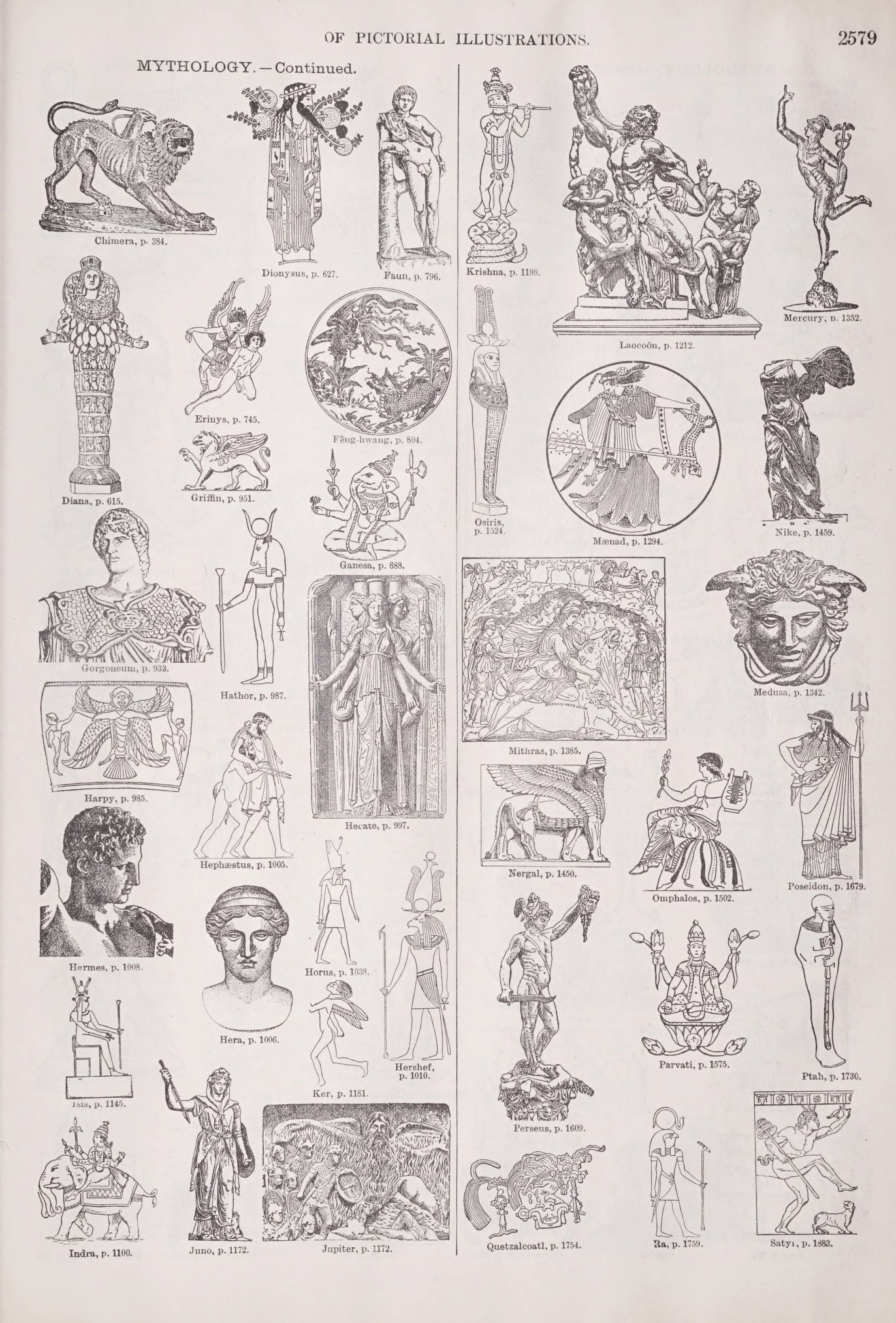
MYTHOLOGY (μυθολογία) is the science which examines μvθoι, or legends of cosmogony and of gods and heroes. Mythology is also used as a term for these legends themselves. Thus when we speak of “the mythology of Greece” we mean the whole body of Greek divine and heroic and cosmogonic legends. When we speak of the “science of mythology” we refer to the various attempts which have been made to explain these ancient narratives. Very early indeed in the history of human thought men awoke to the consciousness that their religious stories were much in want of explanation. The myths of civilized peoples, as of Greeks and the Aryans of India, contain two elements, the rational and the irrational. The rational myths are those which represent the gods as beautiful and wise beings. The Artemis of the Odyssey “taking her pastime in the chase of boars and swift deer, while with her the wild wood-nymphs disport them, and high over them all she rears her brow, and is easily to be known where all are fair,” is a perfectly rational mythic representation of a divine being. We feel, even now, that the conception of a “queen and huntress, chaste and fair,” the lady warden of the woodlands, is a beautiful and natural fancy which requires no explanation. On the other hand, the Artemis of Arcadia, who is confused with the nymph Callisto, who, again, is said to have become a she-bear, and later a star, and the Brauronian Artemis, whose maiden ministers danced a bear-dance (dpκτ∈υeιv; compare Harpocration on this word), are goddesses whose legend seems unnatural, and is felt to need explanation. Or, again, there is nothing not explicable and natural in the conception of the Olympian Zeus as represented by the great chryselephantine statue of Zeus at Olympia, or ...in the Homeric conception of Zeus as a god who “turns everywhere his shining eyes” and beholds all things. But the Zeus whose grave was shown in Crete, or the Zeus who played Demeter an obscene trick by the aid of a ram, or the Zeus who, in the shape of a swan, became the father of Castor and Pollux, or the Zeus who was merely a rough stone, or the Zeus who deceived Hera by means of a feigned marriage with an inanimate object, or the Zeus who was afraid of Attes, is a being whose myth is felt to be unnatural and in great need of explanation. It is this irrational and unnatural element—as Mr Max Müller says, “the silly, senseless, and savage element”—that makes mythology the puzzle which men have so long found it.
Early Explanations of Myths.— The earliest attempts at a crude science of mythology were efforts to reconcile the legends of the gods and heroes with the religious sentiment which recognized in these beings objects of worship and respect. Closely as religion and myth are intertwined, it is necessary to hold them apart for the purposes of this discussion. Religion may here be defined as the conception of divine or at least supernatural powers, entertained by men in moments of gratitude or of need and distress, in hours of weakness, when, as Homer says, “all folk yearn after the gods.” Now this conception may’be rude enough, and it is nearly related to purely magical ideas, to efforts to secure supernatural aid by magical ceremonies. Still the roughest form of spiritual prayer has for its basis the hypothesis of beneficent beings, visible or invisible. The senseless stories or myths about the gods are soon felt to be at variance with this hypothesis. As an example we may take the instance of Qing, the Bushman hunter. Qing, when first he met white men, was asked about his religion. He began to explain, and mentioned Cagn. Mr Orpen, the chief magistrate of St John’s Territory, asked, “Is Cagn good or malicious? how do you pray to him ?” Answer (in a low imploring tone), “ ‘ O Cagn! O Cagn! are we not your children? do you not see our hunger? give us food; ’ and he gives us both hands full” (Cape Monthly Magcv- ∑ine, July 1874). Here we see the religious view of Cagn, the Bushman god. But in the mythological account of Cagn given by Qing he appears as a kind of grasshopper, supernaturally endowed, the hero of a most absurd cycle of senseless adventures. Even religion is affected by these irrational notions, and the gods of savages and of many civilized peoples are worshipped with cruel, obscene, and irrational rites. But, on the whole, the religious sentiment strives to transcend the mythical conceptions of the gods, and is shocked and puzzled by the mythical narratives. As soon as this sense of perplexity is felt, by poets, by priests, or by most men in an age of nascent criticism, explanations of what is most crude and absurd in the myths are put forward. Men ask themselves why their gods are worshipped in the form of beasts, birds, and fishes; why their gods are said to have prosecuted their amours in bestial shapes ; why they are represented as lustful and passionate—thieves, robbers, murderers, and adulterous. The answers to these questions sometimes become myths themselves. Thus both the Mangaians and the Egyptians have been puzzled by their own gods in the form of beasts. The Egyptians invented an explanation—itself a myth—that in some moment of danger the gods concealed themselves from their foes in the shapes of animals. The Mangaians, according to Mr Gill, hold that “the heavenly family had taken up their abode in these birds, fishes, and reptiles.”
A people so curious and refined as the Greeks were certain to be greatly perplexed by even such comparatively pure mythical narratives as they found in Homer, still more by the coarser legends of Hesiod, and above all by the ancient local myths preserved by local priesthoods. Thus, in the 6th century before Christ, Xenophanes of Colophon severely blamed the poets for their unbecoming legends, and boldly called certain myths “the fables of men of old.” Theagenes of Rhegium (520 b.c. ?), according to the scholiast on Iliad, xx. 67, was the author of a very ancient system of mythology. Admitting that the fable of the battle of the gods was “unbecoming,” if literally understood, Theagenes represented it as an allegorical account of the war of the elements. Apollo, Helios, and Hephaestus were fire, Hera was air, Poseidon was water, Artemis was the moon, καί τά λοιπά <ψoιωs. Or, by another system, the names of the gods represented moral and intellectual qualities. Heraclitus, too, disposed of the myth of the bondage of Hera as allegorical philosophy. Socrates, in the Cratylus of Plato, expounds “a philosophy which came to him all in an instant,” an explanation of the divine beings based on crude philological analyses of their names. Metrodorus, rivalling some recent flights of conjecture, resolved not only the gods but even heroes like Agamemnon, Hector, and Achilles “into elemental combinations and physical agencies.” Euripides makes Pentheus (but he was notoriously impious) advance a “rationalistic” theory of the story that Dionysus was stitched up in the thigh of Zeus. When Christianity became powerful the heathen philosophers evaded its satire by making more and more use of the allegorical and non-natural system of explanation. That method has two faults. First (as Arnobius and Eusebius reminded their heathen opponents), the allegorical explanations are purely arbitrary, depend upon the fancy of their author, and are all equally plausible and equally unsupported by evidence. Secondly, there is no proof at all that, in the distant age when the myths were developed, men entertained the moral notions and physical philosophies which are supposed to be “wrapped up,” as Cicero says, “in impious fables.” Another system of explanation is that associated with the name of Euemerus (316 B.C.). According to this author, the myths are history in disguise. All the gods were once men, whose real feats have been decorated and distorted by later fancy. This view suited Lactantius, St Augustine, and other early Christian writers very well. They were pleased to believe that Euemerus “by historical research had ascertained that the gods were once but mortal men.” Precisely the same convenient line was taken by Sahagun in his account of Mexican religious myths. As there can be no doubt that the ghosts of dead men have been worshipped in many lands, and as the gods of many faiths are tricked out with attributes derived from ancestor-worship, the system of Euemerus retains some measure of plausibility. While we need not believe with Euemerus and with Mr Herbert Spencer that the god of Greece or the god of the Hottentots was once a man, we cannot deny that the myths of both these gods have passed through and been coloured by the imaginations of men who practised the worship of real ancestors. For example, the Cretans showed the tomb of Zeus, and the Phocians (Pausanias, x. 5) daily poured blood of victims into the tomb of a hero, obviously by way of feeding his ghost. The Hottentots show many tombs of their god, Tsui-Goab, and tell tales about his death; they also pray regularly for aid at the tombs of their own parents. We may therefore say that, while it is rather absurd to believe that Zeus and Tsui-Goab were once real men, yet their myths are such as would be developed by people accustomed, among other forms of religion, to the worship of dead men. Very probably portions of the legends of real men have been attracted into the mythic accounts of gods of another character, and this is the element of truth at the bottom of Euemerism. This is not the place to deal fully with the modern form of the system as set forth by Mr Herbert Spencer.
Later Explanations of Mythology.— The ancient systems of explaining what needed explanation in myths were, then, physical, ethical, religious, and historical. One student, like Theagenes, would see a physical philosophy underlying Homeric legends. Another, like Porphyry, would imagine that the meaning was partly moral, partly of a dark theosophic and religious character. Another would detect moral allegory alone, and Aristotle expresses the opinion that the myths were the inventions of legislators il to persuade the many, and to be used in support of law” (Met., xi. 8, 19). A fourth, like Euemerus, would get rid of the supernatural element altogether, and find only an imaginative rendering of actual history. When Christians approached the problem of heathen mythology, they sometimes held, with St Augustine, a form of the doctrine of Euemerus. In other words, they regarded Zeus, Aphrodite, and the rest as real persons, diabolical not divine. Some later philosophers, especially of the 17 th century, misled by the resemblance between Biblical narratives and ancient myths, came to the conclusion that the Bible contains a pure, the myths a distorted, form of an original revelation. The abbé Banier published a mythological compilation in which he systematically resolved all the Greek myths into ordinary history. Bryant published (1774) A New System, or an Analysis of Ancient Mythology, wherein an Attempt is made to divest Tradition of Fable, in which he talked very learnedly of “that wonderful people, the descendants of Cush,” and saw everywhere symbols of the ark and traces of the Noachian deluge. Thomas Taylor, at the end of the 18th century, indulged in much mystical allegorizing of myths, as in the notes to his translation of Pausanias (1794). At an earlier date (1760) De Brosses struck on the true line of interpretation in his little work Du Culte des Dieux Fetiches, ou Parallèle de l'ancienne Religion de l'Egypte avec la Religion actuelle de Nigritie. In this tract De Brosses explained the animal-worship of the Egyptians as a survival among a civilized people of ideas and practices springing from the intellectual condition of savages, and actually existing among negroes. A vast symbolical explanation of myths and mysteries was attempted by Friedrich Creuzer. The learning and sound sense of Lobeck, in his Aglaophamus, exploded the idea that the Eleusinian and other mysteries revealed or concealed matter of momentous religious importance. It ought not to be forgotten that Lafitau, a Jesuit missionary in North America, while inclined to take a mystical view of the secrets concealed by Iroquois myths, had also pointed out the savage element surviving in Greek mythology. The Most Recent Mythological Systems.— Up to a very recent date students of mythology were hampered by orthodox traditions, and still more by ignorance of the ancient languages and of the natural history of man. Only recently have Sanskrit and the Egyptian and Chal-
daean languages become books not absolutely sealed. Again, the study of the evolution of human institutions from the lowest savagery to civilization is essentially a novel branch of research, though ideas derived from an unsystematic study of anthropology are at least as old as Aristotle. The new theories of mythology are based on the belief that “it is man, it is human thought and human language combined, which naturally and necessarily produced the strange conglomerate of ancient fable.” But, while there is now universal agreement so far, modern mythologists differ essentially on one point. There is a school (with internal divisions) which regards ancient fable as almost entirely “a disease of language,” that is, as the result of confusions arising from misunderstood terms that have survived in speech after their original significance was lost. Another school (also somewhat divided against itself) believes that misunderstood language played but a very slight part in the evolution of mythology, and that the irrational element in myths is merely the survival from a condition of thought which was once common, if not universal, but is now only found among savages, and to a certain extent among children. The former school considers that the state of thought out of which myths were developed was produced by decaying language; the latter maintains that the corresponding phenomena of language were the reflexion of thought. For the sake of brevity we might call the former the “philological” system, as it rests chiefly on the study of language, while the latter might be styled the “historical” or “anthropological” school, as it is based on the study of man in the sum of his manners, ideas, and institutions.
The System of Mr Max Muller.— The most distinguished and popular advocate of the philological school is Mr Max Müller, whose ideas must now be stated. Their exposition is chiefly to be found in Mr Müller’s Selected Essays and in his Lectures on Language. As the opposite system, the historical or anthropological system, is that which will be adopted in the remainder of this article, our criticism of Mr Müller’s ideas must be accepted as that of an opponent. The problem set himself by Mr Müller is to explain what he calls “the silly, savage, and senseless” element in mythology (Sei. Ess., i. 578).
(1.) Mr Müller says (speaking of the Greeks), “their poets had an instinctive aversion to everything excessive or monstrous, yet they would relate of their gods what would make the most savage of Red Indians creep and shudder,”—stories, that is, of the cannibalism of Demeter, of the mutilation of Uranus, the cannibalism of Cronus, who swallowed his own children, and the like. “Among the lowest tribes of Africa and America we hardly find anything more hideous and revolting.”
(2.) Mr Müller refers the beginning of his system of mythology to the discovery of the connexion of the Indo-European or, as they are called, “Aryan” languages. Celts, Germans, speakers of Sanskrit and Zend, Latins and Greeks, all prove by their languages that their tongues may be traced to one family of speech. The comparison of the various words which, in different forms, are common to all Indo-European languages must inevitably throw much light on the original meaning of these words. Take, for example, the name of a god, Zeus, or Athene, or any other. The word may have no intelligible meaning in Greek, but its counterpart in the allied tongues, especially in Sanskrit or Zend, may reveal the original significance of the terms. “To understand the origin and meaning of the names of the Greek gods, and to enter into the original intention of the fables told of each, we must take into account the collateral evidence supplied by Latin, German, Sanskrit, and Zend philology” (Led. on Lang., 2d ser., p. 406). A name may be intelligible in Sanskrit which has no sense in Greek. Thus Athene is a divine name without meaning in Greek, but Mr Müller advances reasons for supposing that it is identical with ahana, “the dawn,” in Sanskrit. It is his opinion, apparently, that whatever story is told of Athene must have originally been told of the dawn, and that we must keep this before us in attempting to understand the legends of Athene. Thus (op. cit., p. 410), he says, “we have a right to explain all that is told of him” (Agni, “fire ”) “as originally meant for fire.” To take another example, Mr Müller proves by aid of Sanskrit philology that Zeus originally meant the sky, and, as a result, “there was nothing that could be told of the sky that was not in some form or other ascribed to Zeus.” If, then (to take an example of our own), we read that Zeus, to pacify the jealousy of Demeter, mutilated a ram, and pretended to have mutilated himself, are we to suppose that this story had originally a meaning in reference to the sky? The system, at all events, is simply this: the original meaning of the names of gods must be ascertained by comparative philology. The names, as a rule, will be found to denote elemental phenomena. And the silly, savage, and senseless elements in the legends of the gods will be shown to have a natural significance, as descriptions of sky, storms, sunset, water, fire, dawn, twilight, the life of earth, and other celestial and terrestrial existences. Stated in the barest form, these results do not differ greatly from the conclusions of Theagenes of Rhegium, who held that “Hephaestus was fire, Hera was air, Poseidon was water, Artemis was the moon, και τά λοιπά ό/ιοίως.” But Mr Müller’s system is based on scientific philology, not on conjecture, and is supported by a theory, which we shall try to explain, of the various processes in the evolution of myths out of language.
(3.) The following is an abstract of Mr Müller’s theory of one process by which myths were developed out of language. “The keenest eye of the antiquary and the philosopher” cannot see farther back, he says, than the period when expressions were coined for the most necessary ideas, and when a grammar began which was destitute of national peculiarities, but contained the germ of all the Turanian as well as the Aryan and Semitic forms of speech. This age Mr Müller calls the Rhematic period (Sei. Ess., i. 306). (As yet there were no myths, or none alluded to by Mr Müller.) This was followed by an age in which at least two families of language, the Aryan and Semitic, left “the nomadic stage of grammar,” and received once for all the peculiar impress of their formative system. There were as yet no such tongues as the Greek, Sanskrit, and Latin we know, only the Aryan speech from which these languages differentiated themselves. This was the Dialedic period. (As yet we understand that there were no myths, or none which Mr Müller takes into account.) We now come to the Mythopoeic age. It was “half-way between the Dialectical period, presenting the human race gradually diverging into different families and languages, and the National period, exhibiting to us the earliest traces of nationalized language, and a nationalized literature in India, Persia, Greece, Italy, and Germany” (op. cit., i. p. 311). The Mythopoeic age, according to Mr Müller (op. cit., i. 308), came after the “unavoidable divergence of dialects and languages,” between that period and the age of “the establishment of laws and customs and the first beginnings of religion and poetry.” Mr Müller’s next step is to examine the intellectual and social conditions of man in the Mythopoeic age. This he does by aid of philology. He analyses the words which, being common to Sanskrit, Greek, Latin, and German, must have existed in Aryan speech before the nations that talked these languages separated from the common stock. Although, as we have seen, the Mythopoeic age came before “the earliest concentrations of political societies, the establishment of laws and customs,” yet Mr Müller demonstrates that man, in the Mythopoeic age, had political societies, and customs if not laws. Man, in the age called Mythopoeic, the age when myths were made, already possessed the modern, or at all events the patriarchal, form of the family. His life was “half nomadic, half pastoral.” He had abundance of domesticated animals, he practised agriculture, and...