
The Arabian gazelle (Gazella Arabica), found from persia to North Africa.
Word of the Day: Catachrestical
Cora
Encyclopedia Britannica
CORA, an ancient city of Italy, about seven miles southeast of Rome by the Appian Way. Various traditions about its origin are found in the Roman writers; but all agree in acknowledging its great antiquity, and for a long period it ranked as one of the most important cities of Latium. After being lost sight of in history for about twelve hundred years it reappears in the 13 th century, and under the name of Cori it continues to the present day, a town of from 5000 to 6000 inhabitants. Situated on a hill that rises above the Ponptine marshes, and divided by an olive grove into two portions, Cori presents a fine appearance from the plain. Besides the walls erected in the 15th century by Ladislas of Naples, it preserves important remains of its earlier and perhaps its earliest defences, constructed of large polygonal blocks; part of a temple, usually distinguished by the name of Hercules, is incorporated in the church of St Pietro; two Corinthian columns of admirable execution mark the site of the temple of Castor and Pollux; numerous minor antiquities are scattered about the town; and the ravine outside the gateway leading to Ninfa is spanned by the Ponte della Catena, built of massive blocks of tufa.
See for further details Nibby, Dintomi di Borna ; Giovanni Antolini, Il tempiod’ Ercole in Cori, Milan, 1828.
9th ed. Encyclopædia Britannica, vol. 6, p. 368
[228 words — estimated reading time: 2 minutes]
[228 words — estimated reading time: 2 minutes]
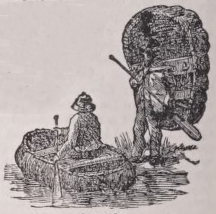
A boat made by covering a wicker frame with leather or oilcloth. It was used by the ancient Britons, and is still used by fisherman in Wales and some parts of Ireland. Also, a similar boat used in Thibet and in Egypt.
The coracoid bone or process.
See Courage
Made of coral; resembling coral
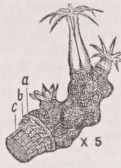
1. In zoology, a genus belonging to the order of vermes zoophyta. The trunk is radicated, jointed and calcarious. The species are distinguished by the form of their branches, and are found in the ocean adhering to stones, bones, shells, etc. coral was formerly supposed to be a vegetable substance, but is now known to be composed of a congeries of animals. coral is red, white and black. It is properly the shells of marine animals of the polype kind, consisting of calcarious earth combined with gelatine and other animal matter. In the South Sea, the isles are mostly coral rocks covered with earth. Corals seem to consist of carbonate of lime and animal matter, in equal proportions.
2. A piece of coral worn by children about their necks.
1. The hard parts or skeleton of various Anthozoa, and of a few Hydrozoa. Similar structures are also formed by some Bryozoa.
3. A piece of coral, usually fitted with small bells and other appurtenances, used by children as a plaything.
Coral
Watson's Biblical & Theological Dictionary
ראמות, Job xxviii, 18; Ezek. xxvii, 16; a hard, cretaceous, marine production, resembling in figure the stem of a plant, divided into branches. It is of different colours,--black, white, and red. The latter is the sort emphatically called coral, as being the most valuable, and usually made into ornaments. This, though no gem, is ranked by the author of the book of Job, xxviii, 18, with the onyx and sapphire. Dr. Good observes, “It is by no means certain what the words here rendered ‘corals and pearls,’ and those immediately afterward rendered ‘rubies and topaz,’ really signified. Reiske has given up the inquiry as either hopeless or useless; and Schultens has generally introduced the Hebrew words themselves, and left the reader of the translation to determine as he may. Our common version is, in the main, concurrent with most of the oriental renderings: and I see no reason to deviate from it.”
Watson's Biblical & Theological Dictionary
[152 words — estimated reading time: 1 minute]
[152 words — estimated reading time: 1 minute]
Coral fish
Webster's Dictionary 1913
A genus of plants, Erythrina, of several species, natives of Africa and America. They are all shrubby flowering plants, adorned chiefly with trifoliate or three-lobed leaves, and scarlet spikes of papilionaceous flowers.
Having coral; covered with coral.
Like coral, or partaking of its qualities.
Like coral, or partaking of its qualities.
A deposit of coralliferous limestone forming a portion of the middle division of the oolite; -- called also coral-rag.
Containing or producing coral.
resembling coral in form.
Same as Anthozoa.
producing coral; coralligerous; coralliferous.
Producing coral; coralliferous.
Consisting of coral; like coral; containing coral.
A submarine plant-like body, consisting of many slender, jointed branches, resembling some species of moss; or animals growing in the form of plants, having their stems fixed to other bodies. These stems are composed of capillary tubes, which pass through a calcarious crust and open on the surface. In the Linnean system, corallines are classed with the zoophytes. They have been distributed by Ellis into vesiculated, furnished with small bodies like bladders; tubular, composed of simple tubes; celliferous, which, when magnified, appear to be fine thin cells, the habitations of small animals; and articulated, consisting of short pieces of stony or cretaceous brittle matter, covered with pores or cells, joined by a tough, membranous, flexible substance, composed of many small tubes. Butin this arrangement of Ellis, the term coralline is synonymous with the more ancient term lithophyta, including all the polypebearing animals, and nearly coinciding with the zoophyta of Linne, and the polypiers of the French naturalists.
Composed of corallines; as, coralline limestone.
1. A submarine, semicalcareous or calcareous plant, consisting of many jointed branches.
2. Formerly any slender coral-like animal; -- sometimes applied more particulary to bryozoan corals.
A fossil coralline.
No thesaurus entries found for "cora".
King James Bible KJV Bible
Berean Standard Bible BSB Bible
2 KJV and 2 BSB verses contain “cora”
Syria was thy merchant by reason of the multitude of the wares of thy making: they occupied in thy fairs with emeralds, purple, and broidered work, and fine linen, and coral, and agate.
Aram was your customer because of your many products; they exchanged turquoise, purple, embroidered work, fine linen, coral, and rubies for your wares.