LIFEBOAT. It will be convenient to consider here, not the lifeboat simply, but also other means of saving life at sea. When it is borne in mind that the vast commerce of such a country as Great Britain extends to every part of the world, that the arrivals and departures from the ports of the country in one year average six hundred thousand vessels, that these are manned by more than two hundred thousand men and boys, and carry goods to the estimated value of six hundred millions sterling, with unknown thousands of passengers, that its seaboard is nearly 5000 miles in extent, many parts of it being exceedingly dangerous to shipping, that about two thousand wrecks occur every year on its shores, and above seven hundred lives are lost, the necessity that exists for a well-organized system of life-saving apparatus becomes very apparent. It is satisfactory to be able to add that this well-organized system is most efficiently provided by the Royal National Lifeboat Institution, with its splendid fleet of two hundred and seventy-one lifeboats, and by the Rocket Service. The number of lives saved annually, either by the lifeboats or by special exertions for which the institution has granted rewards, averages in round numbers nine hundred, and by far the greater proportion of these (four-fifths) are saved by lifeboats. These lifeboats, too, are the means of saving every year from twenty to thirty vessels which, owing to stress of weather, exhausted men, <fcc., would almost certainly have been lost but for the aid afforded by the fresh and experienced lifeboat crews....
The qualities of the lifeboat first deserve our attention. These are such that this boat is able to live in seas, and go into positions of danger, that would overwhelm ordinary boats or insure their destruction. Eight important qualities are possessed by it in a very high degree :—(1) buoyancy; (2) great lateral stability, or resistance to upsetting; (3) the power to right itself if upset; (4) the power of immediate self-discharge when filled with water; (5) strength; (6) stowage room for a large number of passengers; (7) speed against a heavy sea; (8) facility in launching and taking the shore.
The buoyancy of the institution’s lifeboat, or its inability to sink, be it ever so deeply laden, is secured chiefly by means of a watertight deck or floor, air-cases round the sides inboard, and two large air-chambers, one in the bow, the other in the stern. The “extra buoyancy” thus obtained cannot be too great so long as it does not interfere with the space necessary for working the boat and stowing shipwrecked persons. The air-cases round the sides serve also to confine any water shipped to the centre of the boat, a point of great importance. There is an airtight space between the boat’s floor and its bottom, filled partly with air partly with cork-ballast, which gives it additional buoyancy, but the air-chambers above the floor would float the boat even if she were stove in and this space filled with water. In a 33-feet boat the buoyancy obtained by all its chambers is equal to 11∣ tons.
Stability is obtained chiefly by means of ballast. Immense difficulty was experienced in arriving at the present form of the institution’s splendid boat, because qualities of differing value had to be sacrificed to each other in due proportion. Thus, while breadth of beam secured stability, it seriously interfered with the self-righting quality. Ballast, therefore, in the form of a heavy iron keel, instead of breadth, became necessary to give the requisite stability.
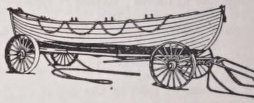
Fig. 1 represents, let us say, the 33-feet, double-banked, ten-oared, self-righting, and self-emptying lifeboat of the institution on its transporting carriage, ready for launching; figs. 2 and 3, respectively, a section and a bird’s-eye view of the same. The breadth is 8 feet, with stowage room for forty-three persons—thirty passengers and thirteen of a crew. The festooned lines (fig. 1) enable people in the water to clamber inboard even without assistance. The shaded parts of figs. 2 and 3 show the position of the air-cases. The white oblong space in fig. 3 shows the free space available for crew and passengers. In fig. 2 are seen the depth to which the air-cases descend, and the height to which the bow and stern air-chambers ascend above the gunwale, also the ballast space between the floor and the keel.
The self-righting power is due to the large elevated air-chambers in bow and stern, coupled with great sheer, or rise fore and aft, of gunwale, to the iron keel, which weighs about 9 cwts. in a 33-feet boat, and to the air-cases and ballast, which latter weighs from 7 to 8 cwts. When the boat is upset it cannot rest on its two elevated air-chambers; it necessarily rolls on one side, then the heavy iron keel and ballast come into play and drag it back to its right position in a few seconds. This principle of self-righting was discovered—at all events first exhibited—at the end of last century, by the Rev. James Bremner of Orkney, but was not finally adopted till the middle of the present century.
The self-emptying quality depends chiefly on the well-known physical fact that water must find its level. The floor of the lifeboat (fig. 2, the dotted double line extending from stem to stern), on which the men’s feet rest when seated on the thwarts, is placed so as to be very slightly—2 or 3 inches—above the level of the sea when the boat is fully manned and loaded. In this floor there are six holes of 6 inches diameter, into which are fitted six metal tubes. These pass through the boat’s bottom into the sea. The water of course enters them, but cannot rise above them into the boat, because it cannot rise above its own level. Valves at the upper ends of the tubes, opening downwards, prevent the annoyance of water spurting in, but allow it freely to run out. When, then, a billow overwhelms the boat, and fills it, the water rushes violently down the discharging tubes until it reaches the sea-level; by that time it has descended below the level of the floor and left the boat empty. So complete and swift is the process that a filled boat frees herself in about half a minute. This principle was first applied by the institution in 1851. Lifeboats devoid of the selfdischarging quality become temporarily useless when filled by a sea, as they can be emptied only by the slow and laborious process of baling.
Strength, that will enable the lifeboat to suffer treatment which no ordinary boat could stand, is dependent on peculiarity of construction and material. The best Honduras mahogany is used, and the diagonal plan of construction adopted,—that is, the boat has two distinct “skins” of planking, both sets of planks being laid on in a position diagonal to the boat’s keel and contrary to each other, besides passing round from gunwale to gunwale under the boat instead of from stem to stern as in ordinary boats. The skins have a layer of prepared canvas between them, and thus great strength and elasticity are combined.
The carriage of the lifeboat is an essential adjunct for the purpose of conveying it over any kind of road or beach to the place where it may be required. It can be run deep into a raging surf, and the boat, with its crew seated and oars ready out, can be launched at once, by blocks and tackle, so as to enable the men to dash forward and meet the incoming rollers with sufficient force to propel it through or over the seas, and thus avoid the risk of being hurled back on the beach. Each lifeboat is furnished with a set of spare oars, as these are frequently broken.
The institution’s lifeboats are of various sizes—six, eight, ten, and twelve oared,—and they are placed at various points of the coast according to the necessities of each station. Some are called out at long intervals; others, such as those near the Goodwin Sands, are constantly on duty in rough weather—that of Ramsgate having a steamer to attend on it, which lies in harbour, with its fires banked up, ready for instant action night and day. The average cost of a lifeboat station is £1000,—the boat and equipments, including belts and carriage, costing £650, and the boat-house £350. The average annual expense of maintaining a station is £70, which is expended in paying the crew for going off and saving or attempting to save life from shipwreck, for exercising the lifeboat once a quarter, paying coxswain’s salary, replacing gear, and repairs.
The lifebelt of the institution is a part of the equipment of the lifeboat which merits special attention, because it is a very efficient contrivance, and has been the means of saving many lives in time past. Fig. 4 shows its appearance and the manner in which it is worn. It was designed in 1854 by Admiral J. R. Ward, the institution’s chief inspector of lifeboats. It is made of cork fastened on canvas, and combines great buoyancy with strength and flexibility. It not only floats a heavily-clothed man head and shoulders above water, but enables him to support a comrade easily —the extra buoyancy being 25 lb. One of its distinctive features is its division at the waist, by which means great freedom of action is allowed. It serves also as a species of armour to protect the wearer’s most vital parts from blows against rock or wreck, while it affords some degree of warmth. No man may serve in the lifeboats of the institution without it, and it would be well if every British ship were obliged to carry lifebelts of this kind.
History.— The first lifeboat was conceived and designed by Lionel Lukin, a London coachbuilder, in 1785. Encouraged in his philanthropic plans by the prince of Wales (George IV. ), Lukin fitted up a Norway yawl as a lifeboat, took out a patent for it, and wrote a pamphlet descriptive of his “Insubmergible Boat.” Buoyancy he obtained by means of a projecting gunwale of cork and air-chambers inside—one of these being at the bow, another at the stern. Stability he secured by a false iron keel. The self-righting and self-emptying principles he seems not to have thought of; at all events he did not compass them. Despite the patronage of the prince, Lukin went to his grave a neglected and disappointed man. But he was not altogether unsuccessful, for, at the request of the Rev. Dr Shairp, Lukin fitted up a coble as an “unimmergible” lifeboat, which was launched at Bamborough, saved several lives the first year, and afterwards saved many lives and much property.
Public apathy in regard to shipwreck was at length swept away by the wreck of the “Adventure” of Newcastle in 1789. This vessel was stranded only 300 yards from the shore, and her crew dropped, one by one, into the raging breakers in presence of thousands of spectators, none of whom dared to put off in an ordinary boat to the rescue. An excited meeting among the people of South Shields followed; a committee was formed, and premiums were offered for the best models of a lifeboat. This called forth many plans, of which those of William Wouldhave, a j>ainter, and Henry Greathead, a boatbuilder, of South Shields, were selected. The committee awarded the prize to the latter, and, adopting the good points of both models, gave the order for the construction of their boat to Greathead. This boat λvas rendered buoyant by nearly 7 cwts. of cork, and had very raking stem and stern-posts, with great curvature of keel. It did good service in after years, and Greathead was well rewarded; nevertheless no other lifeboat was launched till 1798, when the duke of Northumberland ordered Greathead to build him a lifeboat which he endowed. This boat also did good service, and its noble owner ordered another in 1800 for Oporto. In the same year Mr Cathcaι∙t Dempster ordered one for St Andrews, where, two years later, it saved twelve lives. Thus the value of lifeboats began to be recognized, and before the end of 1803 Greathead had built no fewer than thirty-one boats—eighteen for England, five for Scotland, and eight for foreign lands. That these boats were lamentably insufficient to meet the necessities of England was shown year after year by the ever enlarging record of wreck and loss of life on her shores; nevertheless, public interest in lifeboats was not thoroughly aroused till 1823.
In that year Sir William Hillary, Bart., stood forth to champion the lifeboat cause. Sir William dwelt in the Isle of Man, had assisted with his own hand in the saving of three hundred and five lives, and felt the horrors of shipwreck so keenly that he resolved to stir up public men and the nation generally to a sense of their duty in regard to this matter. Eventually, in conjunction with two members of parliament—Mr Thomas Wilson and Mr George Hibbert—he .founded the “Royal National Institution for the Preservation of Life from Shipwreck.” This, perhaps the grandest of England’s charitable societies, and now named the “Royal National Lifeboat Institution,” was founded on the 4th of March 1824. The king and many of the nobility and gentry patronized it. The archbishop of Canterbury presided at its birth; the most eloquent men in the land—among them Wilberforce—pleaded the cause; the institution was launched under the most favourable auspices, and began its noble career with a sum of only £9826. In the first year twelve new lifeboats were built and placed at different stations, besides which thirty-nine lifeboats had been stationed on the British shores by benevolent individuals and by independent associations over which the institution exercised no control though it often assisted them. In its early years the institution placed the mortar apparatus of Captain Manby at many stations, and provided for the wants of sailors and others saved from shipwreck. The latter duty is now efficiently discharged by the ‘ ‘ Shipwrecked Fishermen and Mariners’ Royal Benevolent Society.” At the date of the institution’s second report it had contributed to the saving of three hundred and forty-two lives, either by its own life-saving apparatus or by other means for which it had granted rewards. With fluctuating success, both as regards means and results, the institution continued its good work from year to year—saving many lives, and occasionally losing a few brave men in its tremendous battles with the sea. District or branch societies were established in mostof the coast towns. Ultimately it began to be recognized that inland towns owed something to the lifeboat cause, as well as towns on the coast, and now such cities as Manchester, Liverpool, Glasgow, Edinburgh, &c., have presented lifeboats to the institution and become annual contributors. Since the adoption of the self-righting boats, loss of life in the service has been comparatively small and infrequent.
Towards the middle of this century the lifeboat cause appeared to lose interest with the public, though the life-saving work was prosecuted with unremitting zeal, but the increasing loss of life by shipwreck, and a few unusually severe disasters to lifeboats, brought about the reorganization of the society in 1850. The late Prince Albert became vice-patron of the institution in conjunction with the late king of the Belgians, and afterwards Her Majesty the Queen, who had been its patron since her accession, became an annual contributor to its funds. About the same time its present secretary, Mr Richard Lewis, barrister-at-law, was appointed. The following year (1851) the duke of Northumberland became its president, and from that time forward a tide of prosperity set in which is literally unprecedented in the history of benevolent institutions, both in regard to the great work accomplished and the pecuniary aid received. Its flow of prosperity has never since been checked. In 1850 its committee undertook the immediate superintendence of all the lifeboat work on the coasts, with the aid of local committees. Periodical inspections, quarterly exercise of crews, fixed rates of payments to coxswains and men, and quarterly reports were instituted, at the time when the self-righting self-emptying boat came into being. This boat was the result of a hundred-guinea prize, offered by the president, for the best model of a lifeboat, with another hundred to defray the cost of a boat built on the model chosen. In reply to the offer no fewer than two hundred and eighty models were sent in, not only from all parts of the United Kingdom, but from France, Germany, Holland, and the United States of America. The prize was gained by Mr James Beeching of Great Yarmouth, whose model, slightly modified by Mr Peake, one of the committee of inspection, became the foundation of the present boat, which, having been still further improved as time and experience have suggested, is now probably as near to perfection as can be attained.
The shortest way, perhaps, to exhibit the progressive work of the institution is to contrast the report of 1850 with that of 1880. In the former year the receipts had dwindled down to £84 of subscriptions and donations, which, with £270 of dividends (on a capital of £9000) and a balance of £476 on hand, gave an available income of £830. The expenditure was £590, and the lives saved were about one hundred. In 1880 donations and annual subscriptions amounted to £29,240; dividends and interest (on a capital of £231,000) amounted to £9266. The total income was £38,506, besides legacies in the same year to the amount of £40,782. The expenditure, including liabilities, was £40,586, and the number of lives saved was about seven hundred. In the past unusually disastrous year (1881), the institution has saved 966 lives by its boats, and granted rewards for the saving of 155 more, besides rescuing 33 vessels from destruction. The total number of lives saved either by the lifeboats, or by special exertions for which the institution has granted rewards, since its formation, is 28,724, for which services 95 gold medals, 939 silver medals, and £69,000 in cash have been granted as rewards. So highly are the services of the institution appreciated that donations of boats, gifts of money, acknowledgments, and legacies come in from nearly all quarters of the globe, in sums varying from a shilling to £10,000.
Rocket Apparatus.— This, next to the lifeboat, is the most important and successful means by which shipwrecked persons are rescued on the British shores. Many vessels are cast every year on the rocky parts of the coasts, under cliffs, where no lifeboat could be of service. In such places the rocket alone is available. It is worked by the men of the coastguard, with the aid, in a few places, of volunteer rocket brigades. The courage and skill displayed in its use are evinced by the saving of many lives every year, and by the fact that a large proportion of the medals given by the lifeboat institution for heroic conduct are awarded to the men of the coastguard, who, besides managing the rockets, frequently man the lifeboats and also effect rescues in their own boats. The number of lives saved by means of the rocket apparatus in the year ending 30th June 1881 was 657. This, however, is the greatest number saved in any one year since 1856, at which date the life-saving rocket apparatus was placed under the entire control and management of the Board of Trade. The rocket stations on the coast at the 30th June 1881 numbered 288. The Board of Trade now gives a sum of money for each life saved, besides awarding silver and bronze medals for acts of special gallantry.
The apparatus consists of five principal parts, viz., the rocket, the rocket-line, the whip, the hawser, and the sling lifebuoy. The mode of working it is as follows. A rocket, having a light line attached to it, is fired over the wreck. By means of this line the wrecked crew haul out the whip, which is a double or endless line, rove through a block with a tail attached to it. The tail-block, having been detached from the rocket-line, is fastened to a mast, or other portion of the wreck, high above the water. By means of the whip the rescuers haul off the hawser, to which is hung the travelling or sling lifebuoy. When one end of the hawser has been made fast to the mast, about 18 inches above the whip, and its other end to tackle fixed to an anchor on shore, the lifebuoy is run out by the rescuers, and the shipwrecked persons, getting into it one at a time, are hauled ashore. Sometimes, in cases of urgency, the lifebuoy is worked by means of the whip alone, without the hawser. A tallyboard with instructions to wrecked crews, printed in English and French, is sent...