
1. A plant of the genus Malva; so called form its emollient qualities.
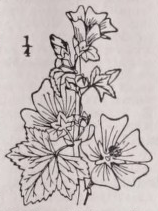
MALLOW, botanically Malva, the typical genus of Malvaceae, embracing about sixteen species of annual and perennial herbaceous plants, widely distributed throughout the northern hemisphere. The mallows possess the reniform one-celled anthers which distinguish the Malvaceae from all other dichlamydeous exogens. The petals also are united by their base to the tube formed by the coalesced filaments of the stamens. The special characters which separate the genus Malva from others most nearly allied to it are the involucre, consisting of a row of three separate bracts attached to the lower part of the true calyx, and the numerous single-seeded carpels disposed in a circle around a central axis, from which they become detached when ripe. The flowers are mostly white or pinkish, never yellow, the leaves radiate-veined, and more or less lobed or cut. Three species are natives of Britain. The musk mallow (Malva moschata) is a perennial herb with five-partite, deeply-cut leaves, and large rose-coloured flowers clustered together at the ends of the branched stems, and is found growing along hedges and borders of fields, blossoming in July and August. It owes its name to a slight musky odour diffused by the plant in warm dry weather when it is kept in a confined situation. The round-leaved mallow (Malva rotundifolia) is a creeping annual, growing in waste sandy places, with roundish serrate leaves and small pinkish-white flowers produced in the axils of the leaves from June to September. It is common throughout Europe and the north of Africa, extending to western Asia. The common mallow (Malva sylvestris), the mauve of the French, is an erect biennial plant with long-stalked roundish-angular serrate leaves, and conspicuous axillary reddish-purple flowers, blossoming from May to ...September. Like most plants of the order it abounds in mucilage, and hence forms a favourite domestic remedy for colds and various other complaints affecting the mucous membrane. The aniline dye called mauve derives its name from its resemblance to the colour of this plant.
The marsh mallow (Aithaea officinalis'), the guimauve of the French, belongs to another genus having an involucre of numerous bracts. It is a native of marshy ground near the sea or in the neighbourhood of saline springs. It is an erect perennial herb, with someλvhat woody stems, velvety, ovate, acute, unequally serrate leaves, and delicate pink showy flowers blooming from July to September. The flowers are said to yield a good deal of honey to bees. The root is used in medicine as a demulcent, on account of its containing more mucilage than the common mallow. It is supposed to form a chief ingredient in the well-known pâte de guimauve lozenges. The marsh mallow is remarkable for containing asparagin, C 4 H 8 N 2 O 3 , H 2 O, which, if the root be long kept in a damp place, disappears, butyric acid being developed. The root also contains about 25 per cent, of starch and the same quantity of mucilage, which differs from that of gum arabic in containing one molecule less of water and in being precipitated by neutral acetate of lead. The marsh mallow is far more largely used on the Continent than in England.
The mallow of Scripture, Job xxx. 4, has been sometimes identified with Jew’s mallow (Cor chorus olitorius), but more plausibly (the word ∏ i ⅛0 implying a saline plant) with Atriplex Halimus, or sea orache. In Syria the Halimus was still known by the name Mallûh in the time of Ibn Beitar. See Bochart, Hieroz., iii. 16.
MALLOW, a municipal and parliamentary borough, market-town, and watering-place in the county of Cork, Ireland, is situated on the Blackwater, 150 miles southwest from Dublin, and 20 north from Cork. The town owes its prosperity to its beautiful situation in a fine valley surrounded by mountains, and to its tepid mineral spring, which is very efficacious for general debility and for scorbutic and consumptive complaints. A spa-house with pump-room and baths was erected in 1828. Besides the parish church in the Later English style, erected in 1818, the principal buildings of the town are the court-house, the work-house and infirmary, and the bridewell. There are a manufactory of mineral water, a condensed-milk manufactory, com-mills, and tanneries. Mallow received a charter of incorporation from James I. The population of the borough in 1871 was 4165, and in 1881 it was 4437.