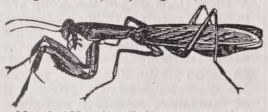
Any one of numerous species of voraciousorthopterous insects of the genus Mantis, and allied genera. They are remarkable for their slender grotesque forms, and for holding their stout anterior legs in a manner suggesting hands folded in prayer. The common American species is M. Carolina.
MANTIS. Probably no other insect has been the subject of so many and widespread legends and superstitions as the common “praying mantis,” Mantis religiosa, I.. (see Insects, Orthoptera, fam. Mantidae, vol. xiii. p. 152). The ancient Greeks endowed it with supernatural powers (μ,άητις, “a diviner ”); the Turks and Arabs hold that it prays constantly with its face turned towards Mecca; the Provençale call it Pre.ga-Diou (Prie-Dieu) ; and numerous more or less similar names—preacher, saint, nun, mendicant, soothsayer, <fcc.,—are widely diffused throughout southern Europe. Children ask it to show them the way, and Mouffet assures us that it rarely or never deceives them; and it is even recorded that one specimen, which alighted on the hand of St Francis Xavier, and which he commanded to sing the praise of God, loudly intoned a very beautiful canticle. In Nubia it is held in great esteem, and the Hottentots, if not indeed worshipping the local species (Μ. fausta), as one traveller has alleged, at least appear to regard its alighting upon any person both as a token of saintliness and an omen of good fortune....
Yet these are “not the saints, but the tigers, of the insect world.” The front pair of limbs are very peculiarly modified,—the coxa being greatly elongated, while the strong third joint or femur bears on its curved underside a channel armed on each edge by strong movable spines. Into this groove the stouttibia is capable of closing like the blade of a penknife, its sharp, serrated edge being adapted to cut and hold. The arrangement is essentially similar to the sub chela of Squilla and Amphipods among Crustacea (q.v.), as well as to the chelicerae of spiders (see Arachnida). Thus armed, with head raised upon the much-elongated and semi-erect prothorax, and with the half-opened fore limbs held outwards in the characteristic devotional attitude, it rests motionless upon the four posterior limbs waiting for prey, or occasionally stalks it with slow and silent movements, finally seizing it with its knife-blades and devouring it. Although apparently not daring to attack ants, these insects destroy great numbers of flies, grasshoppers, and caterpillars, and the larger South-American species even attack small frogs, lizards, and birds. They are very pugnacious, fencing with their sword-like limbs “like hussars with sabres,” the larger frequently devouring the smaller, and the females the males. The Chinese keep them in bamboo cages, and match them like fighting cocks.
The elytra of the common mantis have been compared to a witheringwillow leaf, a circumstance which net improbably aids in concealing them from their prey. Some of the tropical forms exhibit as perfect mimicry of the leaves as the leaf insects proper (Phasmidae). Bates found a mantis on the Amazon which exactly resembled the white ants it preyed upon, while Wallace mentions a Javanese species which mimics a pinkorchid flower, and “is said to feed largely on butterflies,—so that it is really a living trap, and forms its own bait !”
The common species fixes its somewhat nut-like egg capsules on the stems of plants in September. The young are hatched in early summer, and resemble the adults, but are without wings.
See Westwood’s Introd. Mod Class, of Insects, 1840, and forthcomingmonograph of the family.
9th ed. Encyclopædia Britannica, vol. 15, p. 503 [553 words — estimated reading time: 4 minutes]
The decimal part of a logarithm, as distinguished from the integral part, or characteristic.
No thesaurus entries found for "mantis".
No Bible verses found for "mantis".
This site uses cookies to remember your display preferences (search sources and editions, Bible version, auto-link, images, light/dark theme). No personal data whatsoever is collected. Privacy Policy