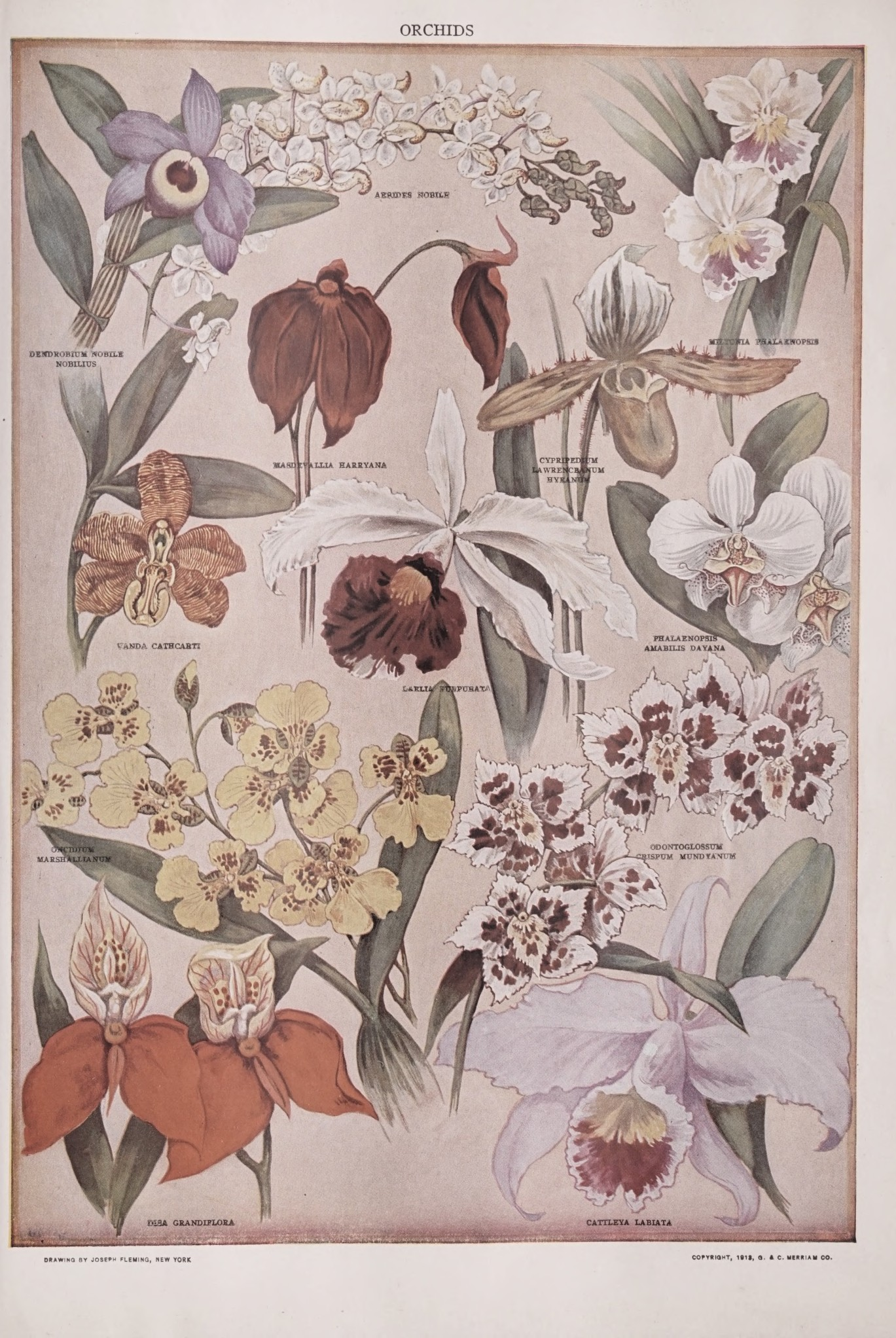
Any plant of the order Orchidaceae. See Orchidaceous.
Word of the Day: Catachrestical
Pertaining to, or resembling, a natural order (Orchidaceae) of endogenous plants of which the genus Orchis is the type. They are mostly perennial herbs having the stamens and pistils united in a single column, and normally three petals and three sepals, all adherent to the ovary. The flowers are curiously shaped, often resembling insects, the odd or lower petal (called the lip) being unlike the others, and sometimes of a strange and unexpected appearance. About one hundred species occur in the United States, but several thousand in the tropics.
Same as Orchidaceous.
One versed in orchidology.
The branch of botany which treats of orchids.
Orchids
Encyclopedia Britannica
ORCHIDS. The word Orchis is used in a special sense to denote a particular genus of the Orchid family (Orchidaceae) ; very frequently, also, it is employed in a more general way to indicate any member of that large and very interesting group. It will be convenient here to use the word Orchis as applying to that particular genus which gives its name to the order or family, and to employ the term “orchid” in the less precise sense....
The flowers of all orchids, though extremely diverse within certain limits, and although superficially very different from those of other monocotyledons, are all formed upon one common plan, which is only a modification of that observable in such flowers as those of the narcissus or snowdrop {Galanthus). The conformation of those flowers consists essentially in the presence of a six-parted perianth, the three outer segments of which correspond to a calyx, the three inner ones to a corolla. These segments spring apparently from the top of the ovary,—the real explanation, however, being that the end of the flower-stalk or “thalamus,” as it grows, becomes dilated into a sort of cup or tube enclosing and indeed closely adhering to the ovary, so that the latter organ appears to be beneath the perianth instead of above it as in a lily, an appearance which has given origin to the term “inferior ovary.” Within the perianth, and springing from its sides, or apparently from the top of the ovary, are six stamens whose anthers contain pulverulent pollen-grains. These stamens encircle a style which is the upward continuation of the ovary, and which shows at its free end traces of the three originally separate but now blended carpels of which the ovary consists. An orchid flower (disregarding for the moment a very small number of exceptions) has an inferior ovary like that just described, but with the ovules-on the walls of the cavity (not in its axis or centre), a six-parted perianth, a stamen or stamens, and a style or styles. The main distinguishing features consist in the fact that one of the inner pieces of the perianth become⅛ in course of its growth much larger than the rest, and usually different in colour, texture, and form. So different is it that it receives a distinct name, that of the “lip” or “labellum.” In place of the six stamens we commonly find but one (two in Cypripediitm), and that one is inseparably blended with the style to form the “column,” bringing about the-condition technically called “gynandrous.” Moreover, the pollen, instead of consisting of separate cells or grains, consists of cells aggregated into “pollenmasses,” the number varying in different genera, but very generally two, four, or eight, and in many of the genera provided at the base with a strap-shaped stalk or “caudicle” ending in a flattish gland or “viscid disk” like a boy’s sucker. The style has very generally at its upper part a peculiar pouch-like process called the “rostellum,” in which the viscid disk of the pollen-masses is concealed till released in the manner presently to be mentioned. It would appear, then, that the orchid flower differs from the type in the irregularity of the perianth, in the suppression of five out of six stamens and of two out of three styles, and in the union into one column of the one stamen and the one style which remain in the adult flower. In addition to these modifications, which are common to nearly all orchids, there are others generally but not so universally met with; among them is the displacement of the flower arising from the twisting of the inferior ovary, in consequence of which the flower is so completely turned round that the “lip,” which originates in that part of the flower, conventionally called the posterior or superior part, or that nearest to the supporting stem, becomes in course of growth turned to the anterior or lower part of the flower nearest to the bract, from whose axil it arises. Other common modifications arise from the union of certain parts of the perianth to each other, and from the inordinate outgrowths from the lip.
These statements are borne out by evidence derived from a variety of sources, such as that afforded by the progressive development of the parts of the flower from their earliest to their most complete condition, by the anatomy or internal organization of the parts of the flower, by the number and distribution of the vascular bundles which run through the cellular tissue, by the comparative morphology of the floral organs of the different genera of the order, and by teratology, or the study of unusual or monstrous formations, which reveals the existence of a complete series of intermediate forms constituting a regular gradation from the ordinary irregular gynandrous flower to regular flowers with six separate stamens such as we have taken as the type.
What brings about—what has brought about—this extraordinary series of changes, by virtue of which a flower typically as regular as a snowdrop becomes transmuted into the forms often more grotesque and extraordinary than can be found in any other group of plants? To the first part of the question the reply is that the present form has been inherited from generation to generation of orchids; to the second part the answer most in accordance with the present state of knowledge is that these modifications are associated with the structure and habits of insects and their visits to the flowers. Cross fertilization, or the impregnation of any given flower by pollen from another flower of the same species on the same or on another plant, has been proved to be of great advantage to the plant by securing a more numerous or a more robust offspring, or one better able to adapt itself to the varying conditions under which it has to live. This cross fertilization is effected by the agency of insects. They are attracted to the flower by its colour or its perfume; they seek, collect, or feed on its honey, and while so doing they remove the pollen from the anther and convey it to another flower, there to germinate on the stigma when its tubes travel down the style and their contents ultimately come in near apposition, perhaps in actual confluence, with the “oosphere” or immature egg, which becomes in consequence fertilized, and thereafter gradually develops into a new plant. To facilitate the operations of such insects, by compelling them to move in certain lines so as to secure the due removal of the pollen and its subsequent deposit on the right .place, the form of the flower and the conformation of its several parts are modified in ways as varied as they are wonderful. Other insects visit the flower with more questionable result. For them the pollen is an attraction as food, or some other part of the flower offers an inducement to them for a like object. Such visitors are clearly prejudicial to the flower, and so we meet with arrangements which are calculated to repel the intruders, or at least to force them to enter the flower in such a way as not to effect mischief. It would be quite impossible within the limits of this article to go into detail on this subject. All we can do is to give one or two illustrations, referring the reader desirous of fuller information to Darwin’s Fertilization of Orchids.
In the common orchids of British meadows, Orchis Morio, mascula (Shakespeare’s long purples), <tc., the general structure of the flower is as we have described it. In addition there is in this particular genus, as indeed in many others, a long tubular spur or horn projecting downwards from the back of the lip, whose office it is to secrete and store a honeyed juice; the forepart of the lip forms an expanded plate, usually larger and more brightly coloured than the other parts of the flower, and with hairs or ridges and spots of various kinds according to the species. The remaining parts of the perianth are very much smaller, and commonly are so arranged as to form a hood overarching the “column.” This column stands up from the base of the flower, almost at right angles to the lip, and it bears at the top an anther, in the two hollow lobes of which are concealed the two pollen-masses, each with its caudicle terminating below in a roundish gland, concealed at first in the pouch-like rostellum at the front of the column. Below the anther the surface of the column in front is hollowed out into a greenish depression filled with viscid fluid,—this is the stigma. The other parts of the flower need not detain us. Such being in general terms the mechanism of the flower of a common orchis, let us now see he w it acts. A bee, we will assume, attracted by the colour and perfume of the flower, alights on that part of it which is the first to attract its attention,—the lip. There, guided by the hairs or ridges before-mentioned, it is led to the orifice of the spur with its store of honeyed juice. The position of this orifice, as we have seen, is at the base of the lip and of the column, so that the insect, if of sufficient size, while bending his head to insert his proboscis into the spur, almost of necessity displaces the pollenmasses. Liberated from the anthers, these adhere to the head or back of the insect by means of the sticky gland at the bottom of the caudicle. Having attained his object the insect withdraws, taking with him the pollen-masses, and visits another flower. And now occurs another device or adaptation no less marvellous than those of which mention has been made. The two anther-cases in an orchis are erect and nearly parallel the one to the other; the pollen-masses within them are of course in like case, as may be thus represented ∣∣, but immediately the pollenmasses are removed movements take place in the caudicle so as to effect the bending of this stalk and the placing the pollen-mass in a more or less horizontal position, thus =, or, as in the case of 0. pyramidalis, the two pollenmasses originally placed parallel ∣∣ diverge from the base like the letter V. The movements of the pollen-masses may readily be seen with the naked eye by thrusting the point of a needle into the base of the anther, when the disks adhere to the needle as they would do to the antenna of an insect, and may be withdrawn. Sometimes the lip is mobile and even sensitive to impressions, as are also certain processes of the column. In such cases the contact of an insect or other body with those processes is sufficient to liberate the pollen often with elastic force, even when the anther itself is not touched. In other orchids movements take place in different ways and in other directions. The object of these movements will be appreciated when it is remembered that, if the pollen-masses retained the original direction they had in the anther in which they were formed, they would, when transported by the insect to another flower, merely come in contact with the anther of that flower, where of course they would be of no use; but, owing to the divergences and flexions above alluded to, the pollenmasses come to be so placed that, when transplanted to another flower of the same species, they come in contact with the stigma and so effect the fertilization of that flower. These illustrations are comparatively simple; it would have been easy to select others of a more complicated nature, but all evidently connected with the visits of insects and the cross fertilization of the flower. In some cases the form of the male flowers is so different from that of the female that before the different flowers had been found on the same spike, and before the facts of the case were fully known, they were taken to be representatives of distinct genera.
The floral structure is so curious that perhaps less attention has been paid to the vegetative organs than the peculiarities of their organization demand. We can only allude to some of these points. The orchids of British fields are all of terrestrial habit, and their roots are mostly tuberous (fig. 5), the tubers being partly radical partly budlike in their character. There is often a marked alternation in the production of vegetative and flowering shoots respectively; and, sometimes, from various circumstances, the flowering shoots are not produced for several years in succession . This fact will account for the profusion with which some orchids, like the common bee orchis for instance, are found in some seasons and their scarcity in others. Tropical orchids are mostly epiphytal,—that is, they grow upon trees without deriving nourishment from them. They are frequently provided with “pseudo-bulbs,” large solid swellings of the stem, in the tissues of which water and nutritive materials are stored. Very generally, too, such plants have aerial roots, of thick or thin wire-like form, covered with a spongy white investment, the constituent cells of which are found under the microscope to contain spiral fibres tightly coiled up within them. By these “air-roots” the plants are able to absorb watery vapour and perhaps actual water.
The number of species of orchids is greater than that of any other monocotyledonous order—not even excepting grasses—amounting to between 4000 and 5000 at least. This large number is partly accounted for by the diligent search in all countries that has been made for these plants for purposes of cultivation,—they being held at present in the greatest esteem by plant-lovers, and prices being paid for new or rare varieties which recall the days of the tulipo-mania. It must be admitted, however, that orchid-lovers have better reasons to support their fancy than had the speculative growers and barterers of tulips.
The economic uses of orchids are not remarkable. When we have mentioned vanilla, which consists of the pods of an orchid, we have mentioned about the only economic product that now comes into market Salep, still used in the Levant, consists of the dried tubers of some terrestrial orchid, and contains a relatively large amount of nutritious matter.
Cypripedium demands notice, inasmuch as it, with one or two other genera, constitutes a tribe of the order in which two stamens are present, one on each side of the column instead of one only at the top. What may be considered the normal number of stamens is, as has been said, six, arranged in two rows. In most orchids the only stamen developed to maturity is the posterior one of the three opposite to the lip (anterior before the twisting of the ovary), the other two, as well as all three inner ones, being entirely absent, or present only in the form of rudiments. In Cypripedium all three of the outer stamens are wanting, but the two lateral ones of the inner series are present, the third being undeveloped. This aιτangement may be understood by reference to the following diagram, representing the relative position of the stamens in orchids generally and in Cypripedium. The letter L indicates the position of the labellum; the large figures indicate the developed stamens; the italic figures show the position of the suppressed stamens.
1 1 4 5 4 5
6 6 2 3 2 3
L L
Arrangement of stamens Arrangement of stamens in Orchis. in Cypripedium.
9th ed. Encyclopædia Britannica, vol. 17, p. 816
[2,623 words — estimated reading time: 15 minutes]
[2,623 words — estimated reading time: 15 minutes]
No thesaurus entries found for "orchid".
No Bible verses found for "orchid".