
pers.; the objective case of I, answering to the oblique cases of ego, in Latin. [Latin mihi.] Follow me; give to me; go with me The phrase 'I followed me close, ' is not in use. Before think, as in methinks, me is properly in the dative case, and the verb is impersonal; the construction is, it appears to me
Word of the Day: Catachrestical
One. See Men, pron.
An uxorious, effeminate man. [Not used.]
An uxorious, effeminate, or spiritless man.
A fermented liquor consisting of honey and water, sometimes enriched with spices.
2. A drink composed of sirup of sarsaparilla or other flavoring extract, and water. It is sometimes charged with carbonic acid gas.
3. A meadow.
Mead
Encyclopedia Britannica
MEAD, Richard (1673-1754), physician, was born on August 11, 1673, at Stepney (near London), where his father, at one time minister of the parish, had been ejected for nonconformity in 1662. He was sent to Utrecht, where he studied for three years under Graevius; having decided to follow the medical profession, he then went to Leyden and attended the lectures of Hermann and Pitcairn. In 1695 he graduated in philosophy and physic at Padua, and in the following year he returned to his native place, entering at once on a successful practice. His Mechanical Account of Poisons appeared in 1702, and in 1703 he was admitted to the Royal Society, to whose Transactions he contributed in that year a paper on the parasitic nature of scabies. In the same year he was also elected physician to St Thomas’s Hospital, and appointed to read anatomical lectures at the Surgeons’ Hall. On the death of Radcliffe in 1714 Mead became the recognized head of his profession; he attended Queen Anne on her death-bed, and in 1727 was appointed physician to George II., having previously served him in that capacity when he was prince of Wales. He died on February 16, 1754. For his place in the annals of medical science see Medicine, p. 811 of the present volume.
Besides the Mechanical Account of Poisons, of which a second edition appeared in 1708, Mead published a treatise De Imperio Solis et Lunae in Corpora Humana et Morbis inde Oriundis (1704), A Short Discourse concerning Pestilential Contagion, and the Method to be used to prevent it (1720), De Variolis et Morbillis Dissertatio (1∙747), Medica Sacra, sive de Morbis insignioribu^aui in Bibliis memorantur Commentarius (1748), On the Scurry (1/49), and Monita et Praecepta Medica (1751). A Life of Mead by Dr Maty appeared in 1755.
9th ed. Encyclopædia Britannica, vol. 15, p. 656
[306 words — estimated reading time: 2 minutes]
[306 words — estimated reading time: 2 minutes]
1. med'o. A tract of low land. In America, the word is applied particularly to the low ground on the banks of rivers, consisting of a rich mold or an alluvial soil, whether grass land, pasture, tillage or wood land; as the meadows on the banks of the Connecticut. The word with us does not necessarily imply wet land. This species of land is called, in the western states, bottoms, or bottom land. The word is also used for other low or flat lands, particularly lands appropriated to the culture of grass.
2. The word is said to be applied in Great Britain to land somewhat watery, but covered with grass.
3. MEADOW means pasture or grass land, annually mown for hay; but more particularly, land too moist for cattle to graze on in winter, without spoiling the sward.
4. [Mead is used chiefly in poetry.]
Of or pertaining to a meadow; of the nature of a meadow; produced, growing, or living in, a meadow.
1. A tract of low or level land producing grass which is mown for hay; any field on which grass is grown for hay.
A plant of the genus Thalictrum.
A plant of the genus Colchicum.
A plant of the genus Peucedanum.
A plant of the genus Spiraea.
A plant.
Alt. of Meadowwort
The name of several plants of the genus Spiraea, especially the white- or pink-flowered S. salicifolia, a low European and American shrub, and the herbaceous S. Ulmaria, which has fragrant white flowers in compound cymes.
Of or pertaining to meadows; resembling, or consisting of, meadow.
Meadville
Encyclopedia Britannica
MEADVILLE, a city of the United States, county seat of Crawford county, Pennsylvania, on the left bank of French Creek, a tributary of the Alleghany river, and at the junction of the Franklin branch with the main line of the New York, Pennsylvania, and Ohio Railroad, 102 miles from Salamanca. It is a well-built town, maintains a large trade with the oil regions, and has railway and other machine works, glass works, woollen mills, and paper mills. The Meadville theological school was established by the Unitarians in 1844; and Allegheny College, opened in 1816 as a Presbyterian Church institution, has been carried on since 1833 by the Methodist Episcopal Church. Meadville was founded by General David Mead as a fortified post in 1789. In 1816 it had only 400 inhabitants; but the number was 3702 in 1860, 7103 in 1870, and 8860 in 1880.
9th ed. Encyclopædia Britannica, vol. 15, p. 656
[145 words — estimated reading time: 1 minute]
[145 words — estimated reading time: 1 minute]
1. Thin; lean; destitute of flesh or having little flesh; applied to animals.
2. Meager were his looks,
3. Sharp misery had worn him to the bones.
4. Poor; barren; destitute of richness, fertility, or any thing valuable; as a meager soil; meager limestone.
Poorly; thinly.
1. Leanness; want of flesh.
2. Poorness; barrenness; want of fertility or richness.
3. Scantiness; barrenness; as the meagerness of service.
Alt. of Meagreness
1. Destitue of, or having little, flesh; lean.
2. Destitute of richness, fertility, strength, or the like; defective in quantity, or poor in quality; poor; barren; scanty in ideas; wanting strength of diction or affluence of imagery.
3. Dry and harsh to the touch, as chalk.
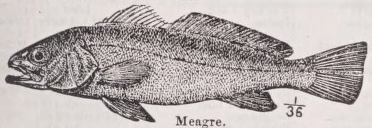
A large European sciaenoid fish (Sciaena umbra or S. aquila), having white bloodless flesh. It is valued as a food fish.
Poorly; thinly.
Immateriality Roget’s Thesaurus §317
N. immateriality, immaterialness, # incorporeity, spirituality, inextension, astral plane, personality, i, myself, me, ego, spirit, astral body, immaterialism, spiritualism, spiritualist
Adj. immaterial, immateriate, incorporeal, incorporal, incorporate, unfleshly, supersensible, asomatous, unextended, unembodied, disembodied, extramundane, unearthly, pneumatoscopic, spiritual, personal, subjective, nonobjective
Type at least 3 letters to search the Bible, or a reference such as John 3:16.