
MUSSEL . [ See Muscle .]
Word of the Day: Catachrestical
1. Any one of many species of marine bivalve shells of the genus Mytilus, and related genera, of the family Mytidae. The common mussel (Mytilus edulis; see Illust. under Byssus), and the larger, or horse, mussel (Modiola modiolus), inhabiting the shores both of Europe and America, are edible. The former is extensively used as food in Europe.
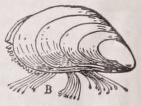
Mussel
Encyclopedia Britannica
MUSSEL, a term applied in England to two families of Lamellibranch Molluscs,—the marine Mytilacea, of which the Edible Mussel, Mytilus edulis, is the representative, and the fresh-water Unionacea, of which the River Mussel, Unio pictorum, and the Swan Mussel, Anodon cygneus, are the common British examples. It is not obvious why these fresh-water forms have been associated popularly with the Mytilacea under the name Mussel, unless it be on account of the frequently very dark colour of their shells. They are somewhat remote from the sea mussels in structure, and have not even a common economic importance.
The Sea Mussel (Mytilus edulis) belongs to the second order of the class Lamellibranchia (see vol. xvi. pp. 685 sq.), namely, the Heteromya, in which the anterior or palliai adductor is much smaller than the pedal or posterior adductor. It and the other Mytilacea are remarkable for the comparatively free condition of the gill-filaments, which, whilst adhering to one another to form gill-plates (vol. xvi. p. 689, fig. 133), are yet not fused to one another by concrescence. It is also remarkable for the small size of its foot and the large development of two glands in the foot— the byssus-forming and the byssus-cementing glands....
The byssus is a collection of horny threads by which the Sea Mussel (like many other Lamellibranch or Bivalve Molluscs) fixes itself to stones, rocks, or submerged wood, but is not a permanent means of attachment, since it can be discarded by the animal, which, after a certain amount of locomotion, again fixes itself by new secretion of byssus from the foot. Such movement is, however, very rare. Mytilus possesses no siphonal tube-like productions öf the margin of the mantle-skirt, nor any notching of the same, representative of the siphons which are found in its freshwater ally, the Dreissena polymorpha. Mytilus edulis is an exceedingly abundant and widely distributed form. It occurs on both sides of the northern Atlantic and in the Mediterranean basin. It presents varieties of form and colour according to the depth of water and other circumstances of its habitat. Usually it is found on the British coast encrusting rocks exposed at low tides, or on the flat surfaces formed by sandbanks overlying clay, the latter kind of colonies being known locally as “scalps.” Under these conditions it forms continuous masses of individuals closely packed together, sometimes extending over many acres of surface and numbering millions. The readiness with which the young Mytilus attaches itself to wicker-work is made the means of artificially cultivating and securing these molluscs for the market both in the bay of Kiel in North Germany and at the mouth of the Somme and other spots on the coast of France.
Natural scalps are subject to extreme vicissitudes: an area of many acres may be destroyed by a local change of current producing a deposit of sand or shingle over the scalp, or by exposure to frost at low tide in winter, or by accumulation of decomposing vegetable matter. The chief localities of natural scalps on the British coast are Morecambe Bay in Lancashire and the flat eastern shores, especially that of the Wash of Lincoln, and similar shallow bays. These scalps are in some cases in the hands of private owners, but the English Government has not granted sufficiently definite rights to such individuals to enable them to protect their property from marauders, and to justify them in undertaking artificial cultivation.
The Sea Mussel is scarcely inferior in commercial value to the oyster. In 1873 the value of mussels exported from Antwerp alone to Paris to be used as human food was £280,000. In Britain their chief consumption is in the deep-sea line fishery, where they are held to be the most killing of all baits. Twenty-eight boats engaged in haddock-fishing at Eyemouth used between October 1882 and May 1883 920 tons of mussels (about 47 million individuals), costing nearly £1800 to the fishermen, about one-half of which sum was expended on the carriage of the mussels. It is quite impossible to calculate the number of tons of mussels annually used in this way by British fishermen, but it amounts to some hundreds of thousands, and the supplying of the market would offer a lucrative investment for capital did the Government grant definite proprietary rights over the fore-shore and sea-bottom to those ready to enter upon such enterprise. Many thousand tons of mussels are wastefully employed as manure by the farmers on lands adjoining scalp-producing coast, as in Lancashire and Norfolk, three half-pence a bushel being the price quoted in such cases. It is a curious fact, illustrative of the ignorant procedure and arbitrary fashions of fisher-folk, that on the Atlantic seaboard of the United States the Sea Mussel, Mytilus edulis, though common, is not used as bait nor as food. Instead, the Soft Clam, Mya arenaria, a Lamellibranch not used by English or Norwegian fishermen, though abundant on their shores, is employed as bait by the fishermen to the extent of 1⅛ million bushels per annum, valued at £120,000. At the mouth of the river Conway in North Wales the Sea Mussel is crushed in large quantities in order to extract pearls of an inferior quality which are occasionally found in these as in other Lamellibranch Molluscs (Gwyn Jeffreys).
Mytilus edulis is considered of fair size for eating when it is 2 inches in length, which size is attained in three years after the spat or young mussel has fixed itself. Under favourable circumstances it will grow much larger than this, specimens being recorded of 9 inches in length. It is very tolerant of fresh water, fattening best, as does the oyster, in water of density 1014 (the density of the water of the North Sea being 1026). Experiments made by removing mussels from salt water to brackish, and finally to quite fresh water show that it is even mote tolerant of fresh water than the oyster; of thirty mussels so transferred all were alive after fifteen days. Mytilus edulis is occasionally poisonous, owing to conditions not satisfactorily determined.
The fresh-water Mussels, Anodon cygneus, Unio pictorum, and TJnio margaritiferus belong to the order Isomya of Lamellibranch Molluscs, in which the anterior and posterior adductor muscles are equally developed. An account of the anatomy of Anodon is given in the article Mollusca. Unio differs in no important point from Anodon in internal structure. The family Unionacea, to which these genera belong, is of world-wide distribution, and its species occur only in ponds and rivers. A vast number of species arranged in several genera and sub-genera have been distinguished, but in the British Islands the three species above named are the only claimants to the title of “fresh-water mussel.”
Anodon cygneus, the Pond Mussel or Swan Mussel, appears to be entirely without economic importance. Unio pictorum, the common Biver Mussel (Thames), appears to owe its name to the fact that the shells were used at one time for holding water-colour paints as now shells of this species and of the Sea Mussel are used for holding gold and silver paint sold by artists’ colourmen, but it has no other economic value. Unio margaritiferas, the Pearl Mussel, was at one time of considerable importance as a source of pearls, and the pearl mussel fishery is to this day carried on under peculiar state regulations in Sweden and Saxony, and other parts of the Continent. In Scotland and Ireland the pearl mussel fishery was also of importance, but has altogether dwindled into insignificance since the opening up of commercial intercourse with the East and with the islands of the Pacific Ocean, whence finer and more abundant pearls than those of Unio margaritiferus arè derived.
In the last forty years of the last century pearls were exported from the Scotch fisheries to Paris to the value of £100,000; round pearls, the size of a pea, perfect in every respect, were worth £3 or £4. The Pearl Mussel is still used as bait in the Aberdeen cod fishery.
For an account of the anatomy of Mytilus edulis the reader is referred to the treatise by Sabatier on that subject (Paris, 1875). Its development from the egg has not been fully studied, but some very important facts as to the structure of the free-swimming young or spat are to be found in the memoir by Lacaze Duthiers, Annules des Sciences Naturelles, 1856. The essayby Mr Charles Harding on Molluscs used for Food or Bait, published by the committee of the London International Fisheries Exhibition, 1883, may be consulted as to the economic questions connected with the Sea Mussel. (E. R. I..)
9th ed. Encyclopædia Britannica, vol. 17, p. 110
[1,463 words — estimated reading time: 9 minutes]
[1,463 words — estimated reading time: 9 minutes]
Musselburgh
Encyclopedia Britannica
MUSSELBURGH, a Scottish burgh of barony and regality, a municipal and parliamentary burgh in the parish of Inveresk and county of Midlothian, 5⅜ miles east of Edinburgh. The burgh, which stretches about a mile along the south shore of the Firth of Forth, is intersected by the river Esk and embraces the village of Fisherrow. In the town is Pinkie House, an ancient baronial residence, formerly a seat of the abbot of Dunfermline, whose monastery held the lands and regality before the Reformation. About a mile to the south-east the battle of Pinkie, so disastrous to the Scottish arms, was fought in 1547. Musselburgh is a place of great antiquity; one of the two stone bridges over the Esk is said to represent an ancient Roman structure, and remains of Roman work have been found at Inveresk in the immediate vicinity. The town has an important factory for fishing-nets, a paper mill, breweries, and other manufactories, and there is a harbour, chiefly for fishermen, at Fisherrow. Loretto School here has its name from the old chapel of Loretto, founded in 1534 by Thomas Duthy, a hermit from Mount Sinai. The Musselburgh Links, east of the river, are much frequented by golfers, and upon the Links there is a good racecourse. The population of the burgh in 1881 was 7866.
9th ed. Encyclopædia Britannica, vol. 17, p. 110
[221 words — estimated reading time: 2 minutes]
[221 words — estimated reading time: 2 minutes]
No thesaurus entries found for "mussel".
No Bible verses found for "mussel".