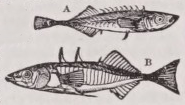
Any one of numerous species of small fishes of the genus Gasterosteus and allied genera. The back is armed with two or more sharp spines. They inhabit both salt and brackish water, and construct curious nests. Called also sticklebag, sharpling, and prickleback.
STICKLEBACK is the name applied to a group of small fishes (Gastrosteus) which inhabit the fresh and brackish waters as well as the coasts of the temperate zone of the northern hemisphere. Although some of the species live chiefly either in fresh or in salt water, they readily accommodate themselves to a change, and, as far as the European kinds are concerned, all may be met with in the brackish water of certain littoral districts. The majority have a compressed well-proportioned body, which in the marine species is of a more elongate form, leading to the allied group of Flute-Mouths (Fistulariidae), which are, in fact, gigantic marine sticklebacks. Their mouth is of moderate width, oblique, and armed with small but firmly set teeth. But their most distinctive characteristic consists in the armature of their head and body. The head is nearly entirely protected by hard bone; even the cheeks, which in the majority of fishes are covered with a naked or scaly skin, are in this genus cuirassed by the dilatedinfraorbital bones. There are no scales developed on any part of the body, but a series of hard and large scutes protects a greater or lesser portion of the sides. The first dorsal fin and the ventrals are transformed into pointed formidable spines, and joined to firm bony plates of the endoskeleton. With regard to the degree in which this armature is developed, not only do the species differ from each other, but almost every species shows an extraordinary amount of variation, so that some older naturalists have distinguished a multitude of species, whilst the majority of the present day are inclined to reduce their number considerably. About ten kinds may be taken to be specifically distinct....
So far as is known at present, all sticklebacks construct a nest for the reception of the spawn, which is jealously guarded by the male until the young are hatched, which event takes place in from ten to eighteen days after oviposition. He also protects them for the first few days of their existence, and provides them with food, until they gradually stray from their home. The construction of the nest varies in the different species.
Sticklebacks are short-lived animals; they are said to reach an age of only three or four years; yet their short life, at least that of the males, is full of excitement. During the first year of their existence, before the breeding-season begins, they live in small companies in still pools or gently flowing brooks. But with the return of the warmer season each male selects a territory, which he fiercely defends against all comers, especially against intruders of his own species and sex, and to which he invites all females, until the nest is filled with ova. At this period he also assumes a bridal dress, painted with blue and red tints. The eggs are of comparatively large size, one female depositing only from 50 to 100; but, as the females deposit their spawn in nests of different males, the number of ova contained in one nest does not exceed one hundred.
Of the species known not one has so wide a geographical range, and has so well been studied, as the common British Three-Spined Stickleback (Gastrosteus aculeatus). It is found everywhere in northern and central Europe, northern Asia, and North America. The development of its scutes and spines varies exceedingly, and specimens may bo found without any lateral scutes and with short spines, others with only a few scutes and moderately sized spines, and again others which possess a complete row of scutes from the head to the caudal fin, and in which the fin-spines are twice as long and strong as in other varieties. On the whole, the smooth varieties are more numerous in southern than in northern localities. This species swarms in some years in prodigious numbers; in Pennant’s time amazing shoals appeared in the fens of Lincolnshire every seven or eight years. Their numbers may perhaps be conceived from the fact that a man employed in collecting them gained, for a considerable time, four shillings a day by selling them at the rate of a halfpenny a bushel. No instance of a similar increase of this fish has been observed in our time, and this possibly may be due to the diminished number of suitable breeding-places in consequence of the general introduction of artificial drainage. This species usually constructs its nest on the bottom, excavating a hollow in which a bed of grass, rootlets, or fibres is prepared; walls are then raised, aud the whole is roofed over with the like material. The nest is an inch and more in diameter, with a small aperture for an entrance.
The Ten-Spined Stickleback (Gastrosteus pungitius) is so called from the number of spines usually composing its first dorsal fin, which, however, may be sometimes reduced to eight or nine or increased to eleven. It is smaller than the three-spined species, rarely exceeding 2 inches in length. Its geographical range nearly coincides with that of the other species, but it is more locally distributed, and its range in northern Asia is not known. With regard to its habits, it differs from the common species only in the selection of the site for its nest, which is generally placed among weeds above the bottom of the water. Breeding males are readily recognized at a distance by the intensely black colour of the lower parts of their body.
Both these species are for their size extremely voracious, causing no small amount of injury if allowed in breeding-ponds in which valuable fish are preserved. During the whole time they are not engaged in their breeding operations they are in pursuit of food. A small stickleback kept in an aquariumdevoured, in five hours’ time, seventy-four newly-hatcheddace, which were about a quarter of an inch long. Two days after it swallowed sixty-two, and would probably have eaten as many every day, could they have been procured.
The Sea Stickleback (Gastrosteus spinachia) is a much larger and more slender species than those mentioned; it attains to a length of 7 inches, and is armed with fifteen short spines on the back. It is extremely common round the British coasts, but never congregates in large shoals. At suitable localities of the coast which are sheltered from the waves and overgrown with sea-weed, especially in rock-pools, one or two males establish themselves with their harems, and may be observed without difficulty, being quite as fearless as their freshwater cousins. Harbours and shallows covered with Zostera are likewise favourite haunts of this species, although the water may be brackish. The nest is always firmly attached to sea-weed, and sometimes suspended from an overhanging frond. This species inhabits only the northern coasts of Europe.
9th ed. Encyclopædia Britannica, vol. 22, p. 548 [1,148 words — estimated reading time: 7 minutes]
Stickled[Imperfect tense and past participle]Webster's Dictionary 1913
Adv. unwillingly, grudgingly, with a heavy heart, with a bad, with an ill grace, against one's wishes, against one's will, against the grain, sore against one's wishes, sore against one's will, sore against one's grain, invita minerva, a contre caeur, malgre soi, in spite of one's teeth, in spite of oneself, nolens volens, perforce, under protest, no, not for the world, far be it from me
V. be obstinate, stickle, take no denial, fly in the face of facts, opinionate, be wedded to an opinion, hug a belief, have one's own way, persist, have the last word, insist on having the last word, die hard, fight against destiny, not yield an inch, stand out
V.barter, exchange, swap, swop, truck, scorse|, interchange, commutate, compound for, trade, traffic, buy and sell, give and take, nundinate|, carry on a trade, ply a trade, drive a trade, be in business, be in the city, keep a shop, deal in, employ one's capital in, trade with, deal with, have dealings with, transact business with, do business with, open an account with, keep an account with, bargain, drive a bargain, make a bargain, negotiate, bid for, haggle, higgle, dicker, chaffer, huckster, cheapen, beat down, stickle, stickle for, out bid, under bid, ask, charge, strike a bargain, speculate, give a sprat to catch a herring, buy in the cheapest and sell in the dearest market, buy low and sell high, corner the market, rig the market, stag the market
This site uses cookies to remember your display preferences (search sources and editions, Bible version, auto-link, images, light/dark theme). No personal data whatsoever is collected. Privacy Policy