1. A small wind instrument; a pipe with lateral holes or stops, played by blowing with the mouth, and by stopping and opening the holes with the fingers.
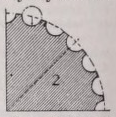
2. A channel in a column or pillar; a perpendicular furrow or cavity, cut along the shaft of a column or pilaster; so called from its resemblance to a flute It is used chiefly in the Ionic order; sometimes in the Composite and Corinthian; rarely in the Doric and Tuscan. It is called also a reed.
3. A long vessel or boat, with flat ribs or floor timbers, round behind, and swelled in the middle; a different orthography of float, flota.
4. Armed in flute An armed ship, with her guns of the lower tier and part of those of the upper tier removed, used as a transport, is said to be armed in flute
1. A musical wind instrument, consisting of a hollow cylinder or pipe, with holes along its length, stopped by the fingers or by keys which are opened by the fingers. The modern flute is closed at the upper end, and blown with the mouth at a lateral hole.
2. A channel of curved section; -- usually applied to one of a vertical series of such channels used to decorate columns and pilasters in classical architecture. See Illust. under Base, n.
3. To play on, or as on, a flute; to make a flutelike sound.
FLUTE, a wind instrument which in a variety of forms has been in constant use from the earliest ages, To Olympus the Phrygian has been ascribed the introduction of flute-playing into Greece, an art which was much encouraged in the later days of the empire. The Greeks employed professional flute-players in many of their religious ceremonies, and competitive trials of skill were frequent. The old English flute, called ↑hQ flute-à-bec, from the supposed resemblance of the mouthpiece to the beak of a bird, was played from the upper and wider end, had seven finger holes, and was made of various sizes, called treble, alto, tenor, and bass flutes respectively. This instrument continued in common use to about the middle of the 18th century, when it was gradually superseded by the modern horizontal {flauto traversa) or “German” flute. Handel was one of the first to introduce the new instrument into the orchestra, employing it for solos in The Ode on Saint Cecilia's Day (1739), notably in the air “The soft complaining Flute.” But the capacities of the traverso of Handel’s time were very limited in comparison with those of its modern representative, which possesses a workable compass of about three octaves from the low C in the trebleclef, with all the chromatic intervals. Various systems of fingering have been introduced from time to time by the most eminent flautists and flute-makers, and concertos for the flute as a solo instrument have been composed with a view to exhibiting the powers of celebrated performers. In orchestral scores the flute part is generally placed at the top, and is written in the violin or G clef. The piccolo or octave flute, the E flat or tierce, the D flat or minor ninth (transposingpiccolo), the flute d’amour, a minor third below the ...ordinary instrument—are all varieties of the traversa, which like the fife is blown by an oval shaped hole in the side, near the stopped end of the tube Other branches, now obsolete, of the flute family were—the recorder, varying in length of tube from about twelve inches to three feet, the largest being known as the bass recorder; the comet, shaped like a quadrant, and gradually tapering towards the mouthpiece; and the pilgrim's staff, having a tube about six feet in length. For other less important varieties the reader is referred to Musurgia, Luscinius, 1536; Harmonie Universelle, Mersenne, 1636. Among the foundation stops of most organs will generally be found one or more “flute” stops, e.g., the hold fiöte, of eight feet tone, and the octavo flute, of four feet tone. The flageolet is a smaller variety of the old fiute-à-bec, and was formerly used in the orchestra. Handel has written an obbligato part for it in the well-known barytone air “O, ruddier than the cherry.” The fife, much used in military bands, is simply an octave flute in D, played horizontally, and having six finger holes and one key.
9th ed. Encyclopædia Britannica, vol. 9, p. 350 [504 words — estimated reading time: 3 minutes]
After that thou shalt come to the hill of God, where is the garrison of the Philistines: and it shall come to pass, when thou art come thither to the city, that thou shalt meet a company of prophets coming down from the high place with a psaltery, and a tabret, and a pipe, and a harp, before them; and they shall prophesy:
After that you will come to Gibeah of God, where the Philistines have an outpost. As you approach the city, you will meet a group of prophets coming down from the high place, preceded by harps, tambourines, flutes, and lyres, and they will be prophesying.
And the harp, and the viol, the tabret, and pipe, and wine, are in their feasts: but they regard not the work of the LORD, neither consider the operation of his hands.
At their feasts are the lyre and harp, tambourines and flutes and wine. They disregard the actions of the LORD and fail to see the work of His hands.
Ye shall have a song, as in the night when a holy solemnity is kept; and gladness of heart, as when one goeth with a pipe to come into the mountain of the LORD, to the mighty One of Israel.
You will sing as on the night of a holy festival, and your heart will rejoice like one who walks to the music of a flute, going up to the mountain of the LORD, to the Rock of Israel.
Therefore mine heart shall sound for Moab like pipes, and mine heart shall sound like pipes for the men of Kir-heres: because the riches that he hath gotten are perished.
Therefore My heart laments like a flute for Moab; it laments like a flute for the men of Kir-heres, because the wealth they acquired has perished.
That at what time ye hear the sound of the cornet, flute, harp, sackbut, psaltery, dulcimer, and all kinds of musick, ye fall down and worship the golden image that Nebuchadnezzar the king hath set up:
As soon as you hear the sound of the horn, flute, zither, lyre, harp, pipes, and all kinds of music, you must fall down and worship the golden statue that King Nebuchadnezzar has set up.
Therefore at that time, when all the people heard the sound of the cornet, flute, harp, sackbut, psaltery, and all kinds of musick, all the people, the nations, and the languages, fell down and worshipped the golden image that Nebuchadnezzar the king had set up.
Therefore, as soon as all the people heard the sound of the horn, flute, zither, lyre, harp, and all kinds of music, the people of every nation and language would fall down and worship the golden statue that King Nebuchadnezzar had set up.
Thou, O king, hast made a decree, that every man that shall hear the sound of the cornet, flute, harp, sackbut, psaltery, and dulcimer, and all kinds of musick, shall fall down and worship the golden image:
You, O king, have issued a decree that everyone who hears the sound of the horn, flute, zither, lyre, harp, pipes, and all kinds of music must fall down and worship the golden statue,
Now if ye be ready that at what time ye hear the sound of the cornet, flute, harp, sackbut, psaltery, and dulcimer, and all kinds of musick, ye fall down and worship the image which I have made; well: but if ye worship not, ye shall be cast the same hour into the midst of a burning fiery furnace; and who is that God that shall deliver you out of my hands?
Now, if you are ready, as soon as you hear the sound of the horn, flute, zither, lyre, harp, pipes, and all kinds of music, you must fall down and worship the statue I have made. But if you refuse to worship, you will be thrown at once into the blazingfiery furnace. Then what god will be able to deliver you from my hands?”
They are like unto children sitting in the marketplace, and calling one to another, and saying, We have piped unto you, and ye have not danced; we have mourned to you, and ye have not wept.
They are like children sitting in the marketplace and calling out to one another: ‘We played the flute for you, and you did not dance; we sang a dirge, and you did not weep.’
And even things without life giving sound, whether pipe or harp, except they give a distinction in the sounds, how shall it be known what is piped or harped?
Even in the case of lifeless instruments, such as the flute or harp, how will anyone recognize the tune they are playing unless the notes are distinct?
And the voice of harpers, and musicians, and of pipers, and trumpeters, shall be heard no more at all in thee; and no craftsman, of whatsoever craft he be, shall be found any more in thee; and the sound of a millstone shall be heard no more at all in thee;
And the sound of harpists and musicians, of flute players and trumpeters, will never ring out in you again. Nor will any craftsmen of any trade be found in you again, nor the sound of a millstone be heard in you again.
And Darius sent with them a thousand horsemen, till they had brought them back to Jerusalem safely, and with musical instruments tabrets and flutes.
This site uses cookies to remember your display preferences (search sources and editions, Bible version, auto-link, images, light/dark theme). No personal data whatsoever is collected. Privacy Policy