
A bird of the genus Picus, that pecks holes in trees, or that picks insects form the bark.
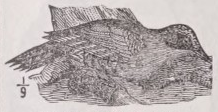
WOODPECKER, a bird that pecks or picks holes in wood, and from this habit is commonly reputed to have its name; but since it is in some parts of England also known as “Woodspeight” (erroneously written “Woodspite”)—the latter syllable being cognate with the German Specht and the French Ëpeiche, to say nothing possibly of the Latin Picus — the vulgar explanation seems open to doubt. More than 300 species of Woodpecker have been described, and they have been very variously grouped by systematists; but all admit that they form a very natural Family Picidae, which according to the view taken in this series of articles belongs to the Order Picariae. Prof. Huxley {Proc. Zool. Society, 1867, p. 467) would separate the Woodpeckers still more under the name of Celeomorphae, and Prof. Parker {Trans. R. Microsc. Society, 1872, p. 219) ∙would raise them still higher as Saurognathae. They are generally of bright particoloured plumage, in which black, white, brown, olive, green, yellow, orange, or scarlet—the last commonly visible on some part of the head—mingled in varying proportions, and most often strongly contrasted with one another, appear; while the less conspicuous markings take the form of bars, spangles, tear-drops, arrow-heads, or scales. Woodpeckers inhabit most parts of the world, with the exception of Madagascar and the Australian Region, save Celebes and Flores; but it may be worth stating that no member of the group is known to have occurred in Egypt....
Of the three British species, the Green Woodpecker, Gecinus or Picus viridis, though almost unknown in Scotland or Ireland, is the commonest, frequenting wooded districts, and more often heard than seen, its laughing cry (whence the name “Yaffil” or “Yaffle,” by which it is in many parts known), and undulating flight afford equally good means of recognition, even when it is not near enough for its colours to be discerned. About the size of a Jay, its scarlet crown and bright yellow rump, added to its prevailing grass-green plumage, make it a sightly bird, and hence it often suffers at the hands of those who wish to keep its stuffed skin as an ornament. Besides the scarlet crown, the cock bird has a patch of the same colour running backλvard from the base of the lower mandible, a patch that in the hen is black. Woodpeckers in general are very shy birds, and to observe the habits of the species is not easy. Its ways, however, are well worth watching, since the ease with which it mounts, almost always spirally, the vertical trunks and oblique arms of trees as it searches the interstices of the bark for its food, flying off when it reaches the smaller or upper branches—either to return to the base of the same tree and renew its course on a fresh line, or to begin upon another tree near by—and the care it shews in its close examination, will repay a patient observer. The nest almost always consists of a hole, chiselled by the birds’ strong beak, impelled by very powerful muscles, in the upright trunk or arm of a tree, the opening being quite circular, and continued as a horizontal passage that reaches to the core, whence it is pierced downward for nearly a foot. There a chamber is hollowed out in which the eggs, often to the number of six, white, translucent, and glossy, are laid with no bedding but a few chips that may have not been thrown out. The young are not only hatched entirely naked, but seem to become fledged without any of the downy growth common to most birds. Their first plumage is dull in colour, and much marked beneath with bars, crescents, and arrowheads.
Of generally similar habits are the two other Woodpeckers which inhabit Britain—the Pied or Greater Spotted, and the Barred or Lesser Spotted Woodpecker— Bendrocopus major and D. minor— each of great beauty, from the contrasted white, blueblack, and scarlet that enter into its plumage. Both of these birds have an extraordinary habit of causing by quickly-repeated blows of their beak on a branch, or even on a small bough, a vibrating noise, louder than that of a watchman’s rattle, and enough to excite the attention of the most incurious. Though the Pied Woodpecker is a resident in Britain, its numbers receive a considerable accession nearly every autumn.
The three species just mentioned are the only Woodpeckers that inhabit Britain, though several others are mistakenly recorded as occurring in the country—and especially the Great Black Woodpecker, the Picus martius of Linnaeus, which must be regarded as the type of that genus. This fine species considerably exceeds the Green Woodpecker in size, and except for its red cap is wholly black. It is chiefly an inhabitant of the fir forests of the Old World, from Lapland to Galicia, and across Siberia to Japan. In North America this species is replaced by Picus pileatus, there generally known as the Logcock, an equally fine species, but variegated with white; and further to the southward occur two that are finer still, P. principalis, the Ivory-billed Woodpecker, and P. imperialis. The Picinae indeed flourish in the New World, nearly one-half of the described species being American, but out of the large number that inhabit Canada and the United States there is here room to mention only a few.
First of these is the Californian Woodpecker, Melanerpes formicivorus, which has been said to display an amount of providence beyond almost any other bird in the number of acorns which it collects and, as shewn in the accompanying figure, fixes tightly in holes which it purposely makes in the bark of trees, and thus “a large pine forty or fifty feet high will present the appearance of being closely studded with brass nails, the heads only being visible.” An extraordinary thing is that this is not done to furnish food in winter, for the species migrates, and after journeying a thousand miles or more only returns in spring to the forests where its supplies are laid up. It has been asserted that the acorns thus stored are always those which contain a maggot, and, being fitted into the sockets prepared for them cup-end foremost, the enclosed insects are unable to escape, as they otherwise would, and are thus ready for consumption by the birds on their return from the south. But this statement has again been contradicted, and moreover it is alleged that these Woodpeckers follow their instinct so blindly that “they do not distinguish between an acorn and a pebble,” so that they “fill up the holes they have drilled with so much labor, not only with acorns but occasionally with stones” (c∕. Baird, Brewer, and Ridgway, North American Birds, ii. pp. 569-571).
The next North-American form deserving notice is the genus Colaptes, represented in the north and east by C. auratus, the Goldenwinged Woodpecker or Flicker, in most parts of the country a familiar bird, but in the south and west replaced by the allied C. rnexicanus, easily distinguishable among other characteristics by having the shafts of its quills red instead of yellow. It is curious, however, that, in the valleys of the upper Missouri and Yellowstone rivers, where the range of the two kinds overlaps, birds are found presenting an extraordinary mixture of the otherwise distinctive features of each, and these birds have been described as hybrids. It would be premature to say whether this view be correct or not, and in regard to it Dr Coues has well remarked {Birds of the Northwest, p. 294), “that it is only in virtue of missing links we are enabled to predicate species in any case,” thereby indicating the possibility (not entertained for the first time) that these supposed hybrids are examples of the more generalized form of Colaptes, which becomes differentiated further to the north and south into the specialized C. auratus and C. rnexicanus. Thus the subject is one highly interesting to the student of evolution.
Some other Woodpeckers deserve especial notice,—among them the Colaptes or Soroplex campestris, which inhabits the treeless plains of Paraguay and La Plata, and had become fully adapted to a territorial mode of life, as long ago observed by Azara and Darwin, but yet has readily returned, since the opportunity has been afforded, to the arboreal habits of its relatives, as remarked by Mr Hudson {Proc. Zook Society, 1'870, pp. 158-160). A similar provision of habit and haunt obtains in a South-African Woodpecker, Gco-colaptes olivaceus, which lives almost entirely on the ground or rocks, and picks a hole for its nest in the bank of a stream {Zoologist, 1882, p. 208).
The Picidae offer a fruitful ground for taxonomical speculation. At least three Subfamilies are admitted by all modern systematists—the Woodpeckers proper, Pιciηse∙, the Piculets, Picurnninae, which are small birds wanting the stiff rectrices of the former; and the Wrynecks {q.v.). Sundevall {Conspectus Avium Picinarum, Stockholm, 1866) gave up the attempt to establish genera in the first of these, though he separated the 254 species which he admitted into 4 Series and 30 Tribes, thereby differing from the method of Malherbe, who, in his great monograph of the Family, recognized 277 species and 19 genera, as well as from Prof. Cabanis, who {Μus. Heineanum, iv. part 2) strove to establish 48 genera in about three-fourths of the whole Family, and from G. R. Gray, who in his Hand List recognized 4 Subfamilies, 19 genera, 74 subgenera, and 312 species. It seems obvious that until the aid of the anatomist is invoked no satisfactory arrangement can be supplied, and it is not certain that even then will the desired end be reached, for Macgillivray, who furnished Audubon with elaborate descriptions of parts of the structure of several North-American forms, found considerable differences to exist between species which can hardly be but nearly allied. Some of the most striking of these differences often lie in the form and development of the hyoid bones, and of the muscles which work the extensile tongue. Unhappily the subject does not seem to have been pursued by any other investigator; but it may be mentioned that some limited researches on the pterylosis, conducted by Kessler (Bull. Soc. Nat. Moscou, xvi. p. 285), in addition to those of Nitzsch, indicate that as being also a promising line of inquiry, though one that has scarcely been attempted by any other workers. (a. n.)