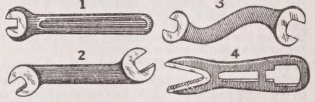
A small bird of the genus Motacilla.
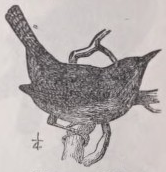
WREN (Anglo-Saxon Wraenna and W renne, Icelandic Pindill), the well-known little brown bird—with its short tail, cocked on high—inquisitive and familiar, that braves the winter of the British Islands and even that of the European continent, and, except in the hardest of frosts, will daily sing its spirit-stirring strain. It is the Motacilla or Sylvia troglodytes of the earlier systematists, and the Troglodytes parvulus, europaeus, or vulgaris of most later writers, save a few who (ignoring not only common sense but also the accepted rules of scientific nomenclature), by an utterly mistaken view of Vieillot’s intention in establishing the genus Troglodytes, reserve that term for some American species—which can hardly be generically separated from the European form—and have attempted to fix on the latter the generic term Anorthura, which is its strict equivalent and was proposed by Rennie on grounds that are wholly inadmissible....
The interest taken in this bird throughout all European countries is scarcely exceeded by that taken in any other, and, though in Britain comparatively few vernacular names have been applied to it, two of them—“Jenny” or u Kitty-Wren”—are terms of endearment. Μ. Rolland records no fewer than 139 local names for it in France; and Italy, Germany, and other lands are only less prolific. Many of these carry on the old belief that the Wren was the King of Birds, a belief connected with the fable that on one occasion the fowls of the air in general assembly resolved to choose for their leader that one of them which should mount highest. This the Eagle seemed to do, and all were ready to accept his rule, when a loud burst of song was heard, and perched upon him was seen the exultant Wren, which unseen and unfelt had been borne aloft by the giant. The curious association of this bird with the Feast of the Three Kings, on which day in South Wales, or, in Ireland and in the south of France, on or about Christmas Day, it was customary for men and boys to “hunt the Wren,” addressing it in a song as “the King of Birds,” is very remarkable, and has never yet been explained.
The Wren hardly needs description here, and its domed nest, apparently so needlessly large for the size of the bird, is a well-known object, for it is built with uncommon care, and often (though certainly not always) in such a fashion as to assimilate its exterior to its surroundings and so to escape observation. Very curious too is the equally unaccountable fact, that near any occupied nest may generally be found another nest, or more than one, of imperfect construction. The widespread belief concerning these unfinished fabrics is implied by their common name of “cocks’ nests,” but evidence to that effect is not forthcoming. The breeding-habits of the Wren were most closely studied and accurately reported by Mr Weir to Macgillivray {Brit. Birds, iii. pp. 23-30) in a way that leads every ornithologist to wish that the same care might be bestowed on other kinds of birds.
The range of the Wren in Europe is very extensive, though it seems to stop short of the Arctic Circle; but it occurs in Algeria, Madeira, and, according to Bolle, in the Canaries. It also inhabits Palestine. Further to the eastward its limits are difficult to trace, because they inosculate with those of a considerable number of local races or species. As might be expected, the form inhabiting Japan, T. fumigatus, seems to be justifiably deemed a species. In North America, T. alascensis occurs in the extreme north-west, and is replaced further to the southward by T. pacificus. Eastward of the Rocky Mountains, the form is T. hyemalis— the well-known Winter-Wren of Canada and the United States. The number of species of Wrens inhabiting North America is, however, very considerable: but authorities are by no means agreed as to how many should be reckoned valid, and they have been segregated into six or seven genera. Here the House-Wren, T. domesticus or aedon, can alone be mentioned. It is a very common summervisitant to most parts of the Eastern States, and where it occurs is of a very familiar disposition, entering into the closest relations with those that cultivate its acquaintance. It is represented in the West by T. parkmaηni.
The Troglodytidae, if they are to be regarded as forming a distinct Family, predominate in the New World, no fewer than 60 species being enumerated in the Nomenclator of Messrs Sclater and Salvin as belonging to the Neotropical Region. But the Troglodytidae by no means contain all the birds to which the name “Wren” is applied. Several of the Sylviidae (cf. Warbler) bear it, especially the beautiful little Golden-crested Wren (c∕. Kinglet) and the group commonly known in Britain as “Willow-Wrens ”— forming the genus Phylloscopus. Three of these are habitual summer-visitants, which differ much more in their manners than in their look. The largest, usually called the Wood-Wren, P. sibilatrix, is more abundant in the north than in the south of England, and chiefly frequents woods of oak or beech. It has a loud and very peculiar song, like the word twee, sounded very long, and repeated several times in succession—at first slowly, but afterwards more quickly, and near the end accompanied by a peculiar quivering of the wings, while at uncertain intervals comes another note, which has been syllabled as chea, uttered about three times in succession. The Willow-Wren proper, P. trochilus, is in many parts of Great Britain the commonest summer-bird, and is the most generally dispersed. In spring its joyous burst of song is repeated time after time, until all around thrills with the loud and merry chorus, and yet never tires the ear. The restless but graceful activity of the bird, as it flits from twig to twig, adds to the charm of its appearance, which Hewitson so well appreciated. The third species, P. collybita or minor (frequently but most wrongly called Sylvia rufa or P. rufus), commonly known as the Chiffchaff, from the peculiarity of its constantly repeated two-noted cry, is very numerous in the southern and western part of England, but seems to be scarcer northward. These three species make their nest upon or very close to the ground, and the building is always domed. Hence they are commonly called “Oven-birds,” and occasionally, from the grass used in their structure, “Hay-jacks,” a name common to the White-Throat (ç.v.) and its allies.
To return, however, to the Troglodytidae or true Wrens. If it cannot be said that they form a peculiar Family, it would be rather to the Sylviidae that they and the Certhvidae (cf. Tree-Creeper) should be assigned, and they seem to be very unfitly placed among the Timeliidae, as has lately been done {Cat. B. Brik Museum, vi. p. 1). These last, so far as any definition can be given of them, belong to the Ethiopian and Indian Regions, while the predominance of the Troglodytidae in the Neotropical Region, as already remarked, is very obvious. (a. n.)
WREN, Sir Christopher (1631-1723), the son of a clergyman, was born at East Knoyle, Wiltshire, in 1631; he entered at Wadham College, Oxford, in 1646, took his degree in 1650, and in 1653 was made a fellow of All Souls. While at Oxford Wren distinguished himself in geometry and applied mathematics; in 1657 he became professor of astronomy at Gresham College, and in 1660 was elected Savilian professor of astronomy at Oxford. It is, however, as an architect that Wren is best known, and the great fire of London, by its destruction of the cathedral and nearly all the city churches, gave Wren a scope for his talent such as probably no architect has ever had to the same extent. Just before the fire Wren was asked by Charles II. to prepare a scheme for the restoration of the old St Paul’s. Iu May 1666 Wren submitted his report and designs for this work; the old cathedral was in a very ruinous state, and Wren proposed to remodel the greater part, as he said, “after a good Roman manner,” and not “to follow the Gothick Rudeness of the old Design.” According to this scheme, only the old choir was left; the nave and transepts were to be rebuilt after the classical style, with a lofty dome at the crossing—not unlike the plan which was eventually carried out.
In September of the same year (1666) the fire occurred, and the old St Paul’s was completely gutted, though the greater part of its walls still remained standing. From 1668 to 1670 attempts were being made by the chapter to restore the ruined building; but Dean Sancroft was anxious to häve the cathedral wholly rebuilt, and in 1668 he had asked Wren to prepare a design for a wholly new church. This first design, the model for which is preserved in the South Kensington Museum, is very inferior to what Wren afterwards devised. In plan it is an immense rotunda surrounded by a wide aisle, and approached by a double portico; the rotunda is covered with a dome taken from that of the Pantheon in Rome; on this a second dome stands, set on a lofty drum, and this second dome is crowned by a tall spire. This plan was devised as being specially suitable to the needs of a Protestant church, but the dean and chapter objected to the absence of a structural choir, nave, and aisles, and wished to follow the mediaeval cathedral arrangement, at least as far as concerned the plan. Thus, in spite of its having been approved by the king, this design was happily abandoned—much to Wren’s disgust; and he prepared another scheme with a similar treatment of a dome crowned by a spire, which in 1675 was ordered to be carried out. Wren had, however, been much hampered by ignorant interference, and apparently did not himself approve of this second design, for he got the king to give him permission to alter it as much as he liked, without showing models or drawings to any one. Wren fully availed himself of this permission, and the actual building bears little resemblance to the approved design, to which it is very superior in almost every possible point. Wren’s earlier designs have the exterior of the church arranged with one order of columns; the division of the whole height into two orders was an immense gain in increasing the apparent scale of the whole, and makes the exterior of St Paul’s very superior to that of St Peter’s in Rome, which is utterly dwarfed by the colossal size of the columns and pilasters of its single order. The present very graceful dome and the drum on which it stands, masterpieces of graceful line and harmonious proportion, were very important alterations from the earlier scheme. As a scientific engineer and practical architect Wren was perhaps more remarkable than as an artistic designer. The construction of the wooden external dome, and the support of the stone lantern by an inner cone of brickwork, quite independent of either the external or internal dome, are wonderful examples of Wren’s constructive ingenuity. The first stone of the new St Paul’s was laid on June 21, 1675; the choir was opened for use December 2, 1697; and the last stone of the cathedral was set in 1710. The stone used is from the Portland quarries; the wooden dome is covered with lead, not copper as was at first proposed. The fine oak stalls were carved by Grinling Gibbons, who received £1333, 7s. 5d. for them. The whole cost of the cathedral was £1,167,474,—of which £810,181 was provided by the London import duty on coal.
After the destruction of the city of London Wren was employed to make designs for rebuilding its fifty burnt churches, and he also prepared a scheme for laying out the whole city on a new plan, with a series of wide streets radiating from a central space. Difficulties arising from the various ownerships of the ground prevented the accomplishment of this scheme.
Among Wren’s city churches the most noteworthy are St Michael’s, Cornhill; St Bride’s and St Mary le Bow, Fleet Street, the latter remarkable for its graceful spire; and St Stephen’s, Walbrook, with a plain exterior, but very elaborate and graceful interior. In the design of spires Wren showed much taste and wonderful power of invention. He was also very judicious in the way in which he expended the limited money at his command; he did not fritter it away in an attempt to make the whole of a building remarkable, but devoted it chiefly to one part or feature, such as a spire or a rich scheme of internal decoration. Thus he was in some cases, as in that of St James’s, Piccadilly, content to make the exterior of an almost barnlike plainness.
The other buildings designed by Wren were very numerous. Only a few of the principal ones can be mentioned :— the custom house, the royal exchange, Marlborough House, Buckingham House, and the Hall of the College of Physicians—now destroyed; others which exist are—at Oxford, the Sheldonian theatre, the Ashmolean museum, the Tom Tower of Christ Church, and Queen’s College chapel; at Cambridge, the library of Trinity College and the chapel of Pembroke, the latter at the cost of Bishop Matthew Wren, his uncle. The western towers of Westminster Abbey are usually attributed to Wren, but they were not carried out till 1735-45, many years after Wren’s death, and there is no reason to think that his design was used. ’ Wren (D.C.L. from 1660) was knighted in 1673, and was elected president of the Royal Society in 1681. He was in parliament for many years, representing Plympton from 1685, Windsor from 1689, and Weymouth from 1700. He occupied the post of surveyor of the royal works for fifty years, but by a shameful cabal was dismissed from this office a few years before his death. He died in 1723, and is buried under the choir of St Paul’s; on a tablet over the inner north doorway is the well-known epitaph—“Si monumentum requiris, circumspice.”
Wren’s genius as an artist is very difficult to estimate; he lived at a most unhappy time, when architecture had sunk almost to its lowest point of degradation. If, however, we bear this in mind we must admit that he was an artist of very remarkable ability; his inventive genius no one can dispute.
For further information the reader should consult the Parentalia, published by Wren’s grandson in 1750, an account of the Wren family and especially of Sir Christopher and his works; also the two biographies of Wren by Elmes and Miss Phillimore; Milman, Annals of St Paul's, 1868; and Longman, Three Cathedrals dedicated to St Paul in London, 1873, pp. 77 sq. See also Clayton, Churches of Sir C. Wren, 1848-49; Taylor, Towers and Steeples of Wren, London, 1881; and Niven, City Churches, London, 1887, illustrated with fine etchings. In the library of All Souls at Oxford are preserved a large number of drawings by Wren, including the designs for almost all his chief works, and a fine series showing his various schemes for St Paul’s Cathedral. (J. H. Μ.)